




Service (C3S)
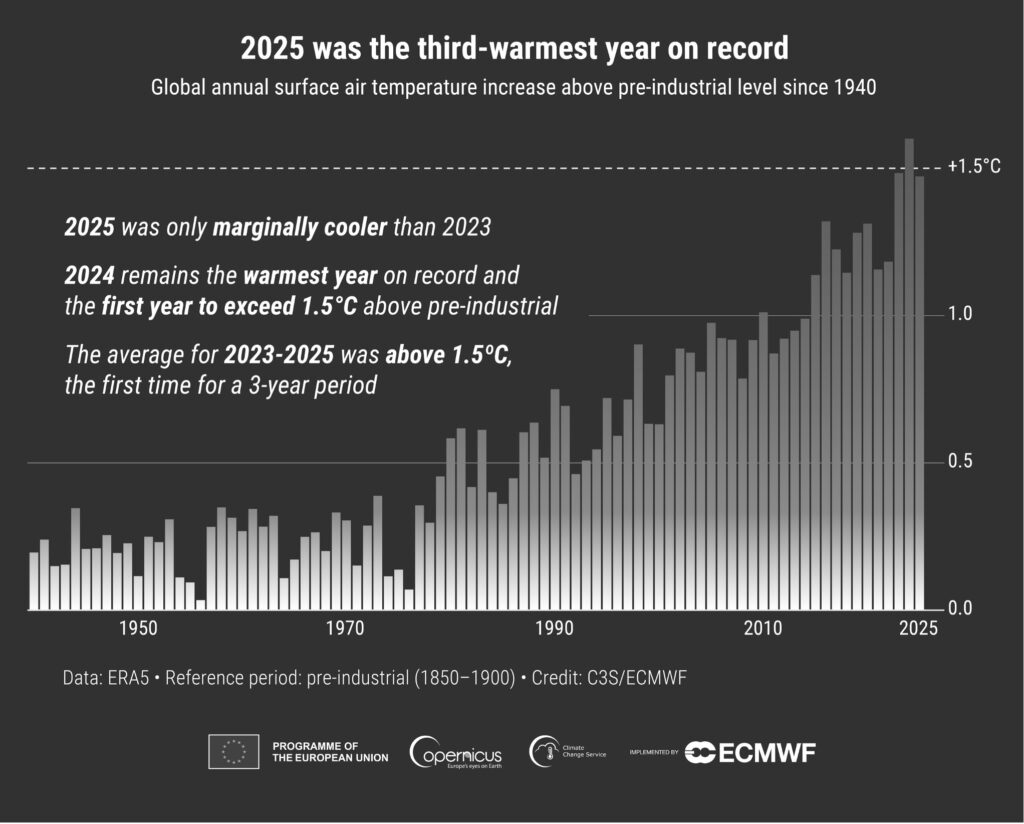
The Global Climate Highlights 2025 report is out, and it confirms what much of the world has already felt: heat is no longer an episode. It is a defining condition. New figures from the Copernicus Climate Change Service show that 2025 was the third warmest year on record, only 0.01°C cooler than 2023 and 0.13°C cooler than 2024, the hottest year ever measured. The global average temperature reached 14.97°C, around 0.59°C above the 1991–2020 average, extending a pattern that has become less surprising than steady. Compared with pre-industrial levels, Copernicus estimates 2025 was 1.47°C above the 1850–1900 baseline.
What stands out most, however, is not the ranking. It is what the trend implies. For the first time in modern climate monitoring, the three-year average temperature for 2023–2025 exceeded 1.5°C above pre-industrial levels. That does not mean the Paris Agreement threshold has been formally crossed in a legal sense, since those assessments are based on longer-term averages. But it does underscore how close the world is drifting toward a temperature range once framed as a boundary to avoid.
The effects of heat in 2025 were neither evenly distributed nor easily contained. Copernicus reports that roughly half of the world’s land areas saw more days than average with at least strong heat stress, defined as a feels-like temperature of 32°C or higher. At that level, heat is not merely uncomfortable. It becomes dangerous. The World Health Organization identifies heat stress as the leading cause of weather-related deaths worldwide, a reminder that climate risk increasingly shows up in hospitals and households, not only in scientific charts.
Heat also acts as an accelerant, pushing other risks into sharper focus. Copernicus highlights the wildfire conditions that intensified across several regions, producing not only carbon emissions but harmful air pollutants such as particulate matter and ozone. Europe recorded its highest annual total wildfire emissions, while parts of North America experienced unusually high fire-related emissions that affected air quality beyond the immediate burn zones. These are the kinds of impacts that quickly spill across borders, disrupting daily life and stressing public infrastructure.
At the poles, the climate system continued to show visible instability. In February 2025, global sea ice, combining the Arctic and Antarctic, fell to a record low in the satellite era, dating back to the late 1970s. The Arctic recorded its lowest monthly sea ice extent in January, February, March, and December, reinforcing the long-term downward direction. Polar change is often discussed as distant, but it is deeply connected to broader climate dynamics, influencing weather patterns and long-term risks for coastal and ecological systems worldwide.
Taken together, the Copernicus findings sharpen a conclusion that is becoming harder to avoid. The central challenge is no longer simply setting targets. It is implementation at speed and scale. It is about whether finance can move faster, whether resilience can be built before losses become permanent, and whether climate governance can match the pace of the physical climate itself. The numbers are no longer a forecast, they are the climate we are already living in.