
The World Economic Forum’s Global Risks Report is often read as a barometer of collective concern: a snapshot of rising pressures, and the risks institutions are gearing up to manage. In that sense, the annual ranking is less a forecast than a signal about political focus, public priorities, and institutional bandwidth.
Read side by side, the 2025 and 2026 reports reveal a shift that matters for climate diplomacy. Climate and nature risks remain dominant over the 10-year horizon, but the 2-year outlook is increasingly shaped by geopolitical strain, societal fragmentation, and information disorder. The danger is not that climate disappears from the list. It is that the world’s attention becomes harder to hold.
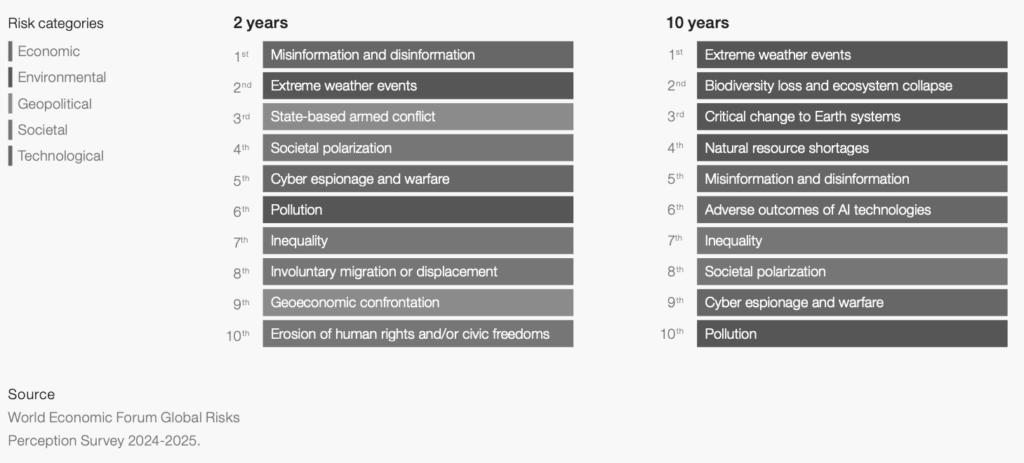
In the 2025 report, short-term risks were led by misinformation and disinformation, followed by extreme weather events, state-based armed conflict, and societal polarization. Climate impacts were already near the top, but the ranking reflected a world struggling with both physical disruption and institutional trust.
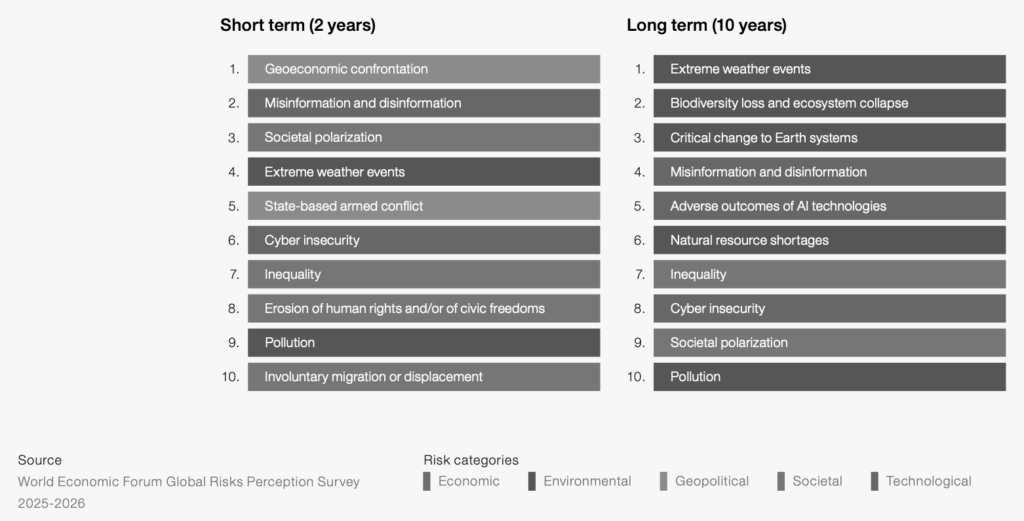
The 2026 report sharpened that short-term framing. Geoeconomic confrontation moved into the first position, followed by misinformation, polarization, and extreme weather. The climate signal remained present, but the ordering suggested something deeper: growing pressure on cooperation itself.
And yet the long-term picture barely changed. Over ten years, extreme weather events remained the top risk, followed by biodiversity loss and ecosystem collapse, and critical change to Earth systems. If anything, the data reinforces what climate science has long made clear: the climate crisis is not receding. The threat is stable, and escalating.
What is shifting is the ability to stay focused.
This divergence matters for the COP process because short-term instability does not merely compete for attention. It actively reshapes what climate action looks like. Geoeconomic confrontation can freeze diplomacy and harden negotiating positions. Information disorder can weaken public trust in institutions and in science. Polarization reduces the space for compromise, even when facts are agreed upon. Together, these pressures make climate commitments harder to finance, harder to implement, and harder to defend politically.
In that sense, the risks at the top of the short-term list are not separate from climate progress. They are increasingly the conditions that determine whether climate progress happens at all.
As COP31 approaches, this becomes an uncomfortable but useful reality check. The challenge will not only be raising ambition. It will be preventing ambition from being diluted by distraction. Climate risks remain the dominant long-term threat. The question is whether the world can treat them with the same urgency when everything else is demanding immediate attention.
Climate may remain No.1 in the data, but it can still lose ground in the decisions that shape outcomes. The danger is not ignorance, it is delay.