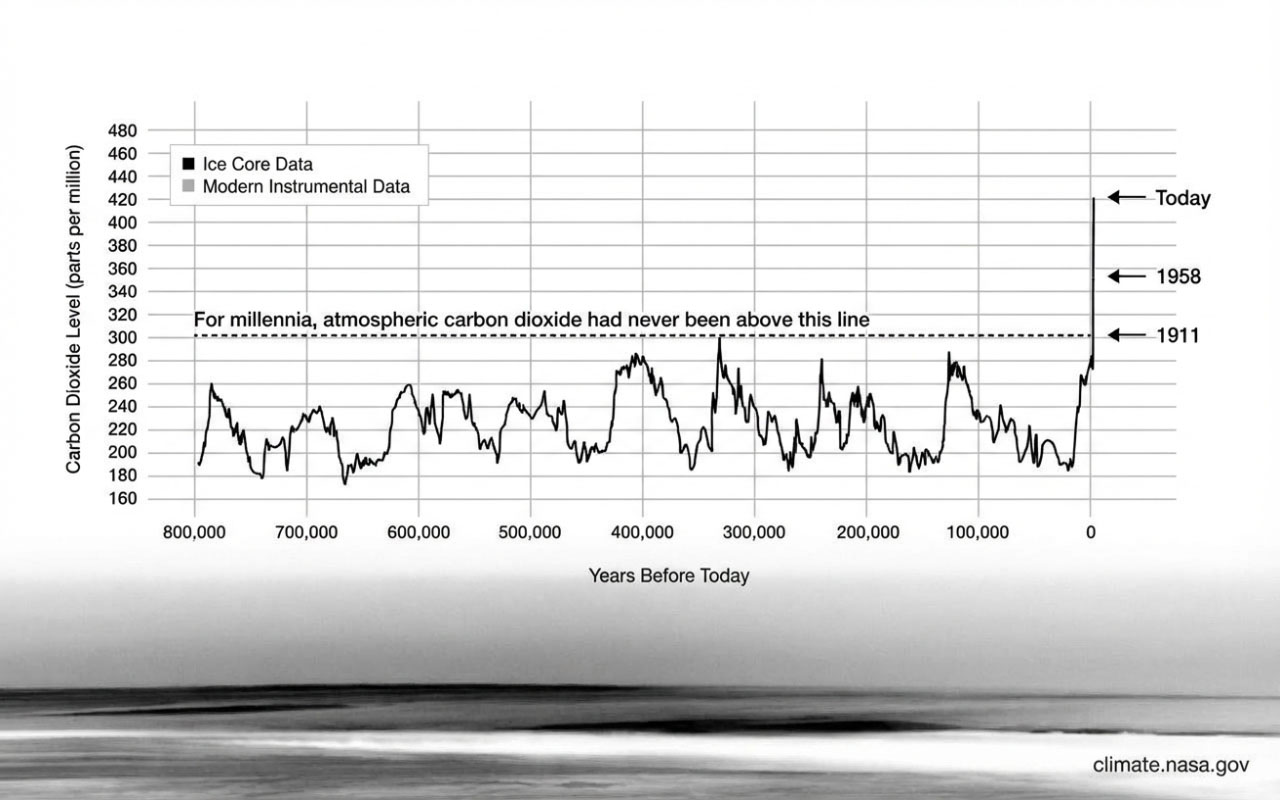


In 2026, the scientific consensus on how close we are to critical thresholds is sharp. The Planetary Health Check 2025, a joint report by the Potsdam Institute for Climate Impact Research (PIK) and the Stockholm Resilience Centre, confirms that seven out of nine planetary boundaries have now been crossed. This latest assessment marks a significant decline in Earth’s stability, with Ocean Acidification joining Climate Change and Biosphere Integrity as boundaries operating well outside the “safe operating space” for humanity.
Simultaneously, research by James Hansen and colleagues (2025) suggests that the 1.5°C target is no longer a realistic goal for avoiding dangerous warming, as the planet’s energy imbalance continues to accelerate. Hansen’s analysis indicates that current atmospheric conditions have already locked in warming near or above the 1.5°C level for the foreseeable future, making the goal of staying well below 2°C the main focus for global climate policy (Hansen et al., 2025).
Introduction to CDR and CCS
In this context, if we look from a systems perspective, we need many solutions working together at the same time to address the crisis we are heading into. This is a complex problem, and there is no one single “magic” solution. In this article, we will look at two specific solutions that often cause confusion or suspicion: Carbon Dioxide Removal (CDR) and Carbon Capture and Storage (CCS). We need to discuss why both are now necessary. It is no longer a theoretical debate about “if” we need them, but a technical discussion about “where” and “how” they should be used.
Defining the Boundaries: CCS vs. CDR
To understand how these tools fit into the system, we first need to define what they actually do.
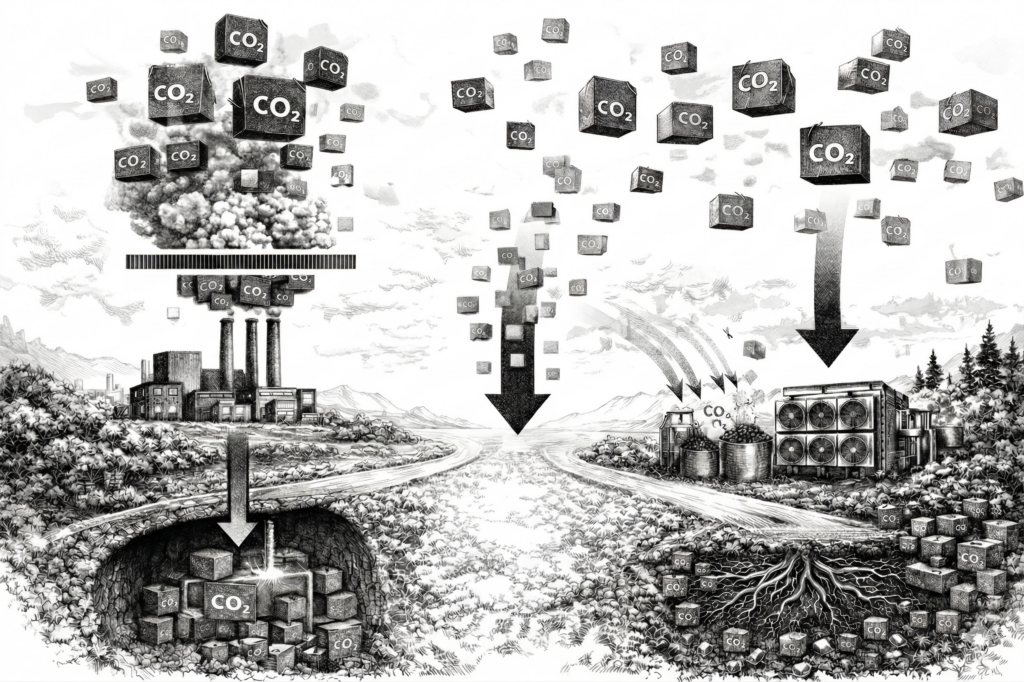
- CCS: This is an abatement tool. It works at the point of origin, like a cement kiln or a steel furnace, to stop CO2 from entering the atmosphere. It addresses the flow of new emissions. In CCSU (Carbon Capture, Storage, and Utilization) the captured carbon is used as a raw material to make products like building materials or fuels instead of just storing the carbon.
- CDR: This is a removal tool. It removes CO2 that is already in the air. This is the only way to clean up the carbon we have already emitted in the past and achieve “negative emissions”.
As we have explored in previous issues of the CDR Brief, CDR has the capacity to go “negative,” while CCS can only help bring a process toward “neutral”.
Why the Distinction Matters
Understanding these differences is not just about technical terms; it is about how we plan our transition. We are currently in a transition phase; what we have called the “Climate Borderlands” in one of our previous articles. This is the difficult middle ground where we must manage the transition while changing the systems we actually have, rather than just waiting for perfect future solutions.
In this space, the distinction between the tools is clear:
- CCS: The criticism often leveled at CCS that it serves as a “life extension” for fossil fuel assets is a valid concern for climate governance. However, when we look at the technical reality of certain industries, we see specific cases where it remains a necessary tool:
- CCS for Process Emissions: In some sectors, like cement, CO2 is released because of the chemical reaction (calcination) needed to make the material. This happens regardless of the energy source. For these industries, CCS is one of the few ways to stop those emissions from reaching the air.
- CCS for High-Heat Industries: Some processes, like making steel or glass, require extremely high temperatures that are still very difficult and expensive to reach using only electricity. In these cases, CCS can act as a bridge to manage emissions while we develop better alternatives.
- CDR for Negative Emissions: While CCS focuses on the “now” of our industrial output, CDR is the only tool that can address the “past” by removing carbon that is already in the atmosphere. It is necessary to balance the global carbon budget as we likely overshoot the 1.5°C pathway.
The Mitigation Hierarchy: No Substitutes for Deep Decarbonization
It is critical to emphasize that neither CCS nor CDR are substitutes for deep emission reductions. Fast and deep decarbonization is the non-negotiable foundation of any 1.5°C or 2°C pathway. In this hierarchy, CCS acts as a localized temporary bridge, a pragmatic necessity for existing large industrial plants that cannot be closed immediately, especially in disadvantaged regions or sectors where the transition is slower and assets cannot be retired early. It is a tool for managing ongoing emissions until these old fossil fuel infrastructures are fully phased out and replaced entirely. CCSU adds a layer of circularity here, where captured carbon is used in products like building materials or synthetic fuels.
Unlike CDR, which remains an unquestionable requirement for atmospheric restoration even if we stop all new emissions today, CCS is transition-bound; it addresses the symptoms of our current industrial and energy systems while we work to replace them.
Addressing “Excess Emissions”
For developing economies and heavy industries (such as steel, chemicals, sub-sectors of shipping), the transition to renewables is often constrained by existing infrastructure and the high cost of total process redesign. However, the necessity of CDR goes beyond these “hard-to-abate” sectors and residual emissions.
In their article at Carbon Gap, Robert Höglund and Eli Mitchell-Larson argue that all “excess emissions” need to be removed. If the cost of abatement is higher than the cost of durable CDR, they name these as “CDR-optimal” emissions.
From a systems perspective, this provides a clearer roadmap. We must prioritize deep reductions everywhere possible. But for emissions that are technically or economically out of reach, durable CDR can be used to ensure the net result for the atmosphere is zero or negative. This removes the uncertainty of what is or isn’t “hard” to abate or which emissions are residual and replaces it with a clear economic and physical requirement: if it’s still going into the air, it must be removed.
A Balanced Strategy for the Transition
The path to staying well below 2°C involves using the full range of tools available, used wisely according to their specific roles. These solutions are not and should not be competing with deep reductions; they are complementary on the climate action spectrum, each addressing a distinct physical requirement of the global carbon budget.
CCS manages some portion of the impact of the industrial world we inherited, preventing new damage. CDR begins the long work of restoring the atmosphere for the future. By using clear definitions and always prioritizing deep reductions, we can navigate this complex transition with both honesty and scientific accuracy.