

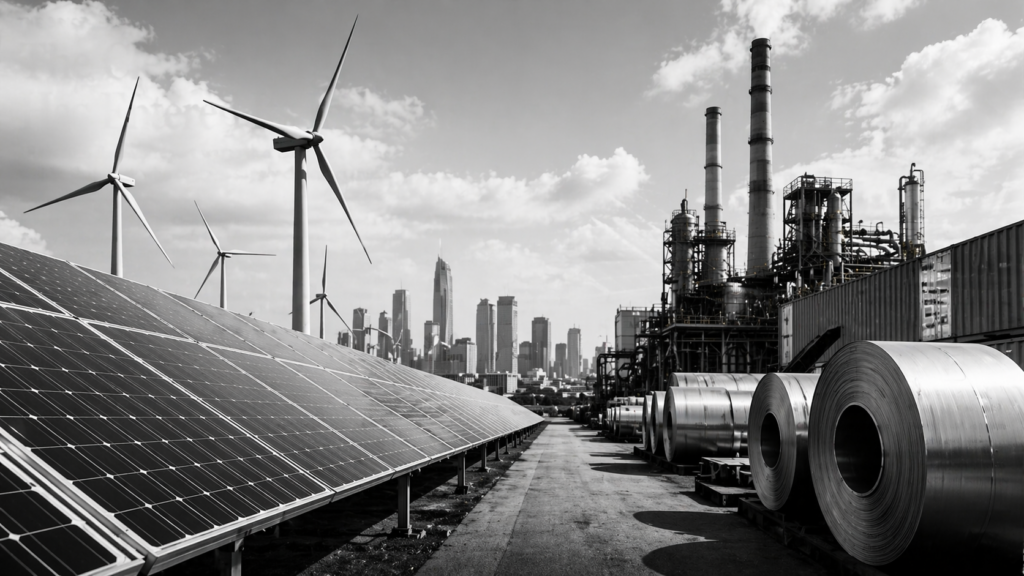
In Energy Technology Perspectives 2026, the International Energy Agency argues that the future of the energy transition will be shaped not only by deployment, but by who controls supply chains, manufacturing capacity and industrial competitiveness.
The energy transition has moved into a new phase. For years, the dominant question was whether clean technologies could scale fast enough to compete with fossil fuels. The report makes the case that this question is no longer sufficient. Clean energy is now large enough, cheap enough and strategically important enough that the central contest has shifted from invention to industrial control. The real battle is over manufacturing, trade, resilience and cost leadership.
The numbers explain why. The IEA says the global market value of clean energy technologies reached nearly USD 1.2 trillion in 2025 after growing by an average of 20% per year over the past decade. Even in its conservative Current Policies Scenario, that market still doubles to around USD 2 trillion by 2035. Under stated policies, it approaches USD 3 trillion. Electric cars dominate the picture, accounting for roughly three-quarters of total market value in 2035 across scenarios, while low-emissions fuels and near-zero-emissions materials remain more dependent on policy support and still struggle with high cost premiums.
But this is not a triumphalist report. Its tone is more cautionary than celebratory. The IEA finds that deployment across many clean technologies continues to rise, yet the underlying system is becoming more fragile. Supply chains are deeply concentrated. China controls between 60% and 85% of production capacity across key clean energy technology supply chains, and more than 95% in some individual steps. That concentration has helped push prices down globally, but it has also created a strategic weakness. The report’s warning is simple: low-cost abundance and high vulnerability can exist at the same time.
That is what gives the report its urgency. Governments are now trying to solve two problems at once. They want cheaper clean technologies to support electrification, industrial modernization and emissions reduction. At the same time, they want less dependence on highly concentrated foreign supply. Those goals do not always align. Tariffs may protect domestic industry, but they can also raise costs. Industrial subsidies may attract factories, but they cannot instantly replicate decades of accumulated efficiency, scale and supplier ecosystems. The IEA shows that even with trade tensions rising, global trade in major clean energy technologies is still expected to more than double by 2035 in its central scenario. This is not the end of globalization. It is the restructuring of it.
One of the report’s strongest contributions is its refusal to reduce competitiveness to wages alone. China’s advantage, the IEA notes, is not simply cheap labor. In many sectors it comes from scale, process efficiency, integrated supply chains, manufacturing experience and consistent policy support over many years. In batteries, manufacturing efficiency explains a large share of the cost gap with Europe. In upstream solar, energy prices matter much more. In heat pumps, component ecosystems matter more. The implication is important: industrial strategy cannot rely on slogans about reshoring. It has to be technology-specific, realistic and selective.
The report is equally measured in its treatment of emerging technologies. Hydrogen has not disappeared, but the exuberance around it has clearly faded. Carbon capture is advancing, but not yet at the scale implied by climate ambition. Nuclear is regaining momentum, including through interest in small modular reactors and fusion, but lead times remain stubborn. Across these sectors, the IEA’s line is disciplined: early promise is real, but commercial traction depends on policy credibility, infrastructure build-out, and the hard economics of deployment. In other words, there are no shortcuts left.
What emerges from Energy Technology Perspectives 2026 is not just a market outlook, but a doctrine for the next phase of the transition. Deployment still matters. Innovation still matters. But increasingly, what matters most is whether countries can build durable industrial ecosystems around clean energy technologies without pricing themselves out of the market. The age of electricity, as the IEA frames it, will not be defined only by what gets installed. It will be defined by who makes the equipment, who secures the inputs, and who can compete when the politics of energy and trade collide.
The IEA’s 2026 flagship report argues that the clean energy transition is no longer only a climate story. It is now an industrial strategy story, a trade story and a security story all at once.