


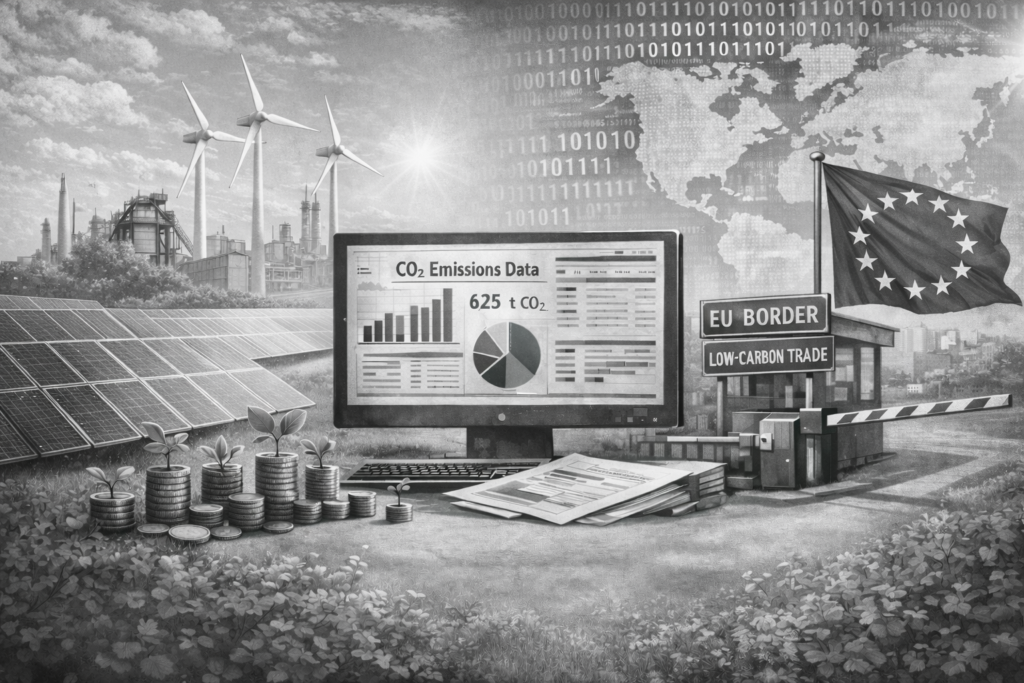
The European Union’s Carbon Border Adjustment Mechanism enters its definitive phase in January 2026. For the first time, EU importers will be required to purchase and surrender CBAM certificates reflecting the embedded carbon content of goods crossing European borders. The transitional reporting period is over. What follows is a financial obligation, priced in real euros per tonne of CO₂.
For Türkiye, the stakes are structural. CBAM-exposed sectors iron and steel, cement, aluminium, fertilisers represent approximately €19 billion in annual exports to the EU. Industry estimates suggest CBAM-related costs could reach €771 million in 2026 alone, rising to €2.5 billion annually by 2032. Cement producers face cost burdens equivalent to roughly 50 percent of product prices; aluminium, 18 percent; steel, 11 percent. These are not marginal adjustments. They reshape the competitive arithmetic of Türkiye’s industrial trade with Europe.
The conventional response to this challenge has centred on two pillars: emissions reduction and carbon pricing. Türkiye’s landmark Climate Law, adopted in July 2025, established the legal groundwork for a national Emissions Trading System, with a pilot phase targeting carbon-intensive sectors from 2026. If a credible domestic carbon price emerges, it can be deducted from CBAM obligations, keeping a portion of carbon revenues within the Turkish economy rather than transferring them to Brussels.
Both pillars are necessary. Neither is sufficient.
The Data Problem No One Is Solving Fast Enough
Between the policy ambition of carbon pricing and the operational reality of CBAM compliance lies a gap that receives far less attention than it deserves: carbon data governance.
CBAM compliance is, at its core, a data operation. It requires companies to measure, document and verify the embedded emissions of every covered product crossing the EU border. That means tracing energy inputs, production parameters, emission factors and precursor materials across complex supply chains. It means matching emissions calculations to auditable evidence invoices, meter readings, ERP records, supplier declarations and assembling them into regulatory reports that meet EU verification standards.
Today, in the majority of Turkish industrial facilities, this process is manual. Production data is collected through email chains and spreadsheets. Emission factors are applied inconsistently. Evidence documents are scattered across departments. A single CBAM report can take weeks to compile, and the resulting output is fragile: difficult to audit, hard to replicate and nearly impossible to scale.
This is not a minor operational inconvenience. It is a systemic vulnerability. As CBAM obligations grow both in cost and in scope, with downstream products and indirect emissions likely to be included in future reviews the gap between what regulators require and what manual processes can deliver will only widen.
Why Digitisation Is Not Optional
The lesson from CBAM’s early implementation is that carbon compliance is becoming a continuous data workflow, not a periodic reporting exercise. The EU’s regulatory architecture increasingly demands granularity: product-level emissions data, facility-specific calculations, time-stamped evidence trails and third-party verifiability. Meeting these requirements at scale is a systems challenge, not a manpower challenge.
Digital carbon management platforms systems that integrate directly with production and energy data sources, apply regulation-aligned calculation methodologies and generate structured, auditable outputs are rapidly becoming essential infrastructure for trade-exposed industries. The core capabilities are not exotic. They draw on established technologies: data integration layers, rule-based calculation engines, document processing, anomaly detection and structured audit trails. What is new is their application to carbon accounting workflows that have, until now, been treated as manual back-office tasks.
The competitive implications are significant. Companies with digitised carbon data pipelines can respond to CBAM reporting cycles in days rather than weeks. They can model cost scenarios across different carbon price trajectories. They can demonstrate data integrity to EU verifiers without assembling ad hoc evidence packages. And critically, they can adapt when regulations changeadjusting emission factor libraries, adding new product categories or incorporating indirect emissionswithout rebuilding their reporting processes from scratch.
Companies without these capabilities face a different trajectory: rising compliance costs, verification delays and an increasing risk that data quality issues translate into financial penalties or lost market access.
Türkiye’s Moment
Türkiye holds a unique position in this landscape. As the host of COP31 in Antalya in November 2026, the country has an opportunity to demonstrate not only policy ambition but operational readiness. The Climate Law and the pilot ETS are important signals. But signals must be supported by systems.
Türkiye’s industrial base is large, diverse and deeply integrated into European supply chains. The country’s steel sector is the EU’s largest external supplier. Its cement and aluminium industries are significant exporters. These are not niche players; they are systemic participants in European manufacturing ecosystems. Their ability to provide reliable, verifiable carbon data is not solely their own concernit is a supply chain integrity issue for European industry as well.
Building digital carbon data infrastructure across this industrial base is a national-scale challenge. It requires investment in technology, but equally in data standards, interoperability frameworks and human capacity. The Turkish Ministry of Commerce’s support programmes for carbon footprint digitisation are a step in the right direction. So is the ongoing work to establish monitoring, reporting and verification systems under the Climate Change Presidency. But the pace must match the regulatory timeline. CBAM certificates will be purchased starting in February 2027 for 2026 obligations. The clock is already running.
From Compliance Cost to Competitive Advantage
The reframing that Türkiye’s industrial exporters need is this: carbon data is not a regulatory burden to be managed. It is infrastructure to be built.
Countries and companies that treat carbon data governance as a strategic capability investing in digital systems, training personnel, integrating production and emissions data flows will find themselves better positioned not only for CBAM, but for the broader regulatory trajectory. The EU Taxonomy, the Corporate Sustainability Reporting Directive, the proposed extension of CBAM to downstream products: each of these mechanisms depends on the same underlying asset reliable, granular, verifiable emissions data.
Türkiye can approach this as a defensive exercise, scrambling to meet minimum requirements as each deadline arrives. Or it can approach it as an infrastructure investment, building digital carbon management capabilities that serve its industries across multiple regulatory frameworks and market contexts.
The difference between these two paths will not be determined by policy statements. It will be determined by whether the systems are in place.
As COP31 approaches, the world will look at Türkiye’s climate ambition. The most convincing evidence of that ambition will not be found in declarations alone. It will be found in whether Turkish industry can produce a verified CBAM report as reliably as it produces a tonne of steel.
*Tugba SARI is the Head of ATP GreenX, Türkiye’s first digital carbon and green energy marketplace, focused on carbon compliance solutions, environmental certificate trading and market intelligence for industrial clients.*