

Why Europe’s Energy Transition Will Be Won on the Demand Side
Europe’s energy debate is still dominated by supply: how many gigawatts of renewables to build, how fast grids can expand, how much storage is needed to balance variability. These questions matter. But they obscure a quieter truth hiding in plain sight: the most reliable, affordable, and resilient energy resource is the energy we never consume.
A new report from the United Nations Economic Commission for Europe (UNECE) makes this case with unusual clarity. Its argument is not that energy efficiency is important, that has been known for decades, but that efficiency must be treated as infrastructure, not as a peripheral policy add-on. When designed systemically, it can cut costs, strengthen energy security, and accelerate decarbonization faster than any single supply-side investment.
The Efficiency Gap No One Talks About
Energy efficiency has improved across the UNECE region since 2000, but progress has slowed and remains uneven. Between 2015 and 2020, efficiency gains across member states averaged roughly 1 percent per year, far below what climate and energy security goals require.
To stay on track for international climate commitments and the Sustainable Development Goals, annual efficiency improvements must rise to at least 4 percent by 2030, a fourfold acceleration. The problem is not technology. Proven solutions already exist across industry, buildings, and transport. The real obstacle is fragmentation: efficiency is still pursued project by project, sector by sector, rather than as a coordinated system.
From Isolated Savings to System Design
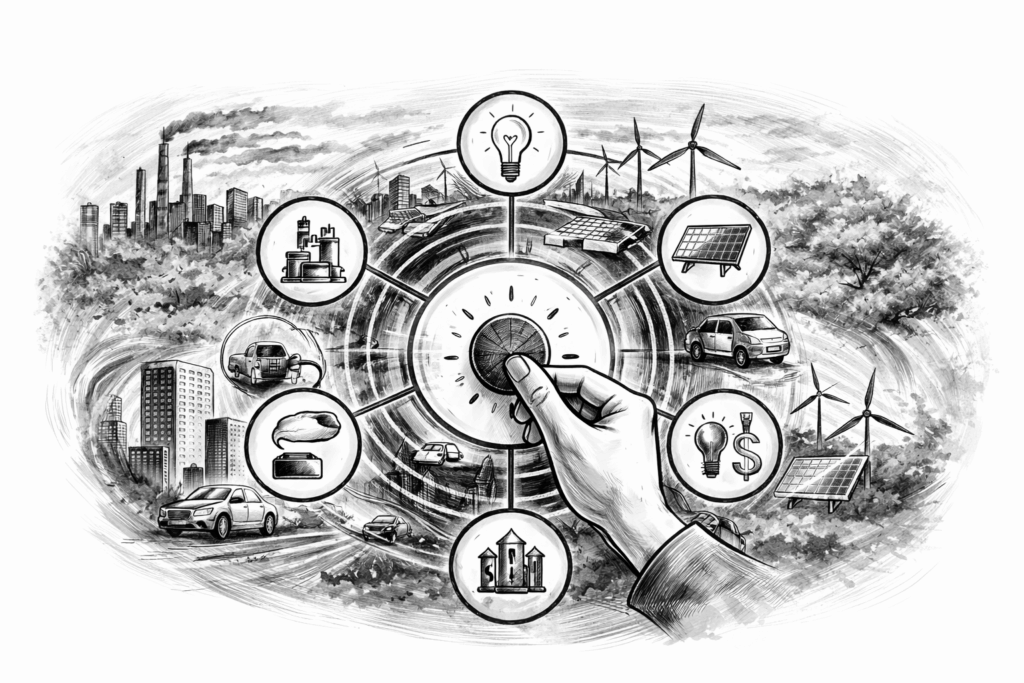
The UNECE report reframes efficiency as a first-order system resource, on par with generation and networks. The logic is simple but powerful: reduce demand first, then meet remaining needs with cleaner supply, and only then address residual emissions.
When demand is lower and flatter, everything else becomes easier. Grid congestion eases. Renewable integration improves. Infrastructure investments can be deferred or avoided altogether. Utilities increasingly refer to this as a “flex-before-wires” approach, procuring verified efficiency and flexibility before approving new grid reinforcements.
In practical terms, verified demand-side flexibility and deep efficiency measures can defer up to 30 percent of planned distribution-level grid upgrades in suitable contexts. That translates into billions saved, lower system costs for consumers, and faster deployment timelines.
Where the Biggest Gains Are
Industry
Deep process efficiency, through heat integration, optimized drives, industrial heat pumps, and digital energy management, can reduce industrial energy use by 20 to 30 percent. Waste-heat recovery adds another 10 to 15 percent, often at low cost. When industrial sites are clustered, these measures unlock industrial symbiosis: shared heat networks, by-product reuse, and flexibility services that turn factories into grid assets rather than grid liabilities.
Buildings
Buildings are often treated as passive energy consumers. In reality, they can function as flexible infrastructure. Deep renovations combined with smart controls, thermal storage, and low-temperature district heating can cut peak loads by up to 30 percent, while improving indoor air quality and reducing energy poverty. Digital monitoring closes the persistent gap between design intent and real-world performance.
Transport
Electrification alone is not enough. Charging infrastructure that is poorly sited or unmanaged risks creating new grid bottlenecks. By contrast, managed charging by default — aligned with grid capacity and renewable availability — can reduce peak loads by 20 to 30 percent. Battery-buffered fast chargers cut grid connection costs by up to 40 percent in constrained areas. When done right, electric vehicles become part of the energy solution, not a new problem.
The Digital Backbone
None of this works without data. Smart meters, interoperable platforms, and digital twins turn efficiency into something measurable, dispatchable, and financeable. Digitalization shifts energy systems from static planning to continuous optimization, enabling performance-based regulation and transparent investment.
But the report is clear: as systems digitalize, cybersecurity and interoperability become public-interest issues. Open standards, strong data governance, and security-by-design are prerequisites, not optional extras.
Why Finance Is the Real Bottleneck
Despite its advantages, energy efficiency remains chronically underfunded. Global annual investment stands at roughly USD 420 billion, less than half of what is needed by 2030. The barrier is not lack of capital, but lack of bankable structures.
Efficiency projects are small, dispersed, and often perceived as risky. The solution lies in aggregation and standardization: bundling projects into portfolios, paying for verified outcomes (kilowatt-hours saved, megawatts shaved), and using blended finance and guarantees to reduce risk. Done right, efficiency becomes an investable infrastructure asset class — one with benefit-cost ratios that often outperform new generation.
More Than Energy Savings
The benefits extend well beyond emissions. Systemic efficiency reduces exposure to energy price volatility, lowers dependence on imported fuels and critical raw materials, creates jobs in construction and digital services, improves public health, and strengthens resilience during extreme weather and market shocks.
In short, efficiency is not about doing less. It is about designing better systems.
The cleanest, cheapest, and fastest energy resource is already available. The remaining question is whether policymakers are willing to treat it not as a footnote, but as the backbone of modern energy policy.