

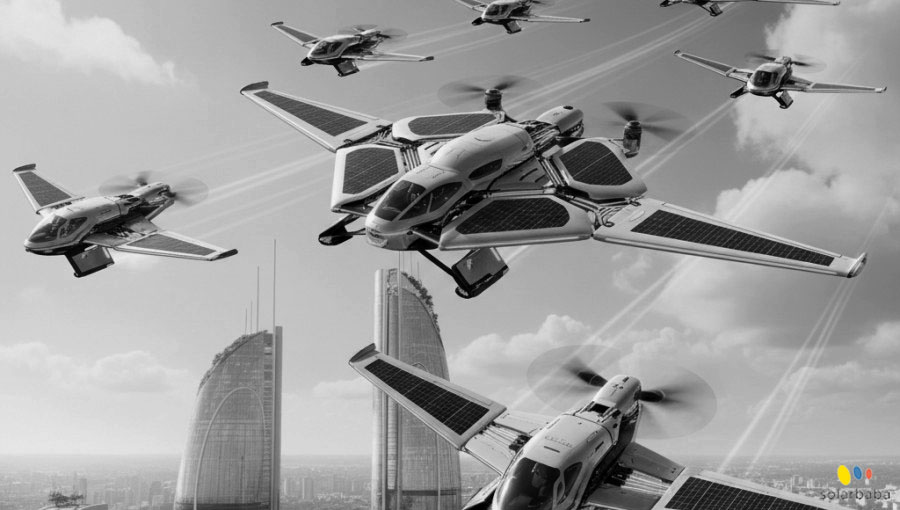
Chinese electric aircraft manufacturer AutoFlight has successfully completed a landmark formation flight involving its heavy-payload V5000 Matrix aircraft and two smaller V2000-series vehicles. The demonstration marks a significant milestone in validating real-time coordination of flight paths, separation distances, and communication between electric aircraft with different sizes and flight characteristics. The achievement represents an important step toward the commercialization of electric vertical take-off and landing (eVTOL) technology for both passenger and cargo transportation, supporting the future of autonomous and piloted electric aviation.
The V5000 Matrix is among the largest crewed eVTOL aircraft currently under development. It features a 20-meter wingspan, a maximum takeoff weight of approximately 5.7 tonnes, and an all-electric configuration capable of carrying up to 10 passengers over a range of 250 kilometers. AutoFlight also offers the V5000CGH cargo variant, equipped with a hybrid-electric propulsion system capable of transporting payloads of up to 1,500 kilograms. Designed to accommodate two standard AKE air cargo containers, the hybrid version offers a range of 1,500 kilometers and a cruising speed of 280 km/h.
The V5000 utilizes 20 dedicated electric lift motors for vertical take-off and landing before transitioning to efficient wing-supported forward flight during cruise operations. Safety has been a key design priority, with redundant flight systems enabling continued controllability even in the event of dual motor failures. Earlier this year, the aircraft successfully completed transition tests between vertical and horizontal flight modes at the Kunshan Civil Unmanned Aerial Vehicle Test Base. Following these successful demonstrations, AutoFlight has officially begun the airworthiness certification process for the hybrid cargo version with the Civil Aviation Administration of China (CAAC).
Source: Solarbaba – In Turkish