
After completing my undergraduate degree in Chemical Engineering at Istanbul Technical University in 2001, I went to Germany to pursue a master’s degree in Energy Conversion and Management at Hochschule Offenburg.
At the time, I could not fully know how decisive that choice would become for my life and career.
Those were the early years of Türkiye’s energy market liberalisation. The Electricity Market Law had only entered into force in 2001, opening the way for a more competitive and regulated electricity market. Renewable energy, however, was still far from becoming the sector we know today. Türkiye’s first Renewable Energy Law would only come in 2005. Wind power existed only in its earliest form, with the country’s first wind power plant commissioned in İzmir in 1998. Solar energy was even further away from becoming a mainstream investment area. Türkiye’s first unlicensed solar power plants began to emerge in the early 2010s, following regulatory changes that allowed small-scale generation, while the country’s first licensed solar power plant would begin operations only in 2015.
In other words, when I was studying energy in Germany, many of the concepts that now define Türkiye’s energy transition were still new, unfamiliar or not yet institutionalised at home. There were no mature solar or wind markets in Türkiye. There were no established regulatory frameworks for the scale of renewable energy deployment we discuss today. There was no broad professional ecosystem around energy transition, grid flexibility, green hydrogen, sector coupling, distributed generation or energy storage.
I learned many of these subjects in Germany before they became part of the mainstream energy conversation in Türkiye.
My early professional experience also reflected this international learning path. During my studies, I worked as an engineer and researcher at Hochschule Offenburg on numerical analysis within an international quality network supported by DAAD. I also spent time in Switzerland at Alstom Power, analysing water and air processes of thermal power plants around the world. These experiences gave me a systems-level view of energy long before the phrase “energy transition” became a common policy language.
When I returned to Türkiye in 2005, I entered a market that was still being formed
I started my career representing European and U.S. technology companies in energy, chemical processes and environmental equipment. Soon after, I moved into electricity trading, market development and combined-cycle power plant engineering at a time when Türkiye’s liberalised electricity market was still learning its own rules, institutions and operating logic.
Between 2008 and 2010, I worked on the planning, engineering and business development of natural gas combined-cycle power plants with a total capacity of approximately 2,200 MW in Türkiye and Bulgaria. At the same time, I was involved in wholesale electricity trading, dealing with independent power producers, eligible consumers, distribution companies, TEİAŞ, EMRA, PMUM, banks and market regulations.
This was not only a technical experience. It was an education in how a power market is built in practice.
Later, I moved more deeply into renewables. I worked on large-scale solar project development, including feasibility studies, site acquisition, grid connection, generation licence applications, power sales strategies and tender preparations. I supported solar investments by international investors and worked on wind energy business development, including service business, repowering, market-entry strategy and partnerships with Turkish companies. I managed business development for solar, wind and biogas projects in Türkiye, Moldova, Ukraine and Uzbekistan, including a high-technology photovoltaic panel manufacturing project and solar power plant portfolios.
Looking back, this professional journey mirrors Türkiye’s own energy transition. I started in a system dominated by thermal power, market liberalisation and electricity trading. I then moved into solar, wind, biogas, energy efficiency, sustainable energy finance, green investments and industrial decarbonisation.
My career did not run parallel to the energy transition. It grew inside it.
That early German education gave me an advantage. Not only a technical advantage, but also a professional one. Especially as a woman.
For the past 24 years, I have continued to work in the energy sector, often in senior and decision-making roles, across Türkiye and internationally. Today, as the founder of EcoMuse Consulting, Country Advisor for Türkiye at EIT InnoEnergy and Member of the Council of Engineers for the Energy Transition (CEET), I can see how much of my career was shaped by the knowledge I acquired before these topics became widely understood in Türkiye.
In recent years, my work has focused on clean energy, green transition, green finance, ESG, resource efficiency, industrial decarbonisation, entrepreneurship and policy development. I have worked with and for international institutions including EBRD, IFC, the World Bank, the European Union and United Nations-related initiatives. I have supported market assessments, feasibility studies, sustainable energy finance programmes, green taxonomy work, renewable energy communities, municipal climate neutrality, energy efficiency finance and clean technology entrepreneurship.
These experiences strengthened my belief that energy transition is never only about technology. It is also about institutions, finance, regulation, markets, people and leadership.
But knowledge alone is never enough, particularly for women in energy.
The energy sector remains one of the most male-dominated parts of the global economy. According to the International Energy Agency, there are far fewer women than men working in the energy sector, and women also remain underrepresented in senior management, entrepreneurship and innovation. IRENA’s gender analysis of the renewable energy sector shows that women account for around 32 percent of the full-time renewable energy workforce. Even in renewables, where the numbers are better than in the wider energy sector, women’s participation remains far from equal, especially in technical and leadership roles.
Türkiye reflects many of these global patterns. The problem is not only entry into the sector. It is staying in the sector. It is being taken seriously in technical discussions. It is being present in the rooms where decisions are made. It is surviving the quiet and sometimes explicit pressures that push women away from technical careers, leadership roles and public visibility.
For a woman engineer, staying in the energy sector is already an achievement. Continuing for more than two decades is another. Reaching a decision-making position is not simply a matter of ambition or competence. It often requires resilience against a professional culture that repeatedly asks women to prove, explain and defend their place.
There are moments when people do not directly tell you to leave the career path, but the message is there. You are expected to step aside. You are expected to be less visible. You are expected to choose support roles rather than decision-making roles. You are expected to accept that technical authority belongs somewhere else.
Remaining in the career becomes a form of resistance.
That is why my work with women in energy has become increasingly important to me. Through Women in Renewable Energy (WiRE), Turkish Women in Renewables and Energy (TWRE), the Global Women’s Network for the Energy Transition (GWNET), through mentoring and training roles, and through projects supporting women entrepreneurs in clean energy, I have seen again and again that talent is not the problem. Access is the problem. Visibility is the problem. Networks are the problem. Confidence, when constantly tested by structural barriers, becomes a professional resource that women are forced to build again and again.
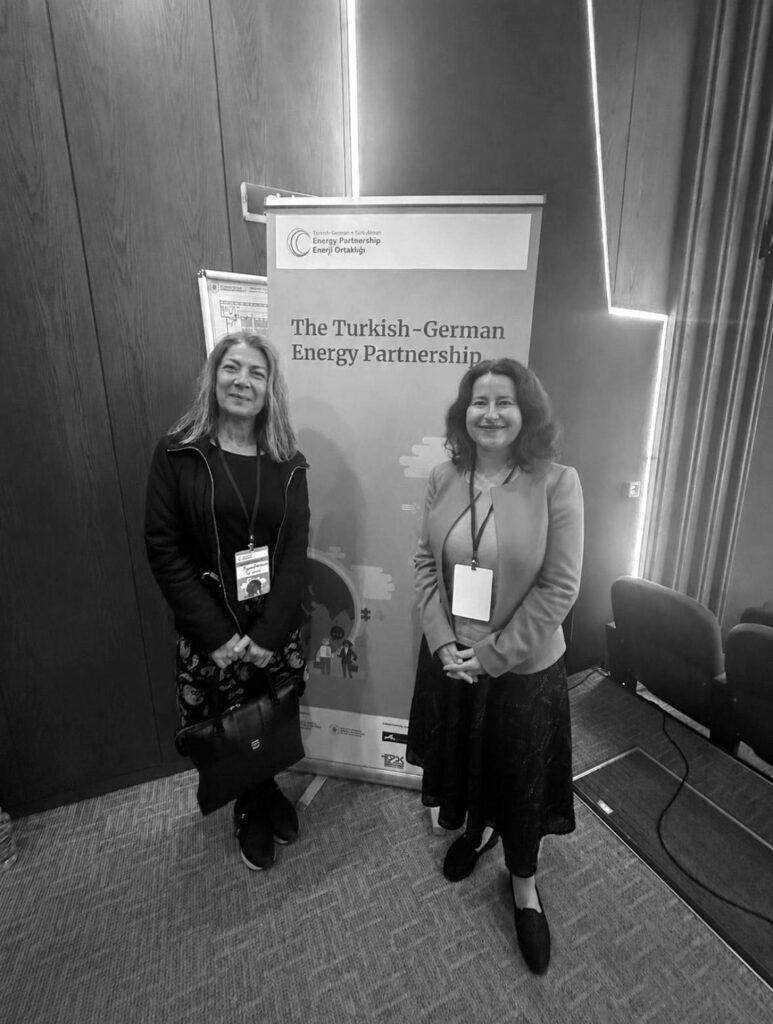
That is also why attending the 7th Turkish-German Energy Forum in Ankara on 19 June was personally meaningful for me.
The forum’s theme, “Partnership for Energy Security” brought together Turkish and German institutions around stronger energy systems, energy efficiency, renewable energy, infrastructure resilience and grid transformation. These are precisely the areas that shaped my early education in Germany and later became central to my professional work in Türkiye and internationally.
The 19 June programme included discussions on resilient energy systems, energy efficiency in data centres, the results of bilateral working groups and task forces, and the future of grid infrastructure. It was a reminder that energy transition is no longer a niche topic. It is now at the centre of economic policy, industrial competitiveness, security of supply and international cooperation.
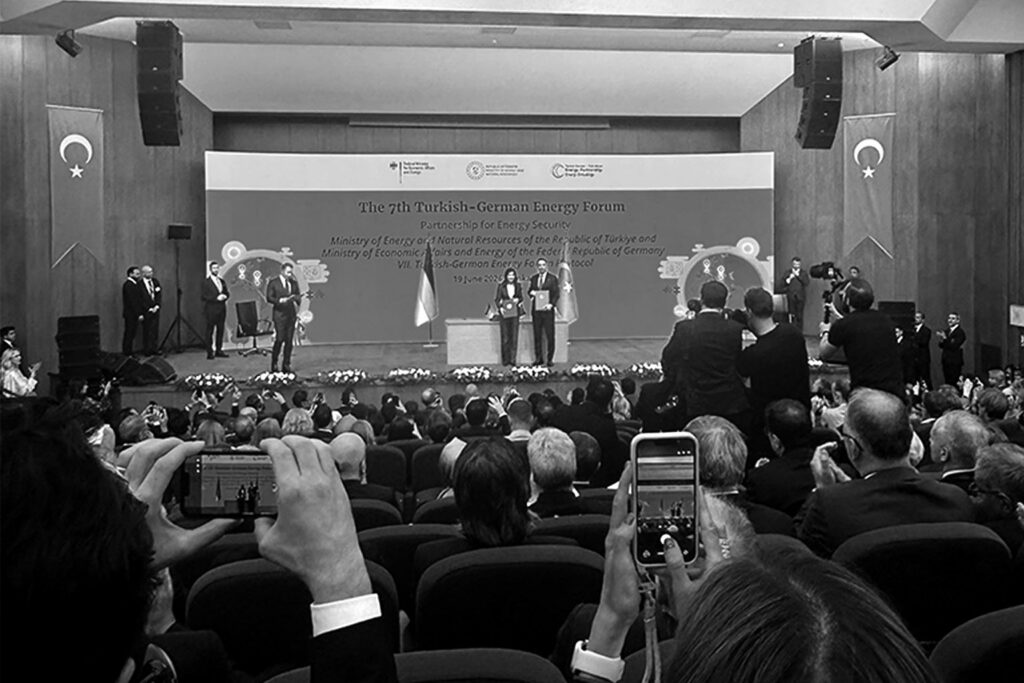
The most symbolic moment for me was seeing H.E. Katherina Reiche, Germany’s Federal Minister for Economic Affairs and Energy, take part in the plenary session with Türkiye’s Minister of Energy and Natural Resources, H.E. Dr. Alparslan Bayraktar.
Germany’s energy minister being a woman is not a small detail. It matters.
It matters because representation changes what younger professionals imagine to be possible. It matters because energy policy is still too often discussed in rooms where women are few. It matters because technical authority, political leadership and strategic decision-making must not be gendered. A woman leading one of Europe’s most important economic and energy ministries sends a powerful signal to every woman engineer, expert and policymaker working in this field.
For me, it also closed a personal circle.
I went to Germany as a young engineer to study energy at a time when Türkiye’s renewable energy market had barely begun. I returned with knowledge that helped me build a career in a sector that was not always ready to make space for women. Two decades later, I sat in Ankara at a Turkish-German Energy Forum, listening to a woman energy minister from Germany speak about energy security, economic resilience and the future of power systems.
The forum also made clear that Turkish-German energy cooperation is entering a broader and more strategic phase.
The discussions moved beyond conventional energy policy. They focused on resilient energy systems, energy efficiency in data centres, grid infrastructure, green hydrogen, renewable energy integration, energy market regulation and the role of innovation in accelerating the transition. The panel on the future of grid infrastructure was particularly important. As electrification grows, renewable energy expands and digital demand rises, the grid is no longer a passive backbone. It is becoming the central infrastructure of energy security.
Another striking theme was the link between energy transition and critical minerals. This is where the forum signalled a new direction. With the protocol signed by Minister Alparslan Bayraktar and Minister Katherina Reiche, the Turkish-German Energy Partnership was expanded and renamed the Turkish-German Energy and Minerals Partnership. The Turkish-German Energy Forum will also continue under a new name: the Turkish-German Energy and Minerals Forum.
This change is more than institutional language. It reflects a new reality. Energy security is no longer only about electrons, molecules, pipelines or power plants. It is also about the minerals and raw materials that make the energy transition possible: the components of wind turbines, solar panels, batteries, grid equipment and digital technologies. As supply chains become more strategic and more vulnerable, critical minerals are becoming part of the energy security agenda.
The forum also produced concrete cooperation signals. Three memoranda of understanding were signed between Turkish and German organisations. ENERCON Global GmbH and ATEŞ Wind Power agreed to cooperate on renewable energy, particularly with the aim of supporting local production of wind turbine components in Türkiye. Pure Energy GmbH and OYAK Çimento agreed to work on industrial energy flexibility and decarbonisation. Bilişim Vadisi and BRYCK Startup Alliance GmbH signed a memorandum to strengthen cross-border entrepreneurship and innovation cooperation, with a focus on energy and climate technologies.
For me, this was the most important message of the day. The energy transition is no longer a narrow technical agenda. It is industrial policy, mineral security, innovation policy, infrastructure policy and gender equality at the same time. It requires engineers, policymakers, investors, entrepreneurs and institutions to work across borders.
And it requires women to be present not only as participants, but as decision-makers.
Looking back at my own journey, from studying energy in Germany at a time when Türkiye’s renewable energy market had barely begun, to working across electricity trading, renewable energy development, sustainable energy finance, green transition policy and global energy advisory roles, I felt the continuity of that story very clearly.
Energy systems become stronger when knowledge moves across borders.
They become more resilient when cooperation becomes concrete.
And they become more just when women remain in the room, shape the agenda and lead the transition.