

For much of its post-Soviet history, Central Asia has treated energy security as a national project. Power plants were built to serve domestic demand. Grids stopped at borders. Self-sufficiency was equated with resilience.
New modelling suggests that this logic is becoming increasingly expensive, and increasingly outdated.
A series of energy system simulations conducted by the Stockholm Environment Institute (SEI), in partnership with the United Nations Economic Commission for Europe (UNECE) and the Economic and Social Commission for Asia and the Pacific (ESCAP), show that regional energy connectivity can deliver lower costs, lower emissions, and greater system resilience than national self-sufficiency, even as electricity demand across Central Asia accelerates toward mid-century.
The findings challenge a deeply ingrained assumption in a region rich in fossil fuels, hydropower, sun, and wind: that energy independence is the safest path forward.
Demand Is Rising Faster Than Capacity Planning
Electricity demand in Kazakhstan, Kyrgyzstan, Tajikistan, Turkmenistan, and Uzbekistan is projected to more than double by 2050, driven by population growth, industrial expansion, and electrification. Uzbekistan and Turkmenistan show the fastest growth, while Kazakhstan remains the system anchor due to its size and resource base.
Meeting this demand through purely national systems is technically feasible. But SEI’s modelling shows it is structurally inefficient. Under a national energy self-sufficiency scenario, each country must overbuild generation, storage, and reserve capacity to manage variability and peak demand independently.
The result is higher system costs and higher emissions than necessary.
What Connectivity Changes
To test alternatives, SEI modelled four futures for Central Asia’s energy system: national self-sufficiency, regional connectivity, full connectivity including limited trade with neighboring regions, and unlimited electricity transmission within Central Asia.
Across all scenarios, one conclusion is consistent. Greater connectivity lowers total system costs. Even when decarbonization modestly increases electricity generation costs, integrated systems reduce overall expenditures by optimizing where and when electricity is produced.
In the most ambitious scenario, annualized electricity system costs fall by up to USD 1.4 billion per year compared with national self-sufficiency. These savings come not from building less infrastructure, but from building it more strategically.
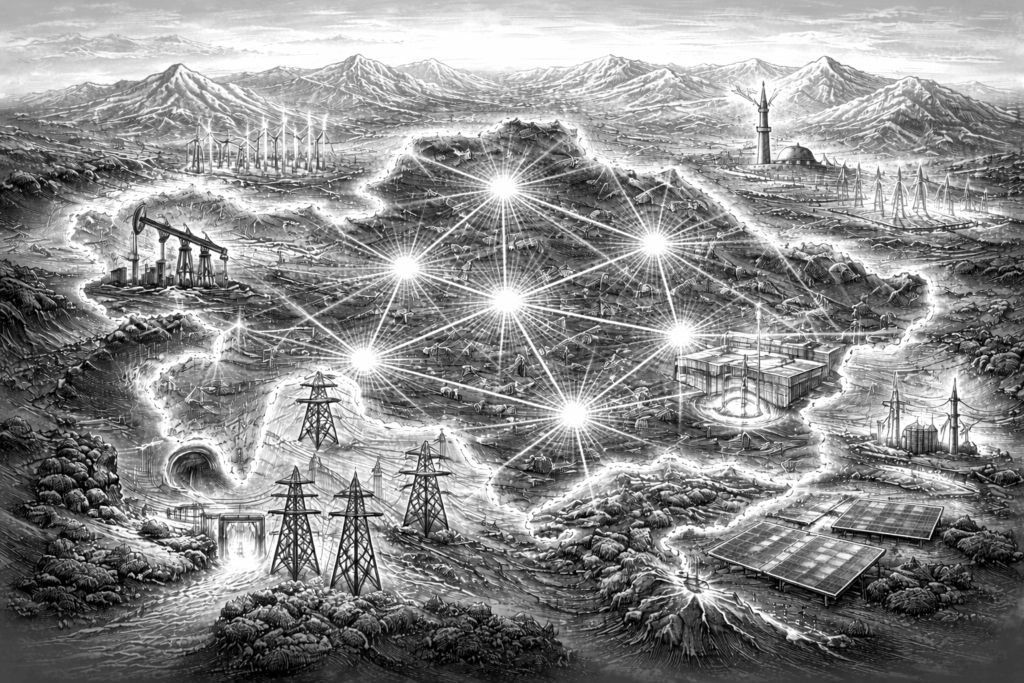
Hydropower from Kyrgyzstan and Tajikistan balances variable solar and wind generation in Kazakhstan and Uzbekistan. Flexible thermal generation plays a declining but stabilizing role. The grid itself becomes a shared regional asset.
Fewer Emissions, If Policies Align
Connectivity is often framed as a geopolitical risk. The modelling suggests it is also a climate opportunity.
Assuming broadly aligned climate policies, regional energy integration significantly reduces greenhouse gas emissions from electricity production. Integrated systems favor low-cost renewables and reduce reliance on carbon-intensive backup generation.
By 2050, emissions intensity under connected scenarios is substantially lower than under national self-sufficiency, even before accounting for emerging options such as low-carbon hydrogen.
The modelling also issues a caution. If countries pursue sharply divergent decarbonization ambitions, increased connectivity can raise the risk of carbon leakage. The climate benefits of integration depend on policy coordination, not just physical interconnection.
Trade Is Not the Main Story
While regional energy connectivity enables exports to neighboring markets, the simulations show that domestic demand and intra-regional trade remain the dominant drivers of system development. Even in the most integrated scenarios, electricity exports to third countries account for only a limited share of total flows.
The real value of connectivity lies closer to home: smoothing seasonal imbalances, sharing reserves, and lowering the cost of meeting peak demand.
Europe, Central Asia, and Strategic Interdependence
These findings also matter beyond Central Asia.
As Europe accelerates its energy transition and seeks to diversify supply chains following the energy shocks of recent years, Central Asia is emerging as a strategically relevant energy partner. Not primarily as a major exporter of electricity, but as a region whose stability, decarbonization pathway, and infrastructure choices affect broader Eurasian energy security.
The modelling shows that exports to Europe are unlikely to become the main driver of Central Asia’s power systems. However, stronger regional integration within Central Asia makes the region more predictable, more resilient, and more investable. That, in turn, lowers geopolitical risk for European partners seeking cooperation on electricity trade, hydrogen, critical minerals, and climate-aligned infrastructure.
In this sense, regional energy connectivity is a geopolitical stabilizer, not a vulnerability.
Grids as Strategic Infrastructure
Achieving these gains requires investment in transmission, particularly within Kazakhstan and between Kazakhstan, Kyrgyzstan, and Tajikistan. Yet transmission represents a relatively small share of total system costs, while enabling large savings across generation and storage.
In practical terms, grids substitute for power plants. Better connections reduce the need for redundant national capacity and allow cleaner resources to be used more efficiently across borders.
A Strategic Choice Ahead
Central Asia now faces a strategic decision. It can continue building parallel national systems that appear resilient but remain costly. Or it can treat energy as a shared regional system, coordinated through infrastructure, markets, and institutions.
The SEI and UNECE / UNESCAP modelling does not argue for integration as an ideological goal. It presents it as a pragmatic response to rising demand, climate pressure, fiscal constraints, and geopolitical uncertainty.
In a region where energy has long been a source of political leverage, cooperation may now offer the most cost-effective form of security.