

Climate change is no longer a subject of interpretation or political preference. It is a scientific reality, established through decades of research, observation, and international assessment. Rising temperatures, extreme weather events, water stress, biodiversity loss, and systemic economic risks are not projections alone. They are unfolding in real time.
For decades, global institutions have played a central role in organizing the response. The United Nations system, particularly the UNFCCC, has provided the architecture through which countries share evidence, negotiate commitments, and coordinate action. The COP process remains the backbone of international climate cooperation, creating a common space for dialogue and accountability.
But climate change is not addressed by agreements alone.
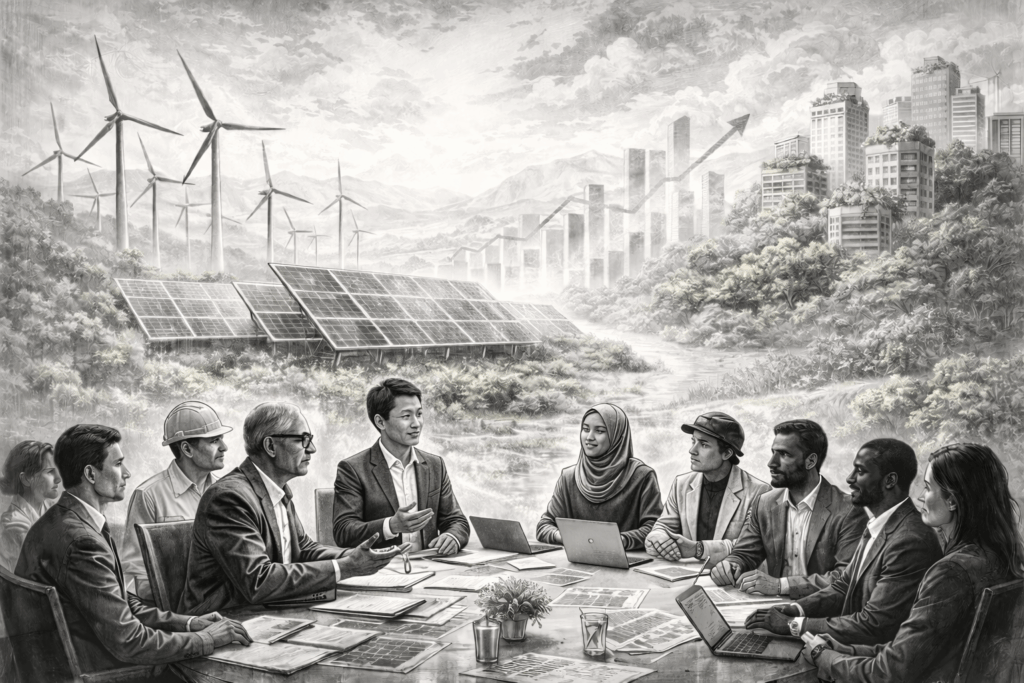
What ultimately determines success is implementation. That work happens across energy systems, financial markets, cities, industries, and communities. It is shaped by engineers designing grids, financiers allocating capital, planners reshaping urban spaces, and practitioners navigating real-world constraints. Their expertise often works quietly in the background, yet it determines whether ambition becomes outcome.
COP31 Türkiye Brief was created to bring those perspectives into view.
The platform is grounded in a simple idea:
ınformed publıc dıscourse strengthens clımate actıon.
Independent analysis, proven data, and diverse expert voices help clarify complex choices and reduce the distance between policy and practice. When facts are accessible and perspectives are openly discussed, trust grows, and so does the capacity to act.
Too often, climate conversations are dominated by a narrow set of voices or simplified narratives. Meanwhile, many experts working at the intersection of science, policy, finance, and implementation remain underrepresented in public debate. Making their insights visible is not about challenging institutions or leaders. It is about complementing them by broadening the context in which decisions are understood and supported.
The focus on Türkiye reflects both timing and purpose. COP31 will take place in Türkiye, making this a natural moment to examine global climate negotiations through the lens of the host country. COP31 Türkiye Brief is a time-bound editorial project, accompanying the COP31 process over the course of a single year. While its name reflects location, its perspective is intentionally global, drawing on international experience and cross-regional learning.
Community plays a quiet but important role in this approach. Not as an alternative to formal structures, but as a space where expertise from different disciplines can intersect. A well-informed community can help connect global goals with local realities, surface practical insights, and support collaboration grounded in evidence rather than rhetoric.
At a moment when the climate agenda is shifting decisively toward delivery, access to credible information matters more than ever. Misinformation and oversimplification weaken collective effort. Transparency, nuance, and dialogue reinforce it.
COP31 Türkiye Brief exists to support that reinforcement. To provide context rather than slogans. To amplify expertise that is often heard too little. And to contribute, in a focused and time-bound way, to a more informed climate conversation during a critical year for global action.
In the end, the strength of the climate response will depend not only on what leaders agree to, but on how widely knowledge is shared and how many voices are invited into the work ahead.