

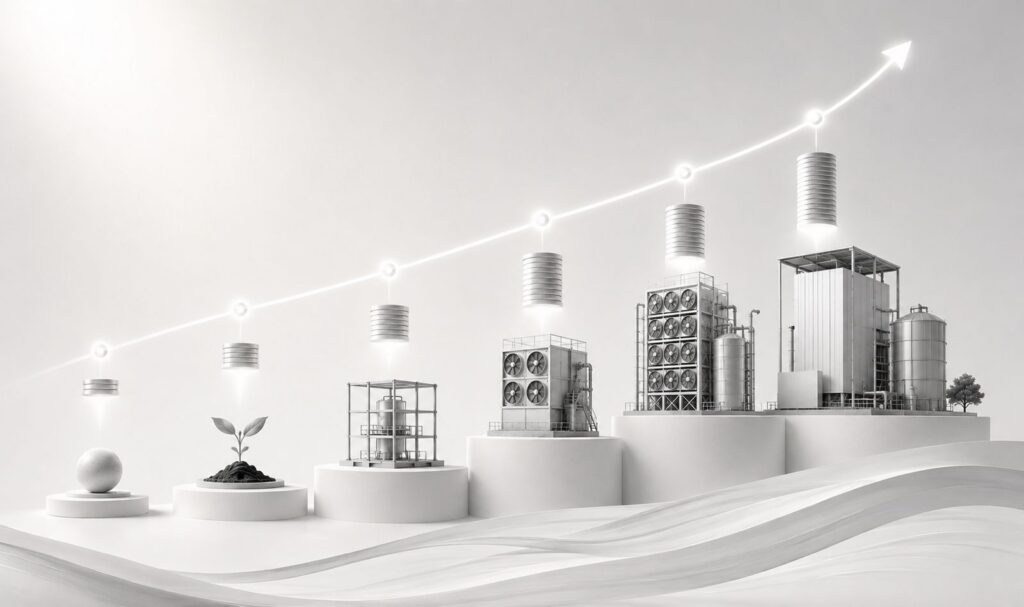
Carbon dioxide removal needs more than good technology. It needs the right financing structure at the right moment. A project may begin as a scientific idea, move into pilot testing, reach a first commercial facility, and only later become a repeatable infrastructure asset. Each stage carries different risks: technology risk, delivery risk, MRV risk, certification risk, buyer risk, and sometimes country risk.
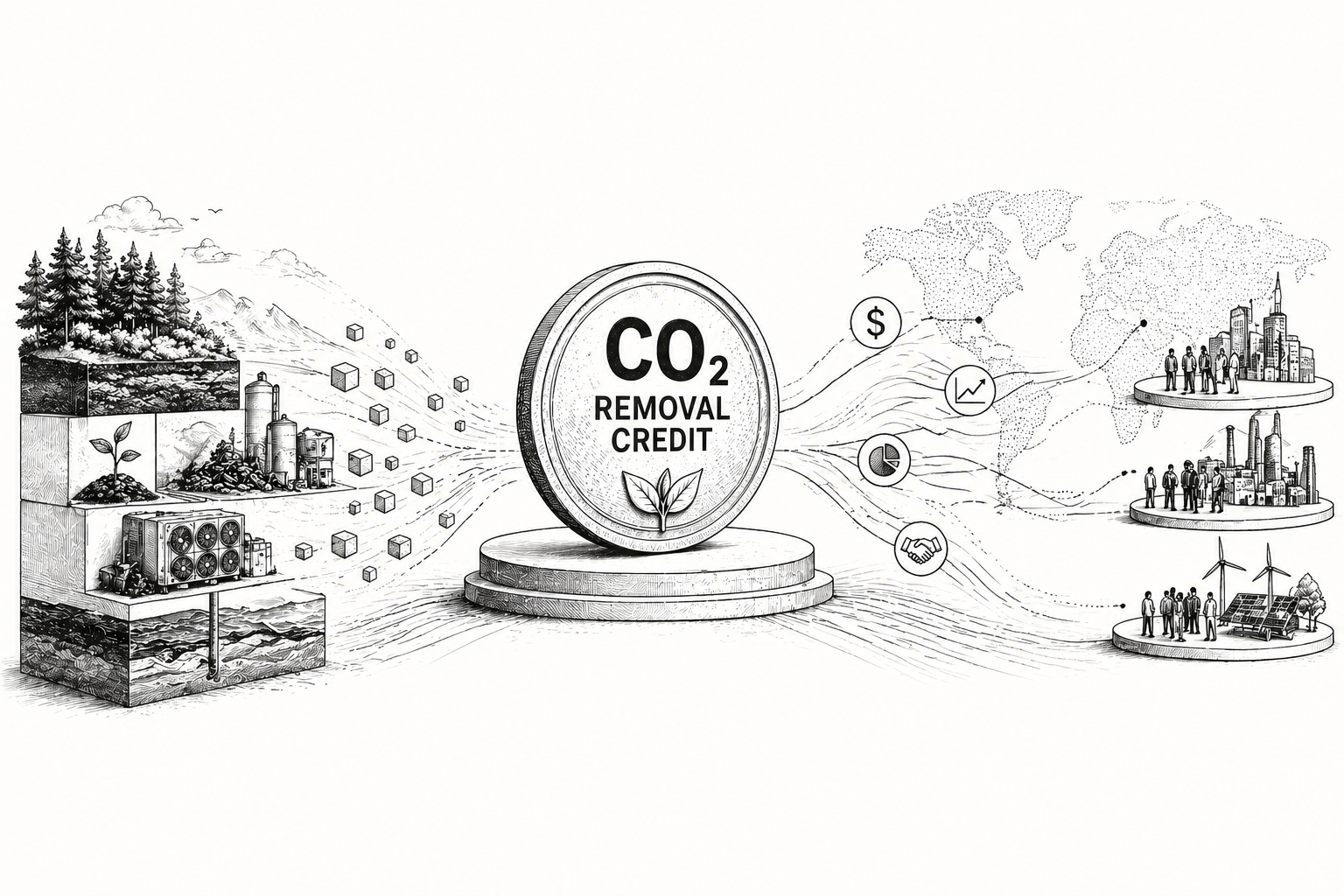
This is why CDR finance is best understood as a sequence of capital layers. Early funding helps ideas prove themselves. Buyer commitments help projects show demand. Public support and risk transfer help first facilities become bankable. Over time, verified credit revenue can become a stronger part of the model, but many projects need financing long before spot credits are available.
The available financing routes also depend on the project’s maturity and technological readiness. A lab-stage ocean alkalinity project, a pilot enhanced weathering company, a modular biochar developer, and a large DAC hub cannot rely on the same capital structure. Different project types need different blends of public support, private capital, buyer demand, and risk management.
1. Grants and public demonstration funding
Public funding often plays the first major role for capital-intensive CDR. It can support pilots, demonstration plants, shared infrastructure, and early commercial deployment when private capital still sees too much uncertainty.
In August 2023, the U.S. Department of Energy announced up to $1.2 billion for two commercial-scale direct air capture hubs in Texas and Louisiana. The aim was to support large-scale DAC deployment and permanent CO₂ storage. In September 2024, Reuters reported that 1PointFive secured up to $500 million from the U.S. Department of Energy for its South Texas DAC Hub.
2. Innovation prizes and catalytic R&D funding
Innovation prizes and catalytic R&D funding help early teams test ideas, improve performance, and attract attention before commercial readiness. They are useful when technical uncertainty is high and the market is too young to price the solution properly.
A major example is the $100 million XPRIZE Carbon Removal competition, funded by Elon Musk and the Musk Foundation. The competition was launched in 2021 to identify solutions capable of removing and durably storing CO₂ at meaningful scale.
3. Venture capital and growth equity
Technology-heavy CDR companies often rely on equity before project revenues become predictable. Venture capital and growth equity can finance teams, hardware development, site development, engineering, and the first deployment phase.
Climeworks is one of the clearest examples. In April 2022, the Swiss direct air capture company raised $650 million in an equity round co-led by Partners Group and GIC, one of the largest capital raises in the carbon removal sector at the time. This type of private investment is especially important for pathways where the technology must scale before costs can fall.
4. Pre-purchase agreements
Pre-purchase agreements are early purchases of future removals, often before a supplier is ready for large-scale delivery. They give developers early revenue, help validate demand, and can support the work needed to move from pilot activity toward verified credit issuance.
A useful example came in November 2023, when American Airlines signed an agreement to purchase 10,000 tonnes of permanent carbon removal from Graphyte, a biomass carbon removal and storage company. Graphyte’s approach converts agricultural and timber residues into dense carbon blocks and stores them underground for long-term sequestration. This kind of early purchase helps a young supplier demonstrate demand before large volumes of verified spot credits are available.
5. Offtake agreements
Offtake agreements are forward purchase contracts for future carbon removal deliveries. They are especially important once a project is beyond the earliest stage but still needs demand certainty to raise capital, build infrastructure, and scale operations. Compared with spot credit sales, offtakes give developers a clearer view of future revenue before the credits are delivered.
In June 2024, Swiss Re agreed to purchase at least 70,000 tonnes of biochar carbon removal credits from Carbonfuture over seven years, with the credits sourced from Exomad Green’s biochar project in Riberalta, Bolivia. OPIS reported that the agreement was notable both for its scale and duration, and that it could help Exomad Green use long-term revenue visibility to expand operations. This example shows how offtake agreements can support CDR suppliers by turning future credit delivery into a clearer financing signal before large spot volumes are available.
6. Advance market commitments
An advance market commitment aggregates buyer demand and sends a larger market signal to suppliers. It helps solve a timing problem: suppliers need confidence to build, while buyers need confidence that supply will exist.
Frontier is the best-known CDR example. Its members committed to more than $1 billion in permanent CDR purchases through 2030, using pre-purchases for earlier companies and larger offtakes for more mature suppliers. This structure is useful because it supports individual projects while also helping build the market itself.
7. Commercial debt, insurance, and risk transfer
Commercial debt is still difficult for CDR because many projects have uncertain delivery timelines and limited operating history. Risk transfer tools can help make debt possible by reducing the lender’s exposure to delivery failure.
In September 2024, Reuters reported that Standard Chartered would provide commercial debt to UNDO after British Airways agreed to purchase more than 4,000 tonnes of enhanced rock weathering credits. The structure involved insurance and partners including CUR8, CFC, and WTW to reduce the risk if sufficient credits were not produced.
8. Tax incentives and production-based support
Tax incentives can make revenue more predictable by rewarding CDR and CCS on a per-tonne basis. They are especially relevant for infrastructure-heavy pathways where long-term economics matter.
In the United States, the 45Q tax credit has been central to CDR and CCS economics and can support eligible projects. For CDR, production-style incentives can reduce dependence on voluntary buyers alone and make projects easier to finance.
9. Public procurement
Public procurement creates demand rather than only supporting development. If governments commit to buying verified removals, they can create a more stable demand signal and help CDR move beyond a purely voluntary market.
A strong example comes from Sweden’s state-supported reverse auction model for BECCS. In 2024, the European Commission approved Sweden’s approximately €3 billion support scheme for projects that capture and permanently store biogenic CO₂ from biomass-based facilities. The program is designed around a competitive auction process, where selected projects can receive support through 15-year contracts. This is one of the strongest examples close to public procurement in CDR, because the state is effectively creating long-term demand for a negative emissions service that meets defined durability and storage conditions.
10. Strategic partnerships and vertical integration
Some CDR projects scale by connecting directly to existing industrial systems. A company may provide feedstock, host infrastructure, co-invest in a facility, or integrate removal into its own operations.
This is especially relevant for biomass, waste, agriculture, cement, mining, and energy systems. A waste company can supply biochar feedstock. A cement producer can host mineralization. A farmer network can support enhanced weathering. These structures reduce project risk because the removal activity is attached to real assets and real operations.
Conclusion: Financing CDR means matching capital to maturity
The central challenge in CDR finance is timing. Projects need capital before they can reliably produce large volumes of verified removals. That means grants, prizes, and equity are important at the earliest stages. Pre-purchases and offtakes help turn future demand into present confidence. Advance market commitments strengthen the market signal. Public support, tax incentives, procurement, insurance, and debt can help projects move toward bankability.
A financing strategy built only around future spot credit sales will struggle to support early deployment. CDR needs a layered financing system that shares risk across public institutions, private investors, corporate buyers, insurers, and project developers. The technologies matter, but the financing structures will determine how many of them survive long enough to deliver.