





For decades, global climate action has been framed through Nationally Determined Contributions (NDCs), the commitments countries submit under the Paris Agreement. These pledges remain the backbone of international climate governance. Yet as the gap between national ambition and on-the-ground delivery persists, a quieter but increasingly consequential shift is underway.
Cities are stepping forward with their own climate commitments.
Often described as Self-Determined Contributions (SDCs), these locally led actions are emerging as a parallel track to national pledges. They are shaped less by diplomatic compromise and more by local realities, infrastructure needs, and direct exposure to climate risk. Increasingly, they are also more measurable and, in many cases, more ambitious.
This shift has gained political recognition at the multilateral level. In his second COP30 letter, published on 8 May 2025, Ambassador André Corrêa do Lago, President of COP30, outlined a vision for global climate action built around the concept of a “Global Mutirão” — a term rooted in Brazil’s Tupi language, meaning collective effort. The letter introduced four Circles of Leadership aimed at advancing cooperation across governments, cities, businesses, and civil society, and explicitly framed self-determined contributions as a grassroots complement to NDCs, rather than a competing track.
The growing role of cities gives this concept practical form. One of the clearest indicators comes from the Global Covenant of Mayors for Climate & Energy, the world’s largest alliance of cities committed to climate action. According to its 2025 Impact Report, today, GCoM unites more than 13,800 cities and local governments across 148 countries, representing approximately 1.2 billion people worldwide, nearly one in every seven people on the planet. Together, these cities are accelerating local solutions aligned with the goals of the Paris Agreement.
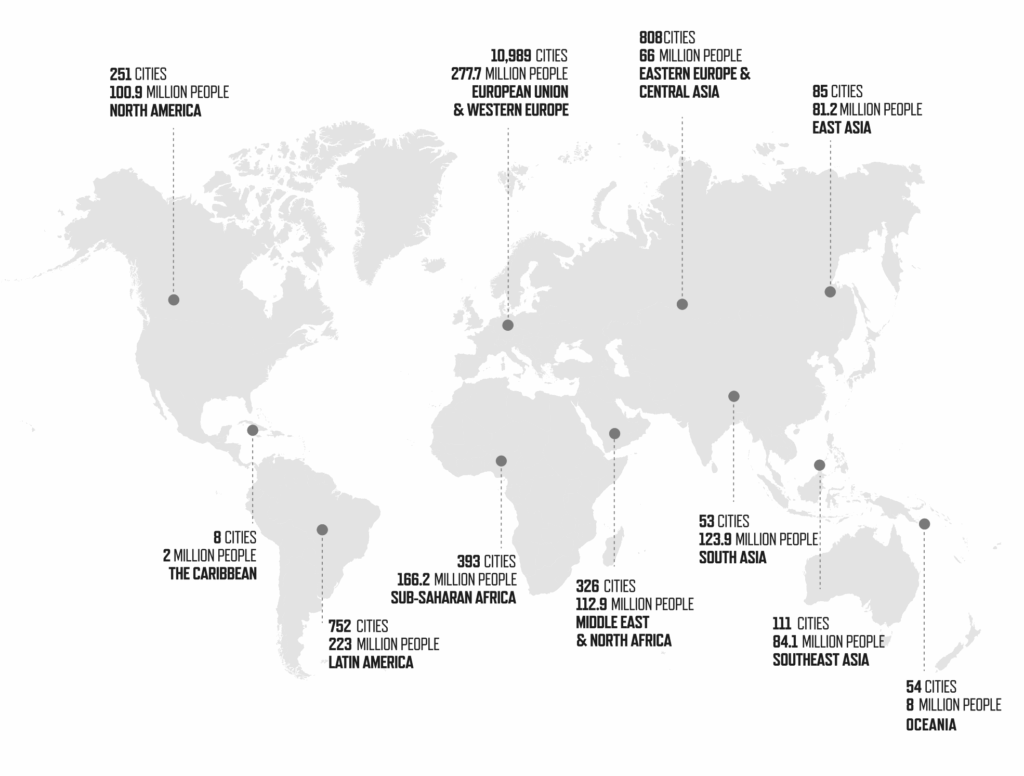
GCoM analysis suggests that city-led action could deliver up to 4.5 gigatons of CO₂-equivalent emissions reductions annually by 2050, closing a significant share of the gap between current NDC trajectories and a pathway consistent with limiting warming to 1.5°C. Yet while 66 percent of NDCs now include some reference to urban action, only 14 percent clearly specify the finance, capacity, and governance frameworks cities need to act at scale.
Beyond the Covenant, networks such as C40 Cities illustrate how local ambition is often advancing ahead of national timelines. Cities including London, Paris, Seoul, and Bogotá are pursuing climate targets and implementation frameworks that, in practice, go further than national commitments, embedding climate action directly into transport systems, building standards, and urban planning. These city-led strategies are typically supported by interim milestones, public disclosure, and sector-specific implementation plans, translating long-term goals into near-term action.
The distinction lies not only in ambition, but in proximity. Cities operate where emissions are generated and impacts are felt. Transport, buildings, waste management, land use, and local energy systems fall largely within municipal control, allowing targets to be translated into operational decisions rather than abstract pledges.
At the same time, the rise of SDCs exposes a structural tension in the climate architecture. Cities are increasingly expected to deliver outcomes without always having sufficient fiscal autonomy, regulatory authority, or access to climate finance. Even among leading cities, progress often depends on national frameworks and international financing mechanisms that remain largely state-centered.
As attention turns toward COP31, this tension will become harder to ignore. If NDCs define the architecture of global climate ambition, SDCs are increasingly defining its execution. The challenge ahead is not whether cities belong in the climate process, but whether global institutions can evolve quickly enough to recognize, enable, and scale what cities are already delivering.
In a climate decade defined less by declarations than by delivery, some of the most consequential climate action may be emerging not from capitals, but from city halls.