


Over the past twenty years, Türkiye’s economy has expanded at a remarkable pace. Rapid urbanization, demographic growth, and rising household incomes have reshaped how energy is consumed, making Türkiye one of the fastest-growing energy markets in the OECD. Electricity and heating demand have surged alongside an expanding building stock, putting increasing pressure on national energy security and deepening reliance on imported fossil fuels.
The building sector sits at the center of this challenge. According to national statistics, buildings account for nearly 37 percent of Türkiye’s final energy consumption, with public buildings responsible for a disproportionately large share. Many of these facilities are sizable, aging, and built before modern energy efficiency standards were in place. The result is high energy use, mounting operating costs, and missed opportunities for emissions reduction — making buildings one of the most cost-effective sectors for action.
Policymakers have not been blind to the problem. Türkiye’s Energy Efficiency Law of 2007 laid the foundation for a national approach to reducing energy intensity, followed by the Energy Efficiency Strategy Document (2010–2023) and the National Energy Efficiency Action Plan (2017–2023). Together, these frameworks created a roadmap for curbing energy consumption across sectors. More recently, the government adopted the Energy Efficiency 2030 Strategy, aligning energy policy with Türkiye’s long-term objective of achieving carbon neutrality by 2053. Across these strategies, the building sector consistently emerges as a priority — particularly large-scale renovation and the use of modern energy performance tools.
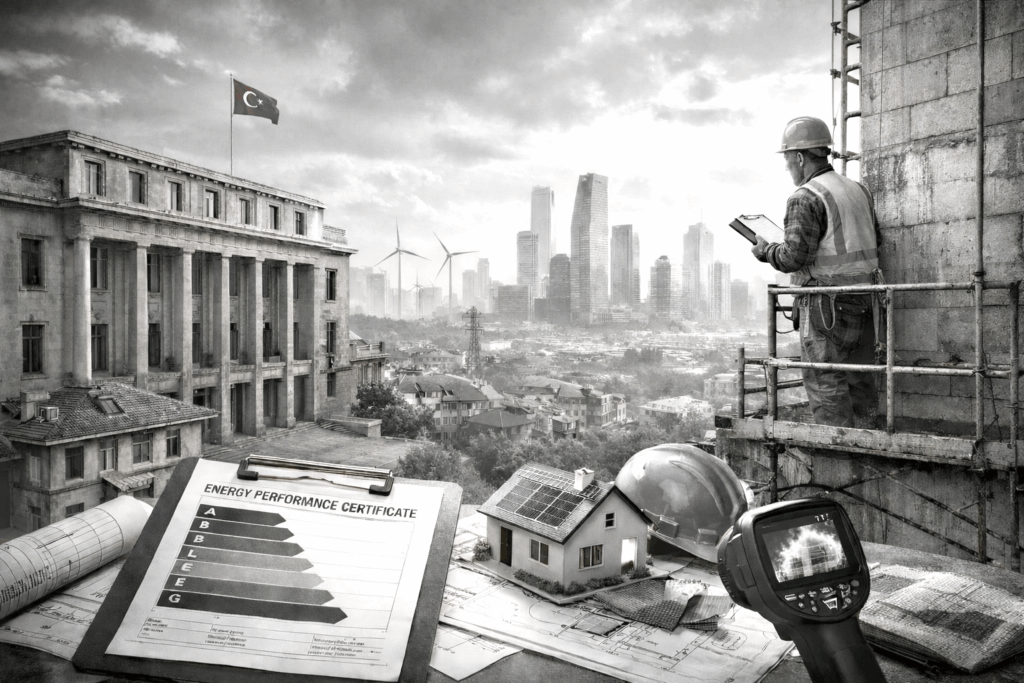
Türkiye’s ambitions are also shaped by its relationship with the European Union. As part of its EU accession process, the country has pursued alignment with the EU Energy Efficiency Directive, its Revised Directive, and the Energy Performance of Buildings Directive. These frameworks introduce tools such as Energy Performance Certificates (EPCs), nearly zero-energy building (NZEB) standards, long-term renovation strategies, and innovative mechanisms like Building Renovation Passports (BRPs). At the European level, the European Green Deal and the Renovation Wave Strategy place building efficiency at the heart of climate neutrality by 2050 — an agenda Türkiye increasingly mirrors as it integrates with European energy and construction markets.
Implementation, however, remains uneven. Large-scale public programs such as the World Bank–financed Energy Efficiency in Public Buildings Project and the Seismic Resilience and Energy Efficiency in Public Buildings Project represent important steps forward. These initiatives recognize Türkiye’s dual vulnerability: high energy consumption and significant seismic risk. By combining structural reinforcement with energy upgrades, they aim to deliver safety, efficiency, and emissions reductions in tandem. Parallel efforts supported by institutions like the European Bank for Reconstruction and Development (EBRD) and the European Investment Bank (EIB) have piloted financing schemes and built early capacity.
Still, obstacles persist. Much of the public building stock predates modern efficiency codes, creating vast renovation needs. Institutional capacity varies widely across central and provincial authorities, with limited experience in energy audits, EPC structuring, and performance-based contracting. Private actors — particularly ESCOs and financial institutions — remain cautious, deterred by perceived risks and the lack of standardized financing models. Public awareness is also low, weakening demand and limiting social acceptance of innovative renovation approaches.
It is against this backdrop that the present Türkiye Energy Efficiency in Public Buildings project by the Word Bank takes shape. Designed as a bridge between policy ambition and on-the-ground implementation, it emphasizes structured dialogue among public authorities, ESCOs, and financial institutions, alongside institutional strengthening and awareness-raising for building users. By introducing tools such as Building Renovation Passports, piloting financing mechanisms, and fostering trust in Energy Performance Contracting, the project aims to generate practical, scalable solutions rather than isolated pilots.
The project also speaks directly to Türkiye’s international commitments. Since ratifying the Paris Agreement in 2021, the country has pledged to reach net-zero emissions by 2053 — a goal that cannot be achieved without deep decarbonization of buildings. By improving energy performance, mobilizing finance, and aligning with EU climate trajectories for 2030, 2040, and 2050, the initiative positions the building sector as a cornerstone of Türkiye’s long-term transition.
In short, Türkiye’s buildings represent both a structural weakness and a strategic opportunity. With energy demand rising, regulatory frameworks maturing, and international alignment accelerating, the moment is ripe for action. This project arrives at a critical juncture — offering a comprehensive approach that combines policy alignment, institutional capacity, innovative finance, and public engagement to reshape the future of Türkiye’s public building stock.