

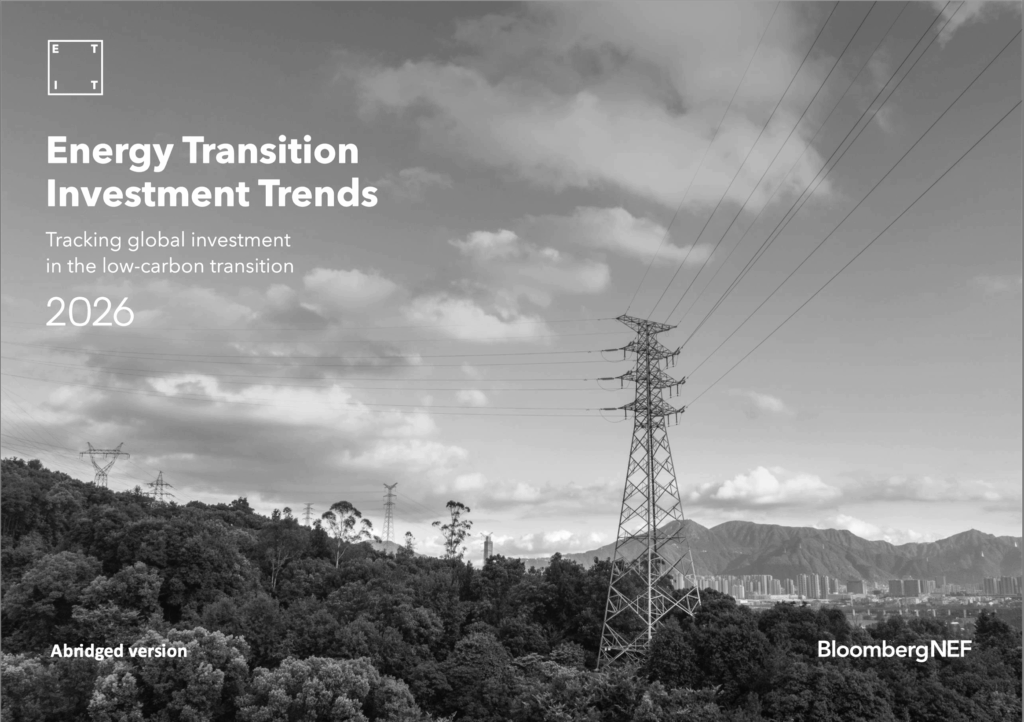
Global investment in the energy transition reached $2.3 trillion in 2025, the highest level on record, according to BloombergNEF’s Energy Transition Investment Trends 2026. Spending rose 8% year on year, defying trade disruptions, geopolitical tension, and uneven policy signals across major economies.
The headline figure tells a story of resilience. The subtext, however, is more complex. Growth in clean energy investment has slowed markedly, from 27% in 2021 to single digits in 2025, suggesting the transition is moving from rapid expansion into a more mature and infrastructure-heavy phase.
Electrification Takes the Lead
Electrified transport emerged as the single largest destination for capital. Investment reached $893 billion, driven by electric vehicle sales and charging infrastructure, firmly placing transport at the center of the global transition.
Renewable energy followed with $690 billion, led by solar. Yet investment declined year on year, largely due to power market reforms in China that introduced new pricing risks for developers. By contrast, power grid investment surged 17% to $483 billion, as countries raced to connect new generation, electrify demand, and meet rising electricity needs from data centers and digital infrastructure.
A Shifting Global Map
China remained the world’s largest single market, investing $800 billion, but recorded its first decline in energy transition investment since 2013. Europe filled much of the gap. The European Union grew 18% to $455 billion, making the largest contribution to global investment growth, while the United States edged up 3.5% to $378 billion despite policy uncertainty.
Taken together, the US, EU, and UK now invest more in aggregate than China, highlighting a more competitive and geographically diversified transition.
Financing Rebounds Selectively
After three years of decline, climate-tech equity financing rebounded sharply, rising 53% to $77 billion in 2025. The recovery was driven primarily by large public market deals and secondary offerings, while venture capital for early-stage startups continued to contract.
Debt markets, meanwhile, remained the backbone of the transition. Energy transition debt issuance reached $1.2 trillion, with strong growth in corporate and project finance, particularly for power grids and electrified transport. Notably, labeled green and sustainable debt accounted for a shrinking share of issuance, as pricing advantages diminished.
The Road Ahead
BloombergNEF projects average annual investment of $2.9 trillion between 2026 and 2030 under its base-case scenario. While this represents continued growth, it remains below the level required to align fully with global net-zero pathways.
The energy transition is no longer defined by momentum alone. It is increasingly shaped by grid capacity, market design, industrial supply chains, and political durability.
The money is arriving; the question now is whether systems, policies, and institutions can move fast enough to meet it.