


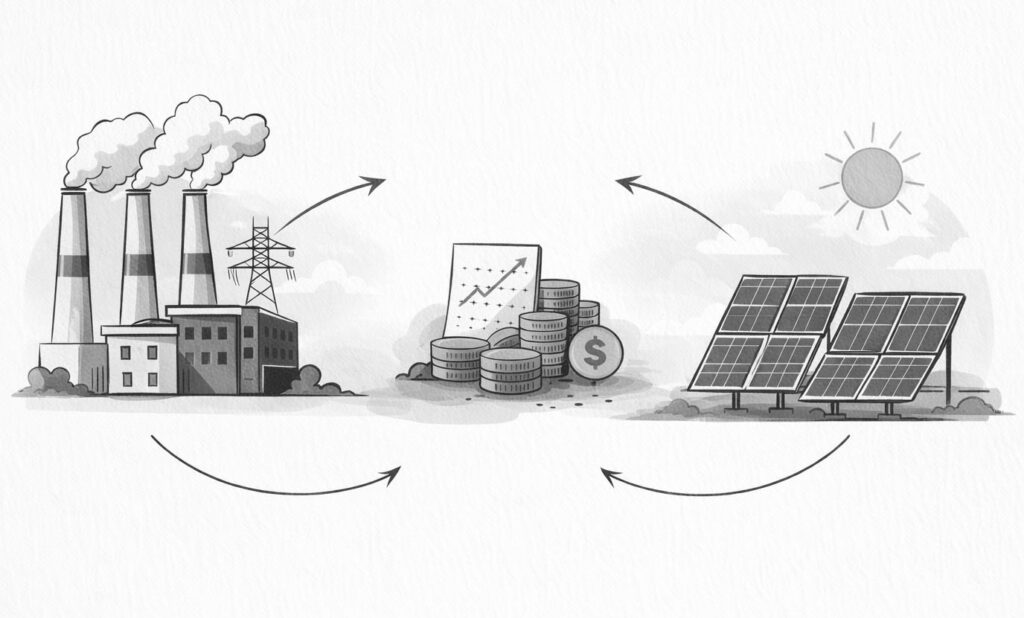
Few terms appear as often in discussions about energy transition as LCOE. Short for Levelized Cost of Energy, it is widely used by policymakers, investors, and analysts to compare the cost of producing electricity across different energy technologies.
At its core, LCOE answers a simple question: What is the average cost of generating one unit of electricity over the lifetime of a power plant? The metric combines all relevant costs such as upfront capital investment, operation and maintenance, fuel where applicable, and financing and spreads them over the total electricity expected to be produced during the asset’s life. The result is usually expressed in cost per megawatt-hour.
In simplified terms, LCOE can be represented as:
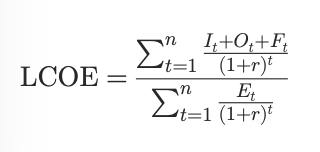
Where:
- Iₜ represents investment expenditures in year t
- Oₜ represents operation and maintenance costs
- Fₜ represents fuel costs, if applicable
- Eₜ represents electricity generated
- r is the discount rate
- n is the lifetime of the project
This formulation reflects the discounted value of both costs and electricity over time, capturing the time value of money. It is this discounting that makes financing conditions such a critical factor in LCOE calculations.
This standardization is precisely what makes LCOE so attractive. It allows a solar power plant in southern Europe to be compared, at least on paper, with a gas-fired plant in North America or a wind project offshore. Over the past decade, falling LCOE figures for renewables have played a major role in reshaping global energy narratives. Solar and wind are now routinely described as the cheapest sources of new power generation in many regions.
However, LCOE is not a price, nor is it a complete measure of value. It does not reflect when electricity is produced, how reliably it can be delivered, or how well it aligns with system needs. A solar plant may have a low LCOE, but its output peaks at midday. A gas plant may have a higher LCOE, but can respond instantly to demand fluctuations. Comparing the two without context can be misleading.
LCOE also abstracts away system-level costs. Grid integration, storage, balancing services, and transmission upgrades are typically excluded, even though they can materially affect the real cost of electricity in a high-renewables system. As power systems evolve, these omitted costs become increasingly important.
Financing assumptions further complicate the picture. LCOE is highly sensitive to discount rates. Technologies with high upfront costs and low operating expenses, such as renewables, benefit significantly from lower financing costs. This is why policy stability, access to capital, and country risk matter as much as technology itself.
LCOE remains a useful starting point. It offers a common language in a complex energy landscape. But it is not the final word. As energy systems shift from isolated power plants to integrated, flexible networks, understanding both the strengths and the limitations of LCOE is essential. In the energy transition, cost matters. Context matters more.