

The Citizens Energy Package is Brussels’ attempt to make the clean-energy transition legible, affordable and politically durable for households.
For years, Europe’s energy transition has been discussed in the language of grids, gigawatts and market design. The European Commission’s Citizens Energy Package changes the register. It brings the transition indoors, to the unpaid bill on the counter, the landlord who will not renovate, the confusing electricity contract and the household that wants solar power but cannot navigate the rules.
Presented on March 10, 2026, as a deliverable under the Action Plan for Affordable Energy, the package aims to reduce bills, protect vulnerable consumers, simplify retail markets and give households a more active role in the clean-energy economy. On April 30, the Commission followed with four practical recommendations and accompanying documents that move the file from broad political statement to implementation guidance for member states, regulators, suppliers, local authorities and civil society.
The political premise is blunt: The transition will not hold if it is experienced mainly as a cost. The Commission notes that nearly one in ten Europeans cannot adequately heat their homes and that more than 30 million report struggling to pay utility bills on time. Retail electricity prices remain above pre-crisis levels, while electricity taxes and levies account for about a quarter of household prices on average. The package is therefore less a climate manifesto than a social contract for decarbonization.
What Brussels is trying to fix
The first problem is protection. The April guidance urges early identification of households at risk of disconnection, with tailored payment plans, debt advice and targeted support such as energy vouchers. But it also points beyond emergency relief to structural remedies: Energy efficiency, cleaner heating alternatives and access to renewables. In the Commission’s framing, a household should not have to choose between paying arrears and joining the energy transition.
The second problem is market opacity. Consumers are expected to behave like rational market participants, yet many face contracts they cannot compare, price signals they cannot use and switching processes they do not trust. The package calls for clearer contract terms, easier comparison of offers and stronger safeguards when suppliers fail. This is not glamorous policy, but it is the plumbing of consumer confidence.
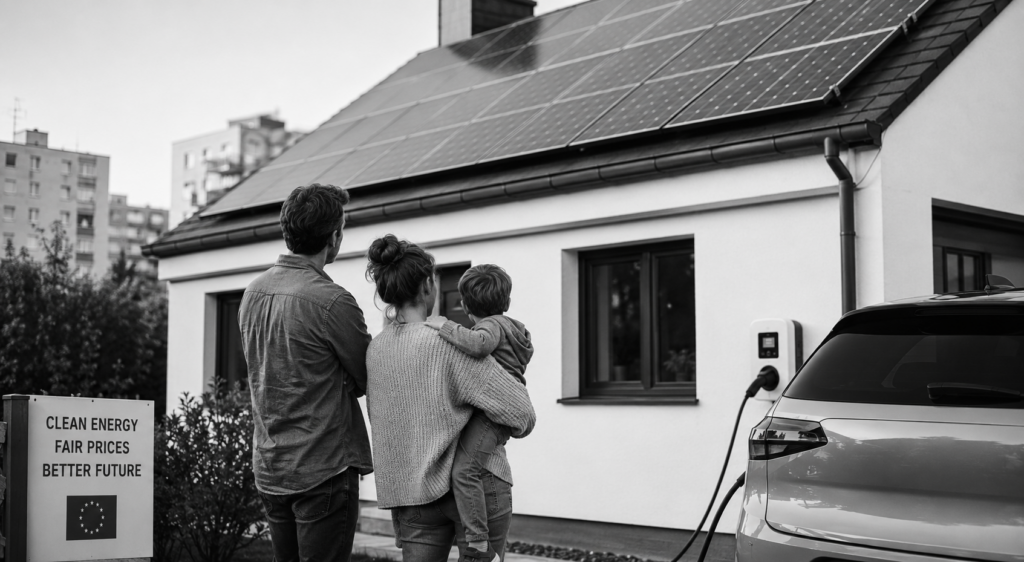
The third problem is participation. The Commission wants households, small businesses and local authorities to become producers, sharers and flexible users of energy, not merely bill payers. Its recommendation on energy communities and self-consumption is meant to lower barriers for collective renewable generation, local sharing and demand-side flexibility. That ambition is accompanied by an energy communities action plan and a report on market-based retail prices and flexibility remuneration.
Why it matters
The package arrives at a delicate moment. Europe has reduced its exposure to Russian fossil fuels, expanded renewables and pushed forward market reforms. But households remain exposed to volatility in global energy markets, weather-driven shifts in supply and demand, and uneven national implementation. In that context, the Citizens Energy Package tries to connect three agendas that are too often handled separately: Affordability, resilience and decarbonization.
Its significance lies in the sequence. First, protect the household. Then simplify the market. Then enable participation. That order matters. A consumer facing disconnection is unlikely to join an energy community. A family that cannot understand its bill is unlikely to respond to dynamic prices. A municipality without one-stop-shop capacity will struggle to translate EU policy into household action.
The Commission is also acknowledging a harder truth: Consumer empowerment is not achieved by giving citizens more options alone. It requires institutions that make those options usable. That means trusted comparison tools, enforceable supplier obligations, accessible renovation advice, transparent timelines for gas phase-out, and local bodies capable of helping residents move from information to investment.
The tension
The Citizens Energy Package is not a large new spending instrument. Much of its force depends on member states implementing existing legislation, using EU and national funding effectively, and strengthening regulatory oversight. That makes it potentially pragmatic, but also vulnerable. Recommendations can clarify expectations; they cannot by themselves retrofit homes, lower network costs or rebuild trust in energy suppliers.
There is also a distributional question. Flexibility contracts and self-consumption can lower costs for households able to shift consumption, install equipment or join collective schemes. But without careful design, the benefits may accrue first to the organized, the housed and the better informed. The package recognizes this risk by emphasizing vulnerable consumers, but implementation will determine whether participation becomes broadly inclusive or another layer of inequality in the energy system.
What to watch next
- Member-state follow-through: Whether national governments translate the recommendations into enforceable consumer protections, disconnection safeguards and clear gas phase-out communication.
- Retail market reform: Whether contract standardization and switching improvements make bills simpler and markets more competitive, rather than merely adding new paperwork.
- Energy communities: Whether permitting, grid access, financing and local capacity are improved enough for community energy to move beyond pilot projects.
- Flexibility with fairness: Whether households that adjust demand are rewarded while those unable to shift consumption remain protected.
Bottom line
The Citizens Energy Package is a reminder that Europe’s clean-energy transition will be judged not only by new capacity installed, emissions avoided or imports displaced, but by whether citizens experience the transition as protection, agency and lower risk. Brussels is trying to make the energy system more resilient by making it more human. The test now moves from Commission language to national execution.