

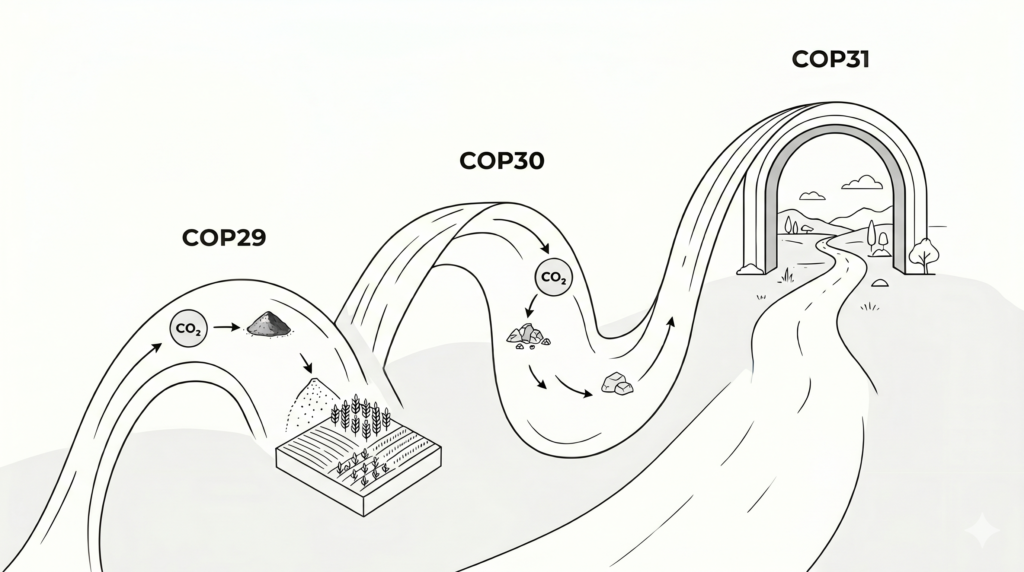
The timeline of global climate action is shifting from decades to years. As we look ahead to COP31 in Antalya, understanding how the carbon removal ecosystem has matured over the past two adjustment cycles is a strategic necessity. The journey from Baku to Belém has fundamentally changed how the world views durable carbon removal*, moving the conversation from “if” we need carbon dioxide removal to “how fast” we can deploy it.
The global regulatory landscape for climate action is moving faster than ever. Over the first half of 2026, the baseline for CDR have shifted from guidelines into active compliance frameworks. As we look toward COP31 in Antalya, understanding this new regulatory context is a strategic necessity for regional industry.
Let’s start with the baseline observations established at COP29 in Baku.
COP29 in Baku: The Global Frameworks
At COP29, the primary focus for carbon removal pioneers was to evaluate the integration of durable CDR within the wider climate landscape, map out startup dynamics, and assess the alignment of political frameworks with scientific parameters. The global community hosted sessions across various spaces, including the IETA, CRIN, and Ocean pavilions, as well as country platforms like Sweden, Canada, and Denmark. The core message uniting these stakeholders was that emission reductions and carbon removals are both required to reach net-zero targets, and that durable CDR serves as a fundamental pillar of climate survival rather than an optional or secondary measure.
Two main structural developments and discussions from Baku established this global baseline:
- The Article 6.4 Progress: Following extensive multi-year negotiation delays, countries finalized the operational rules for this global carbon market. Within the CDR sector, this mechanism establishes a formal UN system for certifying and trading removal credits, intended to provide institutional regulatory confidence and enable host countries to create standardized revenue streams from structural removal projects. In 2026, this framework is shifting into active operation as the UN Supervisory Body finalizes the baseline methodologies and registration tracks required to bring permanent removal projects to market.
- The Discussion on “Double Claiming”: Conversations explored the economics of capital-intensive, early-stage technologies. Because durable CDR pathways remain costly, arguments were presented that allowing both a host country and a corporate buyer to count a high-permanence removal toward their respective targets could act as a vital investment enabler to lower the cost curve before 2030. As analyzed in a recent CDR Brief article, this discussion supports a nested approach to carbon accounting, illustrating how regional programs can scale through dual-incentive structures without requiring Corresponding Adjustments for private voluntary investments.
Baku also highlighted alternative approaches to traditional offsetting, such as the Wuppertal Institute’s The Contribution Claim Model. Under this framework, companies make a direct financial contribution to support global climate goals instead of purchasing a credit to offset their own carbon footprint, increasing transparency and mitigating standard quality concerns. These models began shifting carbon removal from a distant final milestone into an ongoing corporate duty.
COP30 in Belém: The Power of Collective Mobilization
While the discussions in Baku focused primarily on foundational policy frameworks, the subsequent COP30 summit in Belém in late 2025 marked a distinct expansion toward practical mobilization. The global dialogue transitioned into a physical space through the launch of the first Carbon Removals Pavilion (the CDR30 Pavilion), organized and hosted by the Negative Emissions Platform (NEP) .
The pavilion aligned its programming with the Brazilian presidency’s focus on Mutirão (a collective community effort), which also formed the structural basis of the core negotiated UN text, the Mutirão Decision. Under this framework, the carbon removal ecosystem launched the CDR Mutirão under the formal UN Global Climate Action Agenda to connect public policy directly with industrial demand.
By mid-2026, this collective effort has formalized into the CDR2030 platform. This initiative focuses directly on the current decade, establishing clear milestone targets for 2030 to accelerate deployment from existing historical baselines:
- 100 Million Tonnes per year of novel, durable carbon removal capacity by 2030, scaling up from a global baseline of less than 2 million tonnes per year delivered in 2025 (as documented by the State of Carbon Removal).
- 3 Gigatonnes per year of nature-based solutions scaled globally by 2030, building from a global baseline of approximately 2.0 Gt per year in 2025.
- Government Policy Coordination: The Group of Negative Emitters (GONE), initiated by Denmark, Finland, and Panama in COP28, gained significant traction as a focal point for national and subnational alignment, coordination on negative emissions: growing membership, a move toward a more robust secretariat, and a clearer role in connecting public actors with expertise and industry.
- Market Infrastructure and Legal Standardization: Broad policy dialogues focused on the creation of open-source, standardized carbon removal purchase agreements to reduce transactional and legal friction for corporate buyers; and the Open Standard Carbon Removal Agreement (OSCAR) was launched online at CDR30 during COP30.
- Interoperable Market Standards: Collaborative panels explored the alignment between carbon markets and global high-integrity standards to ensure environmental and social integrity across both compliance systems and voluntary frameworks.
- Technical panels about biochar, enhanced rock weathering, BECCS and DAC took place. The pavilion concluded with a strategic consensus that marine and ocean-based CDR to be significantly expanded at the upcoming summit.
The 2026 Regulatory Shift
Following the mobilization in Belém, the first half of 2026 has seen this focus on ongoing responsibility solidify into formal compliance frameworks through independent regulatory tracks:
- The EU CRCF Framework Certification Methodologies (June 2026): The European Commission officially adopted the certification methodologies under the Carbon Removal Certification Framework (CRCF), setting the first legally grounded standards for permanent pathways like Biochar Carbon Removal (BCR) and Direct Air Capture with Carbon Storage (DACCS).
- The SBTi Net-Zero Standard V2.0 (June 11, 2026): SBTi launched its updated corporate standard, formalizing the “Ongoing Emissions Responsibility” framework. This updates corporate rules by establishing a three-phase system: voluntary recognition tiers for current emission mitigation, a mandatory progressive requirement for large companies to fund and contract durable removals starting in 2035, and 100% neutralization of all residual footprints at the final net-zero target year through accepted durable CDR methodologies.
This changing context directly shapes the expectations and atmosphere for the upcoming negotiations at COP31.
COP31 in Türkiye: The Regional Implementation and Leadership Role
This evolutionary path brings the focus directly to regional execution. With international compliance standards like the EU CRCF active and the CDR2030 platform setting clear timelines, the business case for durable CDR has shifted. For industrial exporters facing the financial pressures of the EU’s Carbon Border Adjustment Mechanism (CBAM), novel CDR pathways offer a practical way to manage hard-to-abate residual process emissions and maintain cross-border competitiveness.
Türkiye is positioned to play a critical role in regional deployment, moving beyond localized potential to assume a position of broader CDR leadership across the Mediterranean, the Middle East, and Central Asia. By serving as an industrial, financial, and logistical corridor, the geography can link global compliance frameworks with the asset bases of these overlapping macro-regions:
- The Cement and Heavy Industry Sector: As a global leader in cement and steel production, the country maintains large industrial clusters across the Marmara and Mediterranean regions. Integrating durable CDR pathways, such as point-source biogenic capture, the strategic application of biochar, carbonation during recycling, or mineralization into building materials, directly addresses the unavoidable process emissions that traditional efficiency measures cannot eliminate. This provides a repeatable blueprint for heavy industries throughout the Middle East and Central Asia facing similar transition pressures.
- Agricultural Feedstocks for Biochar: The deep agricultural sector across the Anatolian heartland provides consistent, localized organic residue streams. These feedstocks can fuel and scale the permanent biochar networks that saw high commercial interest during the COP30 sessions, positioning the region as a primary optimization hub for processing biomass residues into highly durable storage formats.
- Geological Potentials: Specific regional geological advantages provide immediate opportunities for both open-surface and subsurface permanent carbon drawdown. The advanced geothermal networks in Western Anatolia, like the fields evaluated for subsurface stabilization mechanisms by Elidemir and Güleç (2018) and the active industrial scale non-condensable gas reinjection programs optimized at the Kızıldere geothermal power infrastructure by Mainar-Toledo et al. (2023), offer immediate configurations for liquid solubility trapping and deep storage. Furthermore, the region contains the massive mafic and ultramafic rock formations required to anchor diverse CDR technologies. The extensive volcanic basalt fields of the Karacadağ plateau (the largest Cenozoic shield volcano in the circum-Mediterranean as documented by Lustrino et al. (2010)) provide an ideal, mineral-rich feedstock resource for Enhanced Rock Weathering (ERW) operations due to their high concentration of fast-weathering calcium and magnesium silicates applied to soils. On the other hand, the Neo-Tethyan mantle ophiolite belts near Antalya, structurally evaluated for their magnesium-rich alteration mineralogy by Yalçın et al. (2015), offer highly reactive peridotite and serpentinite structures chemically optimized for durable in-situ mineral carbonation. This natural carbon-trapping capacity is clearly demonstrated at the adjacent Chimaera seep; mineralogical analysis by Hoşgörmez (2007), confirmed that the gas-fluid reactions inside these ophiolite fractures are actively forming solid carbonate minerals (like hydromagnesite), proving the bedrock’s inherent ability to lock carbon directly into stable subterranean carbonate rock matrices.
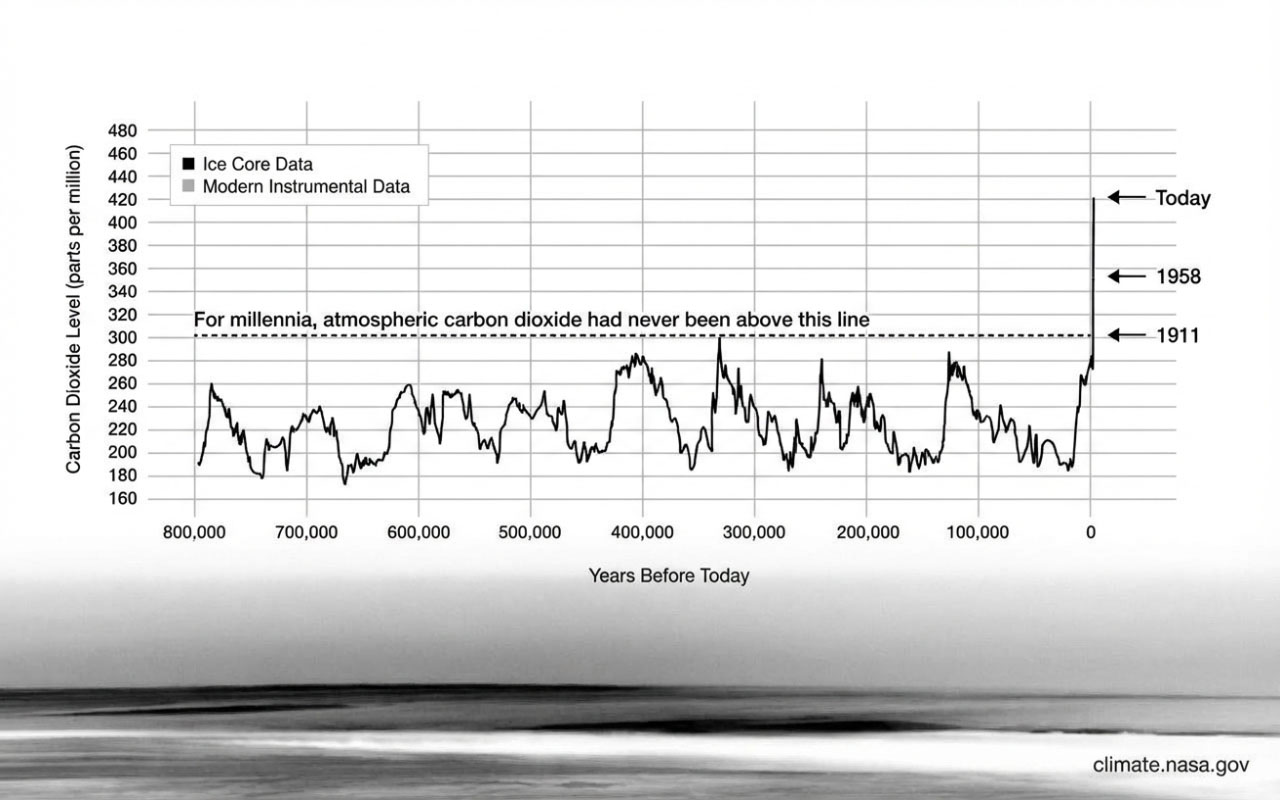
Hosting an expanded Carbon Removal Pavilion at COP31 in Antalya represents a practical industrial opportunity to coordinate this transnational deployment. Recent research has put our situation into sharp focus: a major 2023 study in Science, Toward a Cenozoic history of atmospheric CO2, reveals that current CO2 concentrations are now at levels not seen on Earth for 14 million years. Deep emission reductions are mandatory, but they are no longer enough on their own. The journey to Antalya provides the platform to connect global technological innovations with the industrial ecosystems of our wider region, turning scientific necessity into localized reality.
* When we discuss CDR in this brief, our focus is strictly on durable, novel pathways: high-permanence solutions like biochar, enhanced rock weathering, direct air capture, and geological mineralization, rather than conventional nature-based sinks.