
PLATO’S IDEA, ARISTOTLE’S TELOS, AND IBN ARABI’S AYN-I SABIT
THE PHILOSOPHICAL ANATOMY OF CLIMATE FINANCE
This is the fourth piece in a series on the political economy of climate finance. Previous pieces examined the geopolitical origins of the finance gap, why blended finance fails to deliver, and the plumbing problems ahead of COP31.
In my previous brief, “Blended Finance’s Broken Promise: Why the Money Never Arrives“, I argued that the global climate finance gap is fundamentally a structural plumbing issue. This piece asks a harder question: why does the plumbing stay broken — and who benefits?
For years, we have debated leverage ratios, concessional tranches, and the NCQG floor. The implicit assumption is that climate finance is a system that wants to work but keeps breaking down. What if the system is working exactly as designed — and the design was never primarily about moving capital to where climate change is happening?
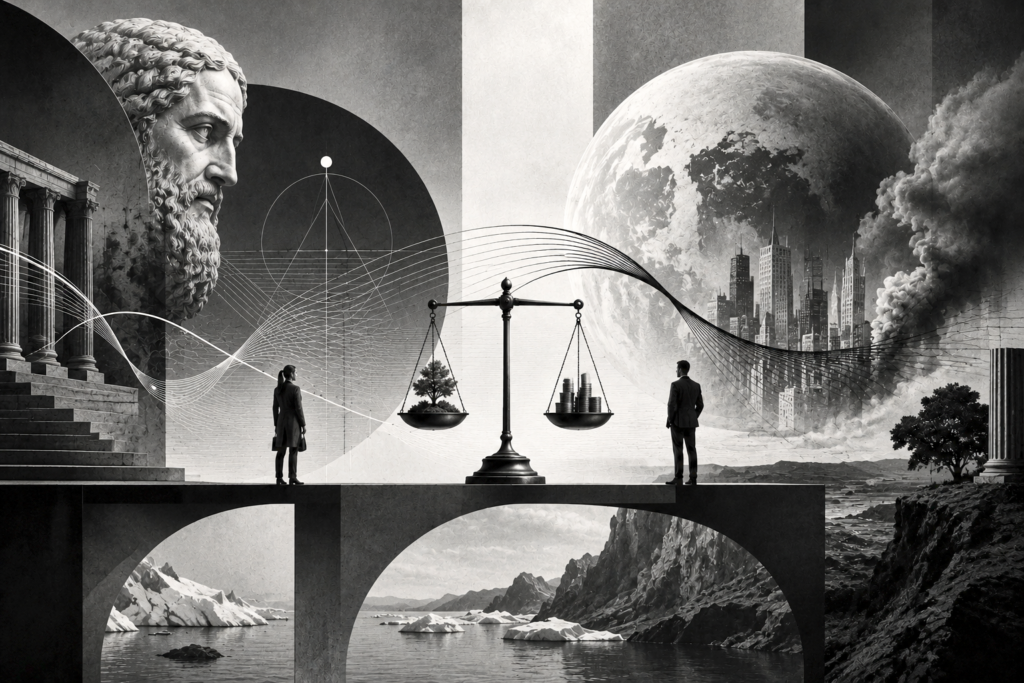
To answer this, we need a philosophical lens. Three concepts — Plato’s Idea, Aristotle’s Telos, and Ibn Arabi’s Ayn-ı Sabit — reveal the structural dynamics that keep the system trapped.
The Three Pillars of Structural Failure
Table 1: Philosophical Pillars of Climate Finance Dysfunction
| Philosophical Concept | Core Idea | Application to Climate Finance | Structural Outcome |
| Plato’s Idea / Cave | Shadows mistaken for reality | Complex financial structures obscure accountability | Complexity as liability shield |
| Aristotle’s Telos | Every entity has a natural purpose | Finance serves political announcements, not climate delivery | Eudaimonic drift (purpose deviation) |
| Ibn Arabi’s Ayn-ı Sabit | Fixed essence veiled by nafs (ego/self-interest) | Intermediary ecosystem preserves its own existence | Gap as a business model |
Pillar One: Plato’s Cave — Complexity as a Shield
A typical blended finance deal involves an MDB first-loss tranche, a bilateral guarantee, a currency hedge, a Special Purpose Vehicle, and a results-based payment mechanism. Nobody — not recipient governments, not investors, not NGOs — can explain why a specific deal succeeded or failed. This is not a flaw. It is the design.
When the South Africa JETP stalled, no single actor was responsible. Complexity made accountability structurally impossible. When you cannot explain failure, you cannot be held responsible for it.
Pillar Two: Aristotle’s Telos — The Drift from Purpose
Aristotle argued every entity has a telos — a natural end. Climate finance’s telos should be moving capital to vulnerable regions. Instead, it serves another purpose: producing political announcements.
The $300 billion headline at COP29 served its function the moment it was announced. Six months later, “what counts as mobilised?” remains unresolved. For a finance minister in Berlin or Washington, the announcement is the policy. Disbursement mechanics are a technical afterthought. This is not cynicism — it is political economy.
Pillar Three: Ibn Arabi’s Ayn-ı Sabit — The Veil of Self-Interest
Ibn Arabi’s Ayn-ı Sabit is the fixed essence of a thing. Climate finance’s fixed essence is justice: fair distribution of climate burdens and resources. But the nafs (self-interest) veils it.
Every bespoke deal generates transaction costs — legal fees, advisory fees, structuring fees — flowing to a Northern-hemisphere intermediary ecosystem. The Convergence data showing stagnation around $15 billion looks like failure. For intermediaries, it is a stable, recurring business. Standardisation — the most recommended reform — would collapse these fees. Resistance to standardisation appears as technical disagreement. Behind it lies material interest.
What This Means for COP31
When Antalya convenes in November, these three dynamics will operate simultaneously:
- Plato’s cave will protect those who don’t deliver. The final text will be technically dense and deliberately ambiguous.
- Aristotle’s drift will substitute announcements for delivery. Definitional questions will be deferred to working groups.
- Ibn Arabi’s nafs will shape outcomes toward structures that keep intermediaries indispensable.
None of this means individuals are bad-faith actors. Many are genuinely committed. But systems have logics that transcend individual intentions.
The Question Worth Asking
The right question for COP31 is not how do we fix the plumbing? That is real and needs solutions.
The harder question is: who benefits from the plumbing staying broken?
Naming this clearly — not as conspiracy but as political economy — is the precondition for change. Because a system this consistent in its failures, over this many years, is not failing by accident.
It is performing exactly as the incentives it was built around would predict.
Until we name those incentives, every COP will produce the same result: a number large enough to absorb pressure, a text complex enough to escape accountability, and a gap profitable enough to persist.