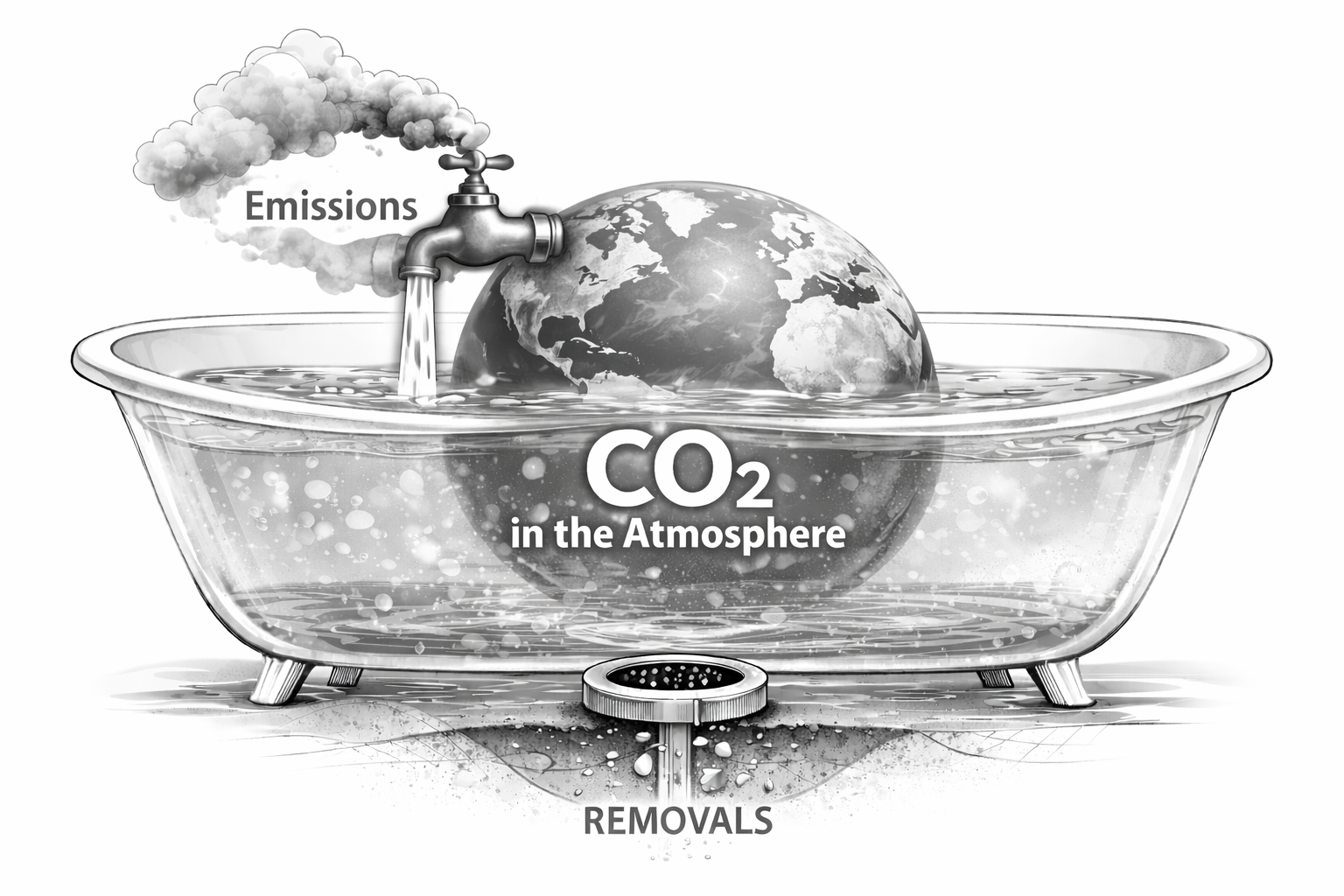
Removing carbon dioxide from the atmosphere is only the first half of carbon removal. The second half is storage. A tonne of CO₂ can be removed today and stored in a forest, soil, biochar, geological formation, mineral, product, or ocean reservoir. Each can create climate value, yet the length of time that carbon remains outside the atmosphere can differ by orders of magnitude.
This is why durability is becoming one of the defining characteristics of high-quality carbon dioxide removal. The 2026 State of Carbon Dioxide Removal report estimates that around 2.2 billion tonnes of CO₂ are currently removed each year, equivalent to around 5% of gross global CO₂ emissions. Conventional, predominantly land-based CDR still accounts for 99.9% of this total. Novel CDR currently removes around 2 million tonnes of CO₂ per year, but is growing rapidly at approximately 40% annually. The same report finds that around 8.8 GtCO₂/yr to stay within 1.5°C target may need to be removed by mid-century and 14–20+ GtCO₂/yr by 2100, to meet Paris Agreement climate targets and address potential temperature overshoot The report highlights a necessary transition where novel CDR rises from less than 0.1% currently to 45% of the mix ~4.0 GtCO₂/yr by 2050 before dominating the 2100 portfolio with 11 to 16 GtCO₂/yr, with conventional CDR peaking at roughly 4.8 GtCO₂/yr mid-century.
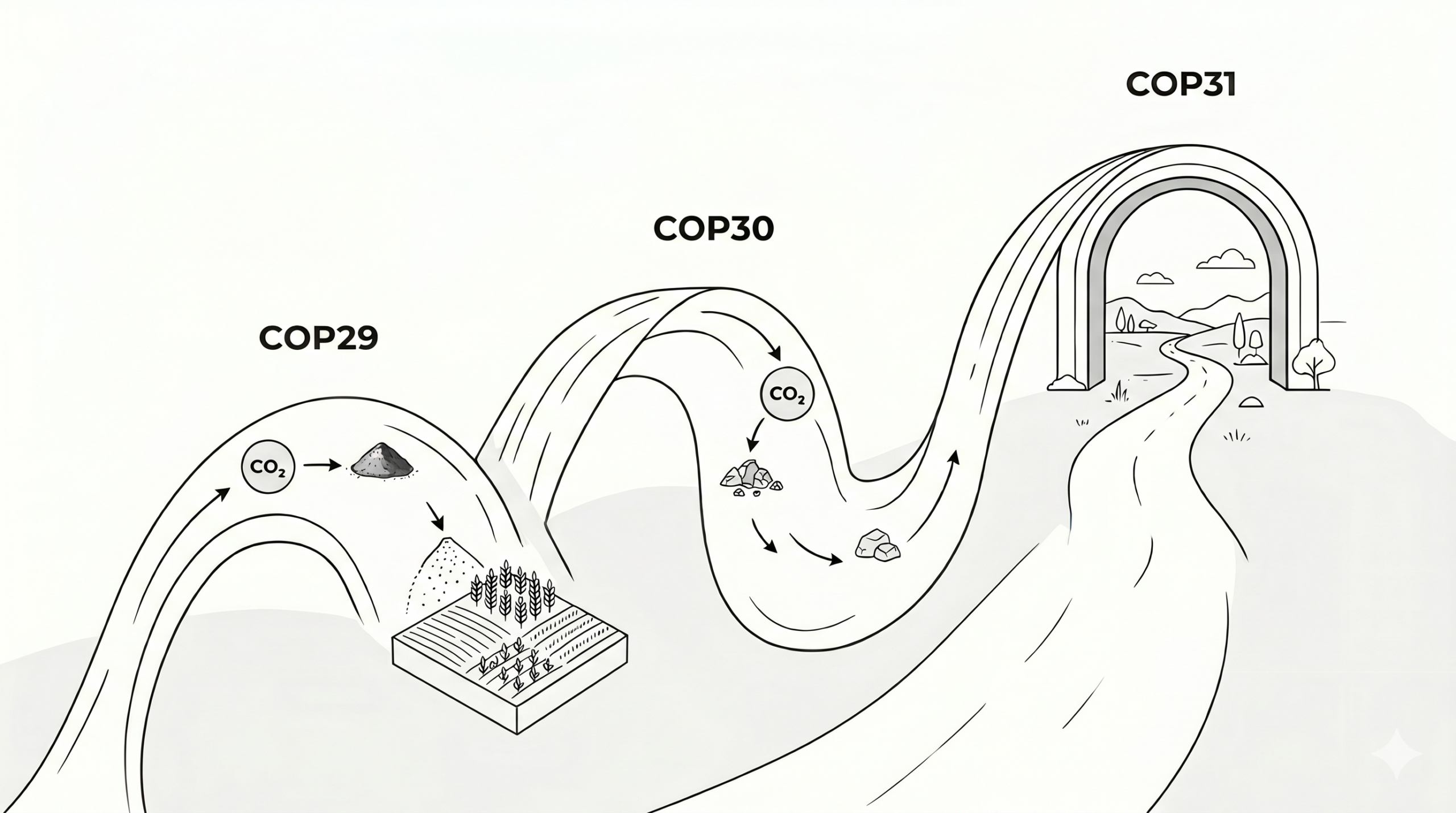
Against this longer-term need, CDR2030 provides a much nearer implementation benchmark. The initiative sets a 2030 target of 100 Mt of novel CDR capacity and 3 Gt of conventional CDR, intended as a shared marker for whether the sector is progressing toward meaningful scale. Reaching that level by the end of this decade would be particularly important for durable CDR, as the infrastructure, markets, policy frameworks, and deployment experience needed for much larger volumes cannot be built overnight.
What do we actually mean by “durable”?
There is no single globally accepted number of years that separates durable from non-durable CDR. Standards currently use different thresholds, which is why it is more useful to think of durability as a spectrum rather than a universal cut-off.
Puro.earth requires supported methodologies to store carbon for at least 100 years, with current pathways spanning 100+ to 1,000+ years. Its current biochar methodology uses a 200+ year durability label, while geologically stored carbon, enhanced rock weathering and carbonated materials are labelled at 1,000+ years. The revised Oxford Principles describe high-durability storage as storage with low reversal risk over centuries to millennia.
Isometric uses a protocol-specific approach to durability. Under the current Isometric Standard, protocols and modules may define one or more Durability Thresholds, and where no threshold is specified the default is 1,000 years. Its biochar framework offers both 200-year and 1,000-year durability options, while its Direct Ocean Capture and Storage protocol requires CO₂ removed from seawater to be placed in a high-durability storage reservoir of more than 1,000 years. These examples show why “durable” is best understood as a spectrum supported by pathway-specific evidence rather than a single universal label.
For this article, a useful practical distinction is that 100+ years can be treated as an entry point into durable storage, while 1,000+ years represents a much stronger benchmark for high-durability CDR when the objective is to address fossil origin CO₂ in the atmosphere. These are market and standard-setting conventions rather than a universal scientific boundary.
Different removals operate on very different timescales
Durability depends on the reservoir, project design, measurement approach, and reversal risk. The figures below are therefore indicative examples drawn from current standards rather than universal values for every project.
| CDR pathway / reservoir | Illustrative durability in current standards |
| Terrestrial storage of biomass | 100+ years |
| Biochar | 200+ years; some protocols offer a 1,000-year crediting option |
| Enhanced rock weathering | 1,000+ years |
| DACCS / BECCS with geological storage | 1,000+ years |
| Carbonated materials / mineralization | 1,000+ years |
Sources: Puro.earth durability categories | Isometric biochar 200-year and 1,000-year options
Nature-based storage needs a different kind of interpretation. The revised Oxford Principles state that well-managed, resilient ecosystems can store carbon for centuries to millennia, provided they continue to be maintained and are not destabilized by future climate change. Biological reservoirs remain dynamic, so fire, drought, disease, harvesting, land-use change, and changing management can increase reversal risk. Durability therefore captures both time and the confidence that the storage will persist.
Why should storage duration match the emission?
Fossil fuels move carbon that was isolated in geological reservoirs into the active carbon cycle. When CDR is used to neutralize residual fossil emissions, the storage timescale becomes central to the integrity of that claim. Short-duration storage can create valuable near-term climate benefit, but a later reversal means that the same carbon liability re-enters the atmosphere.
The Oxford Principles therefore recommend a progressive shift toward removals with low reversal risk and storage lasting centuries to millennia as organizations approach net zero. This is the logic behind the like-for-like principle: long-lived emissions are best matched with storage capable of persisting on similarly long timescales.
Intergenerational Equity: who inherits the carbon liability?
Durability also has an ethical dimension. Article 3 of the UN Framework Convention on Climate Change states that Parties should protect the climate system for the benefit of present and future generations on the basis of equity. The Paris Agreement also explicitly refers to intergenerational equity in its preamble.
Applied to CDR, the principle raises a simple question. If a tonne of fossil CO₂ emitted today is balanced with storage expected to last 100 years, and that storage reverses in the next century, future generations inherit the responsibility for maintaining the store, replacing the removal, or dealing with the carbon again. The intervention may have bought valuable time, but the liability has also been carried forward.
A removal designed to last thousands of years creates a fundamentally different outcome. The probability that future generations will need to manage the same tonne again becomes much lower. Durability can therefore be understood as a way of reducing the transfer of climate liabilities between generations. It turns CDR into a question of responsibility across time, as well as a question of tonnes.
Nature-based solutions remain essential
A focus on durable CDR should never be read as an argument for underinvesting in nature. Forests, wetlands, soils, peatlands, mangroves, and other ecosystems are indispensable to climate action. They protect existing carbon stocks and can provide biodiversity, adaptation, water, resilience, livelihood, and ecosystem benefits that engineered CDR cannot replicate.
The revised Oxford Principles explicitly support continued investment in high-integrity nature-based removals while durable, lower-reversal-risk approaches scale. The climate challenge requires deep emissions reductions, protection and expansion of natural carbon sinks, and rapid development of durable removals. These solutions serve complementary functions.
A permanent problem deserves a durable response
As CDR markets mature, tonnes will increasingly be evaluated by more than quantity. Buyers, policymakers, standards, and companies will need to ask where the carbon is stored, how likely reversal is, who carries liability if it returns, and how long the storage is expected to last.
A tonne stored for 100 years and a tonne stored for 1,000 years can both create climate value, but they provide different climate services. For residual fossil emissions, high durability is what allows carbon removal to address the problem on a comparable timescale. Removing carbon today matters. Keeping it out of the atmosphere long enough that future generations do not have to solve the same problem again is what makes the solution durable in the fullest sense.
Note: Hyperlinked source names and key terms connect directly to the underlying source or standard. Durability values are pathway- and methodology-specific and should not be treated as universal guarantees for every project.