

Climate finance discussions are often dominated by volume. More commitments. Larger funds. Bigger announcements. Yet a critical contradiction remains largely unaddressed: what if the primary bottleneck is no longer how much capital exists, but how slowly institutions move it?
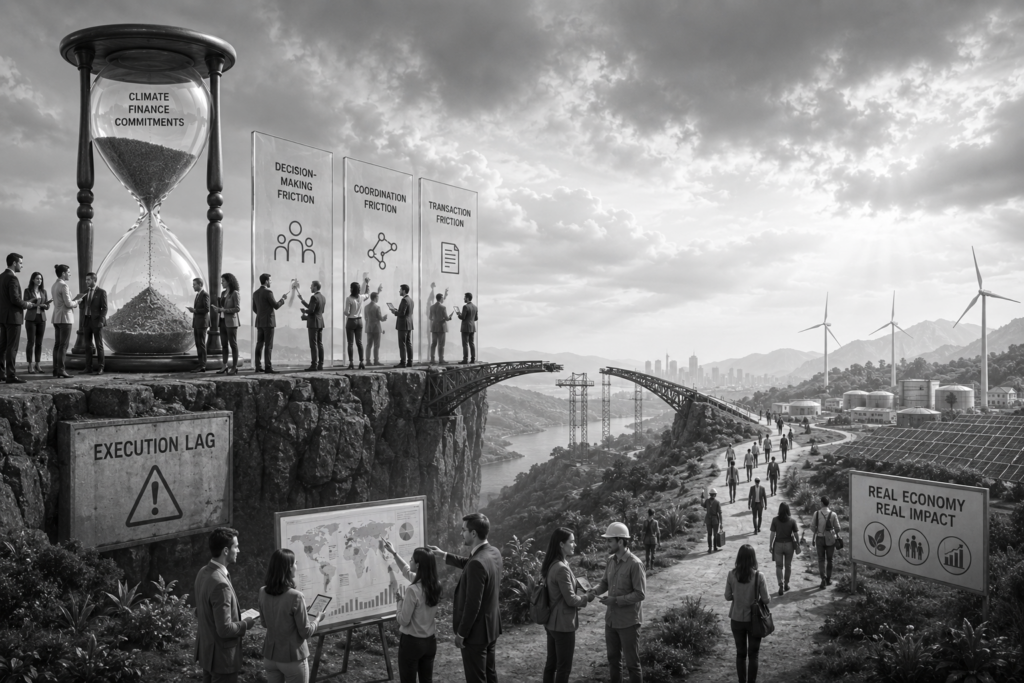
Over the past decade, climate finance commitments have scaled significantly, moving on paper from billions to trillions. In practice, however, a persistent gap remains between capital that is announced and capital that reaches the real economy. The result is a growing disconnect between financial ambition and financial delivery. We are not just facing a capital gap; we are facing an execution lag.
The Mechanics of Institutional Delay
This friction is not primarily caused by a lack of liquidity. It is driven by three structural bottlenecks within the deployment process.
Decision-Making Friction: Before capital can be disbursed, projects often pass through multiple layers of governance, risk assessment, policy review, and approval. While each layer may be justified individually, the cumulative effect can significantly slow deployment.
Coordination Friction: Climate finance frequently requires alignment between donors, development banks, governments, technical experts, private investors, and local implementers. As the number of actors increases, coordination becomes slower and more complex.
Transaction Friction: Despite the repetitive nature of many transition assets—renewable energy projects, industrial retrofits, or landscape restoration initiatives, transactions are often structured individually. New due diligence processes, negotiations, and contractual arrangements are repeatedly recreated, limiting the speed at which capital can move.
The Hidden Cost of Slow Capital
In transition finance, timing is not an operational detail; it is part of the outcome itself. Capital that arrives three years from now is not financially equivalent to capital available today. During periods of delay, project economics can deteriorate. Equipment costs change, currencies fluctuate, political priorities shift, and commercial opportunities disappear. In many cases, delayed capital functions much like unavailable capital.
According to the Independent High-Level Expert Group on Climate Finance, emerging markets and developing economies will require approximately $2.4 trillion annually by 2030 to meet climate and development objectives. Yet mobilizing larger volumes alone will not solve the problem if deployment mechanisms remain slow and fragmented.
Beyond Volume
For years, climate finance discussions have focused on how much capital needs to be raised. Increasingly, the more important question may be how quickly capital can move. A financing system that deploys capital slowly can struggle to deliver outcomes even when resources are available. Volume remains important, but deployment velocity may ultimately become the more decisive metric. The distance between announcement and arrival matters. Climate finance often measures success at the moment commitments are made. The real economy experiences success only when capital is deployed.
We have largely optimized our system for mobilization, disclosure, and commitment-making. Far less attention has been given to the speed and efficiency of deployment. If transition finance is to scale, standardization, repeatability, and execution capacity must become as important as fundraising itself.
The transition will not be determined solely by how much capital is available. It will also be determined by how quickly that capital reaches the sectors, projects, and communities expected to deliver it. The transition will not be won or lost when capital is announced. It will be won or lost when capital arrives.