In the part 3 of this article series, I examined strategic, technical, and financial things that need to be thought about in order to get finance to make our green hydrogen production project investment take place in Türkiye. It is highlighted that the importance of using both international and local funding sources blended with more effective and beneficial financial start-up smoothly maintain the lesser CAPEX (investment) and OPEX (operational) cost with better ROI advantageous.
Contents (part 3)
4. Objectives and Methodology, and Project Maturity Levels (PMLs)
5. Project Scale and Technical Capacity
5.1 H2 Production: Water Treatment and PEM Electrolysis, 5.2 H2 Production Process: Compression to Green Ammonia
6. Funding Sources and Investors
6.1 Current funding sources,
7. Shareholders, Funding Sources, Stakeholder Contributions and Roles
7.1 Capital Efficiency Strategy
7.2 Investment Overview
Keywords: Green Hydrogen, Renewable Energy, Sustainability, Project Management, Community-based
4. Objectives and Methodology, and Project Maturity Levels (PMLs)
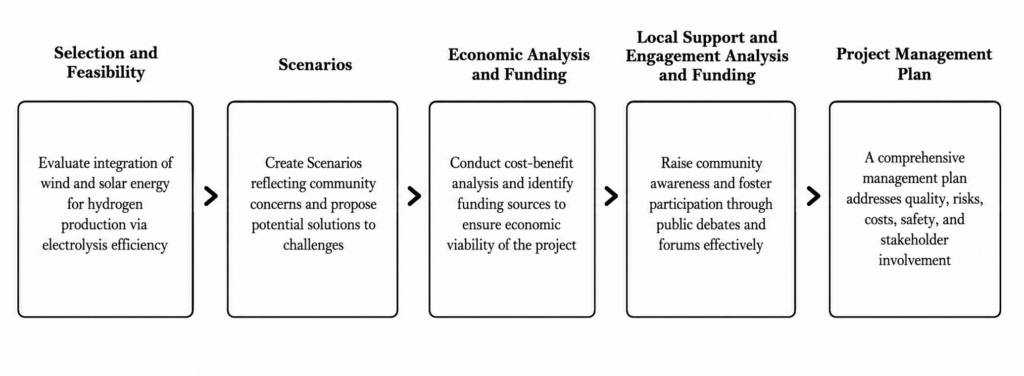
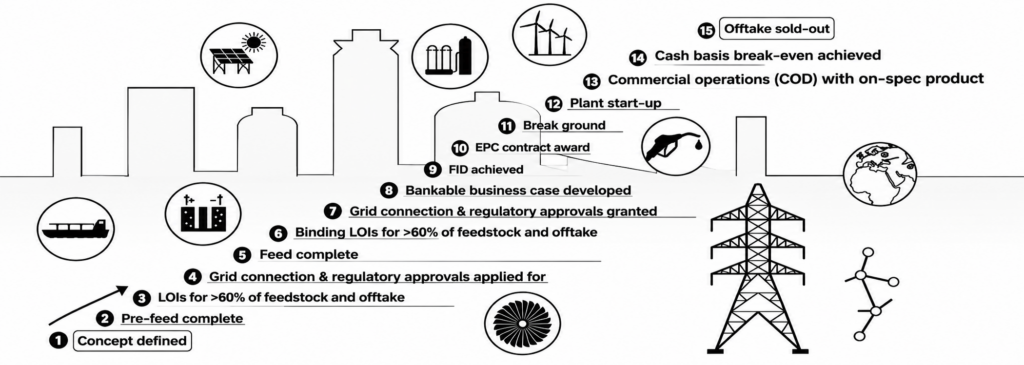
Figure 1. Project Maturity Levels (PMLs) for Sustainable Infrastructure Project Development
5. Project Scale and Technical Capacity
The selected capacity, as a case study, is 120 MW PEM electrolyzer that gets its power from solar and/or wind depending on selection of the efficient energy supply. Based on the above the technical capacities are provided below:
Solar/Wind Power –> BESS Storage –> PEM Electrolysis –> Compression –> Green NH3
Solar PV / Wind Power: 310 MW, the capacity is taken considering the 100% solar power to provide 120 MW continuous power supply to the electrolyzers and remaining power consumption depending on the efficiency and selection of the solar/wind power combination. This is the part of the green hydrogen production facility without any service agreement with any renewable power suppliers. We will see this exercise in the following chapters.
BESS: 60 MW (240 MWh), battery requirement is given only as initial estimation. It can vary or be eliminated depending on the reliable renewable power supply contracts, if it is feasible.
Electrolyzers: 120 MW PEM (24 x 5 MW Stacks), electrolyzer type and capacity can vary depending on the final selection criteria)
Annual H2 Production: 14,100 t/yr (considered 75% of H2 production)
Annual Green NH3: 19,916 t/yr (considered the NH3 is produced by using the 25% of H2 production)
Water Feed: 126,900 m³/yr (for water treatment from the sea water)
CO2 to be Avoided Annually: 141,599 t/yr (105,750 t from Green Hydrogen + 35,849 t/y from Green Ammonia)
Output estimates based on 310 MW solar paired with 60 MW BESS smoothing (initial estimation). CO2 calculation versus conventional grey hydrogen.
Estimation of the CAPEX, OPEX, Green Hydrogen / Ammonia Production (tons/year), ROI and IRR will be shared in the next series of this article. A station is considered for making green ammonia, and additionally refueling hydrogen is optional.
5.1 H2 Production: Water Treatment and PEM Electrolysis
Step 1: Water Treatment
Water Demand 14.5 m3/h, Conductivity less than 0.1 uS/cm
Step 2: PEM Electrolysis
Electrolyzer Load: 120 MW, H2 Output at 70% CF: 1,610 kg/h (14,100 t/yr H2), Efficiency: 65–75%, Load Flexibility: 10–100%, Stack Life: 80k hrs
Step 3: Separation and Purification
Purity: 99.99% H₂
Step 4: Compression and Storage
Multi-stage compression from 15 to 200+ bar for buffer storage and NH₃
5.2 H2 Production Process – Compression to Green Ammonia
H2 Compression –> Buffer Storage –> N2 ASU Air Separation –> Haber-Bosch Reactor (Final Stage)
6. Funding Sources And Investors
Türkiye is quickly adopting the global green hydrogen economy via strategic innovation, infrastructure and global partnerships. With the world moving towards net-zero emissions, Türkiye’s growing hydrogen ecosystem provides a unique opportunity for global entrepreneurs and investors to carve out a niche in the renewable energy market.
The Hydrogen Technology Strategy and Roadmap Turkiye targets an electrolyzer capacity of 2 gigawatts (GW) in 2030, 5 GW in 2035 and 70 GW in 2053. These targets will reduce the cost of green hydrogen production on a daily basis and it is expected to be USD 2.4/kg around 2035 and under USD 1.2 in 2053. This approach is consistent with Turkiye’s long-term vision for carbon neutrality and will lead to the establishment of a low-emission industrial base.
6.1 Current funding sources
The strategy identifies a mix of funding sources:
- EU support mechanisms: Including Horizon Europe, the Innovation Fund, and the Modernization Fund.
- National funds: State investments in R&D, pilot projects, and hydrogen infrastructure.
- Private sector: Partnerships with industrial players to support commercialization.
- International collaboration: To attract foreign investments and technology transfers.
The European Union has announced at least one pilot initiative with some money for technical support projects to accelerate Türkiye’s entry into the green and low-carbon hydrogen economy, in partnership with state energy corporation BOTAS (Turkish Petroleum Pipeline Corporation). The program, named “Boosting Green and Low-Carbon Hydrogen in Türkiye” was announced on June 19 and would seek to improve institutional capacities and grow expertise across the sector throughout the country.
The project, funded via the Instrument for Pre-Accession Assistance (IPA), has three primary deliverables:
• Technical assessment of the hydrogen readiness of BOTAS’ infrastructure.
• A National Hydrogen Master Network Plan
• A large-scale stakeholder capacity building campaign
The European Hydrogen Bank is one of the potential sources of funding to our project because their main goal is to make investments safe and create business opportunities for renewable hydrogen production in Europe (as Turkiye can be considered a part of the funding program). The European Hydrogen Bank gave €992 million to 15 projects in the second domestic auction for the production of renewable hydrogen through the Innovation Fund. The grants ranged from €8 million to €246 million.
There are a number of European funding programs that can help, build and use green hydrogen infrastructure including the World Bank Green Energy Transformation Funds. Here is a list of some important sources of funding summarized, as follows;
6.1.1 International Funding Sources and Investors;
a. World Bank Green Energy Transformation Funds, some examples;
Eligibility: Developing Markets and Employability
b. UNIDO; Mapping of financial and technical assistance of clean hydrogen for developing countries (provides a guideline/technical assistance)
https://hydrogen.unido.org/sites/default/files/2024-05/MAPPING-digital-final.pdf
c. European Hydrogen Bank (through the Innovation Fund)
• Type: Grants (a set amount of money for each kilogram of H2).
• Area: All of the EU
• Goal: Closing the price gap between fossil and renewable hydrogen.
• Status: The second auction in 2025 gave out €992 million; the third auction is expected to happen in late 2025 with a budget of up to €1 billion.
Road Map;
• Monitor on the European Commission’s Innovation Fund portal for the third auction call, which should happen end of 2026.
• Prepare a full project proposal that covers technical details, the amount of hydrogen that will be produced, the structure of cost, and the effect on the environment.
• Sign up for the EU Funding & Tenders portal and fill out the application form when the announcement is done.
• Make sure to meet all the requirements, such as using renewable energy supply to the facility and fulfilling EU sustainability goals.
https://energy.ec.europa.eu/topics/eus-energy-system/hydrogen/european-hydrogen-bank_en
Eligibility: %100 Green Hydrogen, Renewable Energy Integration
d. H2 Global Foundation
• Type: Contracts for Difference (CfD).
• Scope: Exporters from all over the world to Germany.
• Focus: Long-term contracts for green hydrogen and its byproducts.
• Mechanism: The government buys at the market price and sells at a set price, which fills the gap.
https://gh2.org/countries/turkiye
Road Map;
• Keep in touch with the H2Global Secretariat to demonstrate the interest in investment and find out when the next auctions will be held.
• Set up a project which will meet EU export standards, particularly for derivates of hydrogen.
• Ensure the completion of all related procedures for long-term off-take contracts, such as delivery plans and pricing models.
• Work with a European buyer or agents to maintain stronger application.
e. Connecting Europe Facility (CEF) – Energy
• Type: Gifts.
• Scope: Infrastructure that crosses borders including green hydrogen facilities such as underground structure, terminals, pipelines and storage facilities.
•The budget for energy infrastructure from 2021 to 2027 is €8.7 billion achieved.
https://www.iea.org/policies/13398-connecting-europe-facility-energy
Eligibility: Outdoor border effect, infrastructural connection
f. Horizon Europe
• Type: R & D Incentives • Region: EU and nearby countries
• Focus: To emphasize making store and using hydrogen.
• Budget: € 5.6 billion for research purpose for the green energy investments.
https://energynews.biz/turkeys-first-biggest-local-green-hydrogen-plant-has-been-signed/,
https://www.sciencedirect.com/science/article/abs/pii/S036031992305975X
Eligibility: Research and Development Incentives, Consortium Structure, Academical Shares
g. European Bank for Reconstruction and Development (EBRD)
• Type: the green transition in Türkiye’s financial system and increase investments to meet Turkiye’s climate commitments
• Focus: Green Energy Investments
• Budget: € 500 million for the green energy investments.
https://ebrdgeff.com/tr/ebrd-and-green-climate-fund-to-continue-partnership/
Eligibity: Green Energy Investments
h. Private Investors (Energy Producers/Traders, Manufacturers, Finance Suppliers (Banks etc.), and other Investors)
Both international and local investors can involve in acquiring these parts of shares.
6.1.2 Local Funding Sources and Investors:
a. Turkiye Ministry of Energy and Natural Sources ; Green Transformation Support Program (YEKA Model, Clean Energy Fund, Tax Reductions)
Eligibility: Use of Domestic Equipment (including Solar and Wind Power as part of green hydrogen production), Employment impact
b. TUBITAK – TEYDEB; Green Hydrogen R&D Supports (1515 Pioneer R&D, 1501 Industrial R&D, 1509 International Partnership)
Eligibility: Hydrogen projects with a Technology Development and Innovation Component
c. Turkiye Ministry of Industry and Technology; Techno Investment, Strategic Investment, Regional Support
https://www.invest.gov.tr/en/InvestmentGuide/Pages/incentives-guide.aspx
Eligibility: Domestic Technology, Employment, Export Potential
d. Turkiye Ministry of Trade; Foreign Trade supports
https://stip.oecd.org/stip/interactive-dashboards/policy-initiatives/2023%2Fdata%2FpolicyInitiatives%2F99996944
Eligibility: Green hydrogen / green ammonia export support (per ton) – OPEX cost reduction
e. Municipality (Choose one of the Candidate Municipalities, such as Aliağa or Bandırma Municipality);
To offer gratuitous land, infrastructural assistance, and enable authorization to attain shareholder status and acquire a specified percentage of project shares. This constitutes a component of the value-based shareholder strategy aimed at lowering capital expenditure (CAPEX) investment expenses, which may be regarded as an indirect financing source. This initiative is also a component of the Municipality’s community engagement approach, aimed at generating sustainable revenue from the sales of green hydrogen and green ammonia. This will develop urban growth and enhance community life while generating employment possibilities for local residents through municipal engagement.
f. Private Investor Shares (Energy Producers, Energy Traders, Manufacturers, Financial Institutions (Banks, etc.), and other Private Investors); Both international and domestic investors can participate in acquiring these shares.
g. Community Shares; This initiative aims to engage the community in investing in green hydrogen generation and obtaining a percentage of shares. The allocation of shares will be determined following the engagement of foreign and local funding sources prior to the finalization of the financial package.
These actions should coincide with technical and financial evaluation to ensure preparedness when the funding opportunity arises. A professional consultant with experience in green energy projects and an established network will be engaged to advise the steering committee of this investment structure (details regarding the structure and responsibilities of the steering committee will be provided in subsequent chapters of this article series) and to navigate the complexities of these institutions, especially national authorities.
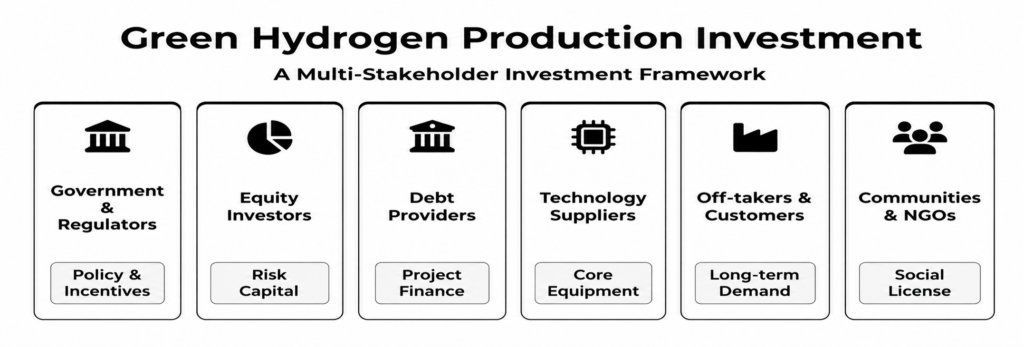
7. Shareholders, Funding Sources, Stakeholder Contributions and Roles :
A. Equipment Partners (OEMs): Equipment Supply, Technology Transfer, O&M Support, and Equipment Discount
B. Local Government and Municipality: Land & Permits, Infrastructure and Policy Support, Tax-Free Green Energy Goals, Non-dilutive Capital, and Supports for Offtake Agreements
C. Private Investors (International and/or Local Investors): Cash Capital Injection, Risk Sharing, Governance Oversight, Strategic Advisory, and Market Connections
D. Project Investment Developer: Project Origination, Strategic Coordination and Development, Permits and Licensing, Financial Structuring, Shareholder Model with Know-How Transfer, Government Relations, Funding Maximization, Project Management, and Risk Management
E. Public Shares (IPO) or increase shares of others against investment funds : Optional, Future liquidity (back-up plan depending on A to D financial settlement )
F. Credit Suppliers or increase shares of others against investment funds : Optional, Vendor financing (back-up plan depending on A to D financial settlement )
7.1 Capital Efficiency Strategy:
Minimizes cash CAPEX through Equipment Partner discounts, Government grants (non-dilutive), Private Investors (cash basis equity involvement), and Project Investment Developer (involvement with value-based equity). Developer focuses on project origination, strategic coordination & optimal funding structure.
7.2 Investment Overview
Gross Project CAPEX: €270.9M (Total Capital Requirement
(It is notde that this is a rough estimation according to EPRI and respective International standards’ cost estimations, accordingly the cost estimation references will be provided in the next series of this article)
Net Investment (After Non dilutive Funding and Incentives): €181.5M (Private + Equipment + Strategic Capital)
Multi-Stakeholder Approach;
🔧 Equipment for Equity: OEMs reduce cash CAPEX
🏛 Government De-Risking: Sovereign backing attracts private capital
🤝 Strategic Partners: Offtake commitments ensure bankability
📈 Financial Flexibility: IPO optionality for future liquidity
Flexible Funding Structure: Ranges accommodate different investor types, market conditions, and negotiation outcomes while maintaining strategic alignment and financial viability.
To be continued…