


In the second article (part 2) of this series, it examines the Investors, Funding, Strategical and Technical Assistance. Identifying investors is crucial for funding the green hydrogen facility in the selected location. This study qualifies for various investors and funding sources elaborated in the following sections, supported by Türkiye’s or any other concerned country’s Ministry of Energy including to serve the financial support in granting and funding some % of investment costs. Additionally, it will make more feasible reducing the payback ratio by funding the some % of the production cost of per kg of green hydrogen, for the country’s de-carbonization policy and the sustainable renewable energy goals.
Contents
3. Selection of the Green Hydrogen Production Location and Criterias for the Investors, Funding, Strategical and Technical Assistance
3.1 Why is Türkiye Considered for the Green Hydrogen Investment? 3.2 Evaluating Optimal Locations for Green Hydrogen Production in Türkiye: A Weighted Analysis, 3.3 Weight Percentage Allocation and City Evaluation
Keywords: Green Hydrogen, Renewable Energy, Sustainability, Project Management, Community-based
3. SELECTION OF THE GREEN HYDROGEN PRODUCTION LOCATION AND CRITERIAS FOR THE INVESTORS, FUNDING, STRATEGICAL AND TECHNICAL ASSISTANCE
This community-based approach aims to enhance local economies and sustainable practices while qualifying for carbon credits and generating revenue through carbon trading. By leveraging these options, the project can ensure financial viability and long-term sustainability.
These diverse financial sources will take place for the development of the green hydrogen plant while promoting sustainability, and optional but preferable community involvement. Additionally, international and Türkiye’s research institutes and renewable and green hydrogen associations like International Renewable Energy Agency (IRENA)’s technical and The Green Hydrogen Producers Association (H2DER)’s coordination supports are valuable to involve jointly to enhance hydrogen technology and storage solutions. Agencies such as the EERA – European Energy Research Alliance, provide regulatory guidance, streamline permitting processes, and champion the development of regional hydrogen strategies (1). Their expertise and regional focus are invaluable for tailoring policies and initiatives to specific local contexts.
The success of any green hydrogen project, and indeed the broader green hydrogen economy, is intrinsically linked to the effective management of stakeholder relationships. From securing investment and navigating regulatory hurdles to ensuring reliable supply chains and stimulating end-user demand, collaboration is key. By proactively engaging with each stakeholder group, understanding their needs and concerns, and fostering strong partnerships, Türkiye can unlock the full potential of green hydrogen and pave the way for a sustainable energy future.
3.1. Why is Türkiye Considered for the Green Hydrogen Investment?
Türkiye’s green energy production is at the planning and very beginning stages of a journey towards becoming greener: moving from a fossil fuel based and highly energy-consuming system towards one that is more efficient, consumer-focused and powered by renewable energy. The international law to limit global warming to below 2°C following the Paris Agreement puts a renewed emphasis on the need for Türkiye to accelerate the renewable green energy transition. For the Türkiye’s energy policy to effectively contribute to the global climate target, the built environment must undergo a deep transformation and become both green and efficient.
Green Hydrogen can play a leading role in transforming the Türkiye’s energy market, by transforming it into a more renewable based, interconnected and variable system that maximizes efficiency and ensures that all resources are used in an optimal way, while at the same time enabling a better living and working environment for the occupants.
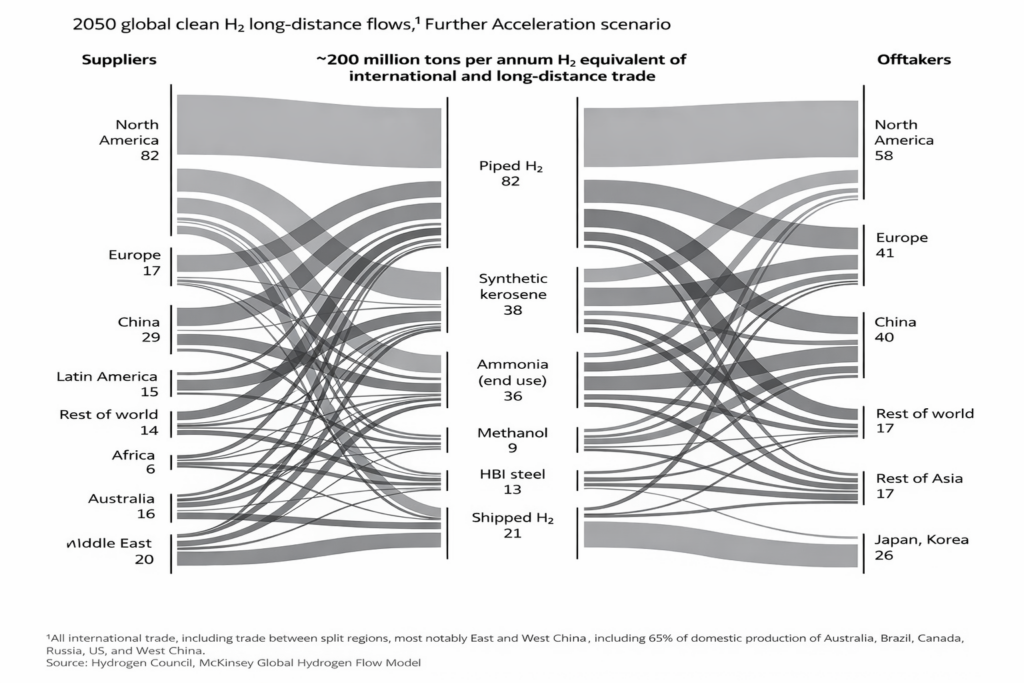
Figure 1: 2050 global clean H₂ long-distance flows,¹ Further Acceleration scenario (2)
Based on 2050 global clean H₂ long-distance flows,¹ Further Acceleration scenario data; left-hand side indicates exporters; right-hand side indicates importing markets. Figure 1 from the Hydrogen Council, McKinsey Global Hydrogen Flow Model “Global Hydrogen Flows – 2023 Update” (2) shows that there is no record of significant amounts of green hydrogen and its derivatives for Türkiye being exported. This makes it clear that Türkiye can invest in green hydrogen projects to make its own hydrogen in this market, which will be good for the country’s economy and green energy transformation.
3.2. Evaluating Optimal Locations for Green Hydrogen Production in Turkiye: A Weighted Analysis
The transition towards a sustainable energy future necessitates the exploration and implementation of alternative energy carriers, with green hydrogen emerging as a promising solution. The strategic placement of green hydrogen production facilities is paramount to achieving both economic viability and environmental responsibility. This study presents a comparative analysis of five locations Aliaga, Bandirma, Yalova, Antalya, and Eregli utilizing a weighted scoring system based on key selection criteria. This methodology aims to provide a structured assessment of their relative attractiveness as potential locations for green hydrogen production.
The selection of optimal sites for such facilities requires a holistic perspective, incorporating factors such as existing infrastructure, the availability of renewable energy resources, the prevailing regulatory landscape, and the proximity to potential markets. The weighted scoring system presented herein offers a framework for objective evaluation; however, it is crucial to acknowledge the inherent subjectivity involved in assigning quantitative values to qualitative aspects. Factors such as “public acceptance” and “municipal support” are inherently dynamic and influenced by evolving public opinion and policy decisions. Therefore, the assessments provided represent a snapshot in time, based on currently estimated data and perceived trends, and are subject to change.
3.3. Weight Percentage Allocation and City Evaluation
In their foundational work, EU’s, local Turkish Policies and Cluster Developments of Hydrogen Communities emphasize the importance of economic viability and environmental responsibility in the strategic placement of hydrogen facilities. Their comparative analysis identifies Aliaga as the most favorable location, followed by Bandirma, Yalova, Antalya, and Eregli, reinforcing the significance of location in optimizing green hydrogen production. This assessment is echoed in a subsequent article by R. Bleischwitz, N. Bader, P. Dannemand, and A. Nygaard (3), which reiterates the critical role of strategic site selection in fostering hydrogen communities across Europe, thereby providing a framework for further studies for Türkiye on this topic.
D. O. L. C. I. Francesco (4) expands the discussion by linking the strategic placement of green hydrogen facilities to the decarbonization of industrial processes. The article highlights the initiatives undertaken by major corporations, such as BP in Rotterdam, to integrate green hydrogen into oil refining and fuel production that can be example for Türkiye. This connection underscores the potential economic benefits of adopting green hydrogen, while also addressing the pressing need to reduce greenhouse gas emissions associated with traditional fuel production methods.
F. Stockl, W. P. Schill, and A. Zerrahn (5) delve into the optimal supply chains and power sector benefits associated with green hydrogen, reinforcing the notion that strategic site selection is vital for ensuring economic viability. Their analysis supports the rankings derived from earlier studies, emphasizing that the integration of green hydrogen into existing energy systems can yield significant advantages.
T. Veenstra, A. H. Schrotenboer, M. A. J. Uit het Broek, and E. Ursavas (6) contribute to the conversation by examining optimal control strategies for integrated hydrogen storage and power generation, further supporting the identified rankings. Their work highlights the importance of innovative strategies in enhancing the efficiency and effectiveness of hydrogen production processes.
Finally, S. Kigle, T. Schmidt-Achert, and M. Ángel Martínez Pérez (7) and S. Farah, N. Bokde, and G. Bruun Andresen (8) provide contemporary insights into the cost and emissions associated with hydrogen production. The former authors focus on country-specific investment risks while emphasizing the need for a structured assessment of potential production sites, and the latter introduce a novel long-term planner for hydrogen production, emphasizing the balance between cost minimization and environmental impact, which is crucial for the sustainable development of hydrogen production facilities, that can be adapted to Türkiye’s green hydrogen production facilities.
Together, these articles construct a robust framework for understanding the optimal locations for green hydrogen production in Europe that can be adapted to Türkiye, with a clear consensus on the rankings of Aliaga, Bandirma, Yalova, Antalya, and Eregli, as well as the underlying factors influencing these assessments.
The methodology employed relies on assigning specific weights to each selection criterion, reflecting their relative importance in the overall assessment. Subsequently, each city is scored against these criteria, allowing for a quantifiable comparison. The following system assumes a “Below Average” rating corresponds to 40%. High, Medium, and Low weighting are represented by multipliers of 3, 2, and 1, respectively. This facilitates the calculation of a composite weighted score for each town/city.
Table 1: The percentage scores across the defined criteria and weighted scores (The scores in this table are given estimated basis as indicative, and it can be improved with real site survey with more detailed analysis. Therefore, this table shows the methodology of selection of correct location. Based on the above, other factors can be added or some factors can be eliminated and % of scores can be adjusted):
| Factor | Aliaga | Bandirma | Yalova | Antalya | Eregli | Weighting |
| Transportation Infrastructure | 90% | 70% | 60% | 65% | 75% | High |
| Municipal Support | 90% | 80% | 50% | 70% | 60% | High |
| Public Acceptance | 80% | 70% | 60% | 80% | 70% | Medium |
| Industrial Customer Proximity | 95% | 80% | 65% | 60% | 80% | High |
| Residential Heating Potential | N/A | N/A | N/A | N/A | N/A | N/A |
| Financial Accessibility | 85% | 85% | 75% | 85% | 80% | High |
| Consultant/Supplier Access | 90% | 85% | 65% | 65% | 80% | Medium |
| Renewable Energy Source Availability | 80% | 90% | 75% | 90% | 65% | High |
| Water Availability (sea water to be used) | 85% | 85% | 85% | 85% | 85% | Medium |
| Land / Permitting | 80% | 80% | 85% | 75% | 85% | High |
| Weighted Score (%) | 86.3 | 80.6 | 68.8 | 74.8 | 75.2 | – |
- Weighted scores are calculated for each candidate city using the formula:
- Weighted Score = (Σ (Factor Score * Factor Weighting)) / (Σ Factor Weighting)
Where:
- Factor Score: The percentage score assigned to a city for a specific factor.
- Factor Weighting: The weight assigned to the factor (3 for High, 2 for Medium, 1 for Low).
Ultimately, integrating this sustainability focused metrics shifts the competitive landscape elevating cities well-endowed with renewable resources. This exercise demonstrates the dynamic and evolving nature of optimal site selection as climate ambitions sharpen and the realities of project development become better understood. As highlighted above, transportation infrastructure, municipal support, public acceptance, industrial customer proximity, financial accessibility, renewable energy resources, water availability and land/permitting all play crucial roles in determining the viability and success of potential green hydrogen hubs.
3.3.1 Transportation Infrastructure: A Foundation for Distribution
Efficient transport is vital for distributing green hydrogen effectively. Aliaga’s port supports shipping and future Hydrogen pipeline that is already under evaluation of the Turkish Republic of Ministry of Energy (9) for the logistics easiness for distribution to the industries in Marmara Region. Aliaga and Bandirma provides reasonable benefits from the ports to Europe for bulk transport, and have strong coastal infrastructures but need inland investment.
3.3.2 Municipal Support: A Catalyst for Project Development
Municipal support is crucial for advancing projects and easing permitting processes. Aliaga and Bandirma show significant local municipal involvement that speeds up timelines. Yalova and Antalya require better local authority engagement due to the lack of heavy industry and majorities are tourism. Clear policies to align with EU and Türkiye’s sustainability goals are critical, particularly in Aliaga and secondly Bandirma, indicating a need for clearer hydrogen project frameworks and incentives.
3.3.3 Public Acceptance: A Key Enabler for Project Success
Public acceptance significantly influences for community –based renewable energy project execution. High awareness in Aliaga fosters support and reduces opposition, while Yalova might face resistance that requires community engagement to build trust. Yalova show growing environmental interest, indicating potential for hydrogen projects, though public knowledge is still developing.
3.3.4 Industrial Customer Proximity: Anchoring Demand
Proximity to industrial clusters strengthens demand for green hydrogen, lessening risks and augmenting market growth. Aliaga’s, Bandirma’s and Eregli’s chemical, food industry and steel sectors create hydrogen demand to lower emissions. Yalova needs strategies for market development, Antalya’s and Yalova’s small industrial base (excluding the tourism industry) limits demand, and requires supportive policies to stimulate interest.
3.3.5 Financial Accessibility: Securing Investment
Capital access is essential for large-scale green hydrogen projects. Financial sectors in Aliaga and Bandirma offer better funding access, while other locations’ banking capacity could attract significant investments, and financial landscape needs more evaluation to identify improvement areas.
3.3.6 Renewable Energy Resources: Powering Green Hydrogen Production
Renewable energy sources are vital for green hydrogen production. Assessing wind, solar, and hydro resources is critical. Bandirma and Aliaga are near wind farms, and Antalya focuses on solar and hydro energy, though competition may arise. Abundant renewable resources facilitate cost-effective hydrogen production.
3.3.7 Water Availability: A Critical Input
Water availability is essential for green hydrogen’s electrolysis process, requiring thorough evaluation of availability and environmental impacts. Sustainable water management is vital to prevent conflicts and negative effects. Options like seawater desalination can help address water scarcity.
In summary, Aliaga, Bandirma, Yalova, Antalya, and Eregli have unique strengths and challenges concerning green hydrogen hub development.
Aliaga demonstrates as a top candidate because of its superior infrastructure and industrial base. Bandirma is located in the second place, raised up by its high renewable energy availability, particularly wind power. Antalya, while excelling in renewable energy by solar power, is hindered by lower heavier industrial situation. Eregli’s score shows its industrial connections especially in steel industry but moderate renewable energy resources. Yalova has the lowest weighted score, due to more moderate rankings throughout the factors.
This analysis demonstrates how it integrates the metrics for sustainability-focused factors that can shift the competitive landscape, favoring cities with considerable renewable resources. The dynamic nature of site selection requires continuous evaluation as project realities will become clearer.
To be continued…..