Olive oil has long been marketed through heritage, taste and geography. But the sector’s defining story in 2026 is increasingly about something else: whether one of the world’s oldest food systems can adapt to a future shaped by climate stress, resource scarcity and tighter environmental expectations. The International Olive Council estimates global olive oil production at about 3.44 million tonnes in 2025/26, down 4 percent from the previous crop year, while consumption remains high at roughly 3.25 million tonnes. That combination of sustained demand and climate-linked volatility is pushing the sector toward a more sustainability-driven model.
Production remains highly concentrated, which makes the entire system vulnerable to environmental shocks. The European Union accounts for about 60 percent of world olive oil production, and Spain alone represents roughly 45 percent of the global market, followed within the EU by Italy, Greece and Portugal. Outside the EU, countries such as Türkiye and Tunisia have become increasingly important producers. In practical terms, this means drought, heat stress or water shortages in a limited number of Mediterranean geographies can reshape global supply, prices and trade flows very quickly.
That is why the next competitive edge in olive oil is no longer only quality. It is resource intelligence. The IOC’s technical agenda increasingly emphasizes modern, efficient and environmentally responsible practices across the chain, from orchard management to milling technology. In olive oil, green transition is not a vague corporate promise. It shows up in irrigation efficiency, energy use at the mill, shorter harvest-to-crush times, lower product loss, better storage, cleaner wastewater treatment and stronger traceability. Sustainability is becoming operational.
This shift matters because olive oil is both culturally symbolic and nutritionally important. The Mediterranean diet, with olive oil at its center, is recognized by UNESCO as Intangible Cultural Heritage, and the IOC describes it as a model for both human and planetary health. Scientific reviews also continue to support olive oil’s health value, particularly through its monounsaturated fat profile and polyphenol content, with higher consumption associated with lower risks of cardiovascular disease, type 2 diabetes and all-cause mortality. In other words, olive oil is not just another commodity under pressure. It is a product whose environmental future and public-health relevance are deeply linked.
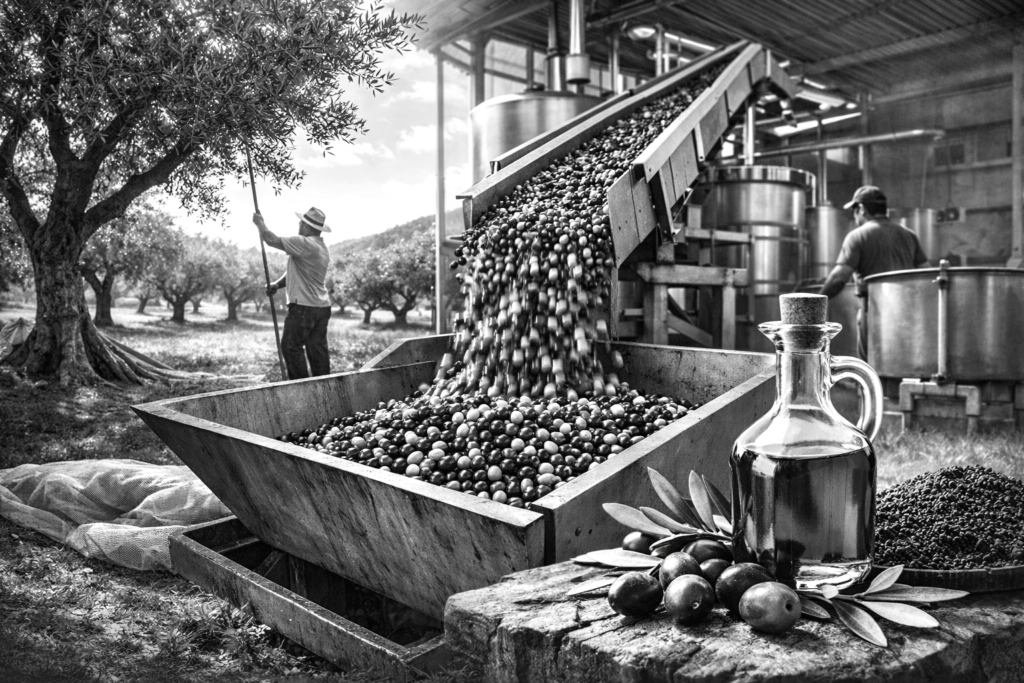
The most important sustainability opportunity, however, may lie outside the bottle. Olive pomace, stones, leaves and mill wastewater have traditionally been treated as disposal problems. That logic is changing. In March 2026, the European Commission highlighted how olive-sector waste can support soil improvement, renewable energy generation and higher-value applications, including uses connected to supplements and cosmetics. This is the clearest sign yet that the sector is moving toward a circular-economy model in which value is recovered not only from the oil itself, but from the full biomass stream.
Seen through that lens, the olive oil sector’s green transition is really a productivity transition. Producers that reduce water intensity, improve energy efficiency, modernize extraction systems and valorize by-products are not merely becoming greener. They are building resilience into their cost structure. In a sector where climate shocks can hit harvests and margins at the same time, sustainability is no longer a branding exercise. It is a business model.
The future of olive oil, then, will not be secured by mythology alone, even if mythology still matters. Athena’s olive tree may remain one of the Mediterranean’s most enduring symbols of wisdom and prosperity. But the modern sector will be judged by something more concrete: whether it can transform a traditional agricultural chain into a lower-waste, lower-carbon, more circular and more efficient system. The next leaders in olive oil will not simply be those who produce the finest oil. They will be those who prove that sustainability itself can be a form of quality.