

For more than three decades the annual United Nations Climate Change Conferences, known as COPs, have been the world’s premier stage for climate diplomacy. What began as negotiations on emissions targets and legal frameworks has shifted into a sprawling, multi-layered agenda that now incorporates technology, global competitiveness, finance, adaptation, equity and resilience. The depth and breadth of today’s discussions reflect not only mounting scientific urgency but also technological advances and economic imperatives. This evolution has given rise to a unique opportunity to tackle the climate crisis — but it is one that can only be realized through collective action steered by expertise and experience.
A Century of COP: From Frameworks to Action
In the earliest years of the COP process, the core conversation was simple by today’s standards: establish a global framework, agree on binding targets for emissions reductions, and create procedural mechanisms that could discipline national contributions. The Kyoto Protocol in 1997 marked a foundational moment, delivering legally binding targets for developed countries, with its focus on compliance and reporting. Early conversations revolved around emissions accounting, common but differentiated responsibilities, and mechanisms such as cap-and-trade that could operationalize compliance.
As the process unfolded through the 2000s, negotiators began to incorporate notions of technology transfer to help developing countries build capacity for mitigation and adaptation, but the technological agenda remained largely framed in terms of support rather than competitive advantage.
Paris 2015 — A Turning Point Toward Implementation
The Paris Agreement in 2015 fundamentally reshaped the COP narrative. Instead of a top-down set of legal targets for some countries, the conference produced nationally determined contributions (NDCs) from nearly every nation. This signaled a shift from a purely regulatory model to one focused on implementation, flexibility and adaptability. Science, finance and policy began to merge — and technology was no longer an afterthought.
The agenda broadened: negotiators discussed not only what countries could commit to but also how the world could mobilize finance, innovation, and institutional frameworks to realize those commitments. The technology conversation evolved from capacity support to enabling rapid deployment of climate solutions worldwide.
Then and Now: How the Dialogue Has Deepened
Compare early COPs with today and the change is stark.
Then: COP negotiators focused narrowly on emissions targets, principles of responsibility, and compliance mechanisms under a legal framework. Technical discussions were limited to metrics, reporting formats and baseline accounting.
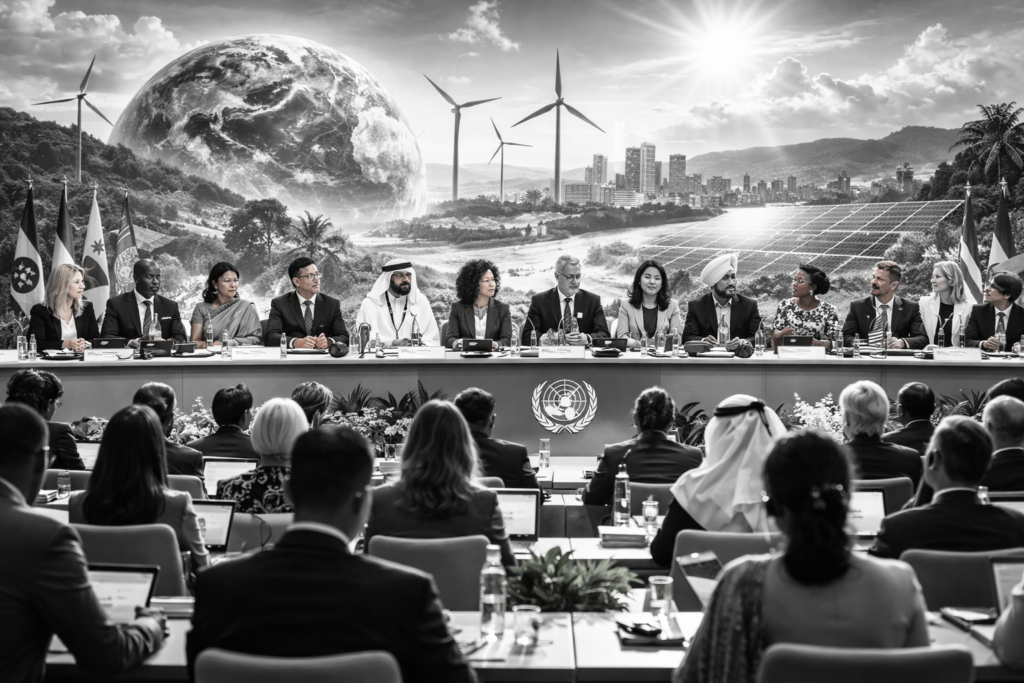
Now: Today’s climate discussions integrate finance, adaptation, technology deployment, economic transformation and equity. COP30 in Belém, hosted ten years after Paris, was explicitly framed as a summit for implementation rather than redesigning global agreements. Delegates grappled not just with lofty targets but with the practical architecture to deliver on them: climate finance, technology deployment pathways, and resilience systems.
COP29 in Baku was widely dubbed the “finance COP,” centering negotiations on scaling up public and private resources, refining carbon markets, and setting new collective finance targets. Parties agreed to triple financial flows to developing countries by 2035 as part of a broader New Collective Quantified Goal (NCQG).
In 2025, COP30 refined these conversations further. Negotiators pushed for finance, adaptation, technology and resilience mechanisms rather than fresh headline commitments. Discussions included structured approaches to climate adaptation, results-based indicators and mechanisms to mobilize long-term investment.
The breadth of these themes underscores how the agenda has matured: climate talks are no longer about single threads in isolation. They require integration across finance, technology systems, industrial policy and socioeconomic resilience.
Competitiveness and the Integration of Innovation
In parallel with the evolution of COP themes, global competitiveness and technological innovation have reshaped national strategies. Climate policy is now deeply intertwined with economic strategy, as countries and corporations alike invest heavily in clean energy, electrification, grid systems, advanced manufacturing, data platforms and digital climate solutions. These technologies influence national growth models, job creation, infrastructure decisions, and trade dynamics.
Climate finance is similarly complex: the era of simple pledges such as the original $100 billion goal has given way to nuanced negotiations over long-term financing architecture, blended finance strategies, carbon markets and adaptation funds. The scale of investment required to decarbonize economies and support resilient systems runs into the trillions annually, dwarfing early expectations.
The Stakes Today: Expertise Over Simplicity
At early COPs, diplomats and scientists discussed emissions targets and compliance. Today, negotiations demand multidisciplinary expertise: legal architects must work alongside climate scientists, technologists, finance experts, economists and human rights advocates to craft feasible pathways. Discussions about adaptation finance must be grounded in macroeconomic modelling and risk assessment frameworks. Technology transfer negotiations intersect with intellectual property norms and global industrial policy. Carbon markets require detailed agreement on reporting, verification and compliance mechanisms.
The result is an agenda that is far from simple. What began as negotiations around binding targets has become a comprehensive examination of how global systems can shift — economically, technologically, socially and politically — to both mitigate and adapt to climate change.
A Unique Moment With No Simple Answers
The evolution of COP themes reveals both progress and complexity. The world is more aware of climate risks, more connected through technology and markets, and more capable of innovation than ever. Yet aligning these forces to deliver equitable outcomes remains extraordinarily difficult. COP30’s emphasis on implementation reflects a shared recognition that climate ambition is not enough without finance, technology pathways, policy coherence and collective action.
The context has shifted from ritual pledges to operational frameworks. Today’s climate diplomacy is a high-stakes arena where science, innovation, competitiveness and equity must converge if the lofty goals of the Paris Agreement are to be realized.
What was once an agenda of relatively straightforward emissions accounting now demands the highest levels of technical expertise, policy acumen and international cooperation. It is this complexity — and this moment of opportunity — that defines the contemporary climate governance landscape.