

This is the fifth piece in a series on the political economy of climate finance. Previous pieces examined the geopolitical origins of the finance gap, why blended finance fails to deliver, the plumbing problems ahead of COP31, and the philosophical anatomy of systemic failure.
This piece looks at what comes next.
The Manifesto
Palantir’s “Technological Republic” manifesto, written by CEO Alex Karp, is not a fringe document. It is a window into how a powerful segment of the Western elite now thinks about governance.
Its core argument: democracy is too slow, too “theatrical,” and too pluralistic to solve existential problems. Instead, a technocratic elite—armed with superior data and algorithms—must take control. Not all cultures are equal. Empty pluralism is a liability. The future belongs to those who build.
This is not a mere debate about technology; it is a blueprint for the consolidation of power.
The Connection to Climate Finance
Our previous essay argued that climate finance is not failing by accident. It works exactly as designed—complexity as a shield, political announcements as a substitute for delivery, and a Northern intermediary ecosystem that profits from the gap.
Palantir’s manifesto does not offer a way out of this trap. It offers a way to justify it. This is already visible as Silicon Valley giants increasingly pivot to climate tech, positioning their proprietary carbon accounting software and supply-chain risk models as the new backbone of global climate governance.
Complexity is not a bug; it is a governance feature. If democratic oversight is “theatre,” then opaque financial structures are not a problem to be solved. They are the natural habitat of a technocratic elite that makes decisions without accountability.
The “gap” is not a failure; it is a business model. The manifesto views the world “as it is” and builds tools for it. In climate finance, the “as it is” is a system where $300 billion pledges are announcements, not deliveries. Building tools for this system means optimizing the existing dysfunction, not fixing it.
Justice is replaced by optimization. Climate finance’s purpose shifts from fair distribution of burdens to strategic alignment with Western geopolitical interests. This is no longer climate justice; it is climate management.
What This Means for COP31
When Türkiye convenes the summit in November, do not look for breakthroughs on the NCQG or the loss and damage fund. Look for these signals instead:
Data as a Weapon: Expect calls for “AI-driven” climate finance platforms that claim to make allocation “objective.” The real question is who controls the data and the algorithms. This is not about efficiency; it is about establishing systemic control.
The Bypass Strategy: The UNFCCC process is slow and democratic by design—features Palantir views as weaknesses. Watch for parallel processes outside the COP: bilateral deals, technology coalitions, and “coalitions of the willing” that bypass the multilateral system entirely. This will accelerate some action but fracture global solidarity.
The Privatization of Accountability: If complexity is a shield, the next step is to privatize oversight entirely. Independent verification will be outsourced to “objective” commercial platforms. The result remains unchanged: no one is held accountable.
The Question for COP31
Our previous essay ended with a question: who benefits from the plumbing staying broken?
Palantir’s manifesto answers it: the technological elite that now sees climate finance as another domain to be conquered.
This is not a conspiracy theory, but the predictable path of political economy. The system is not failing. It is being captured.
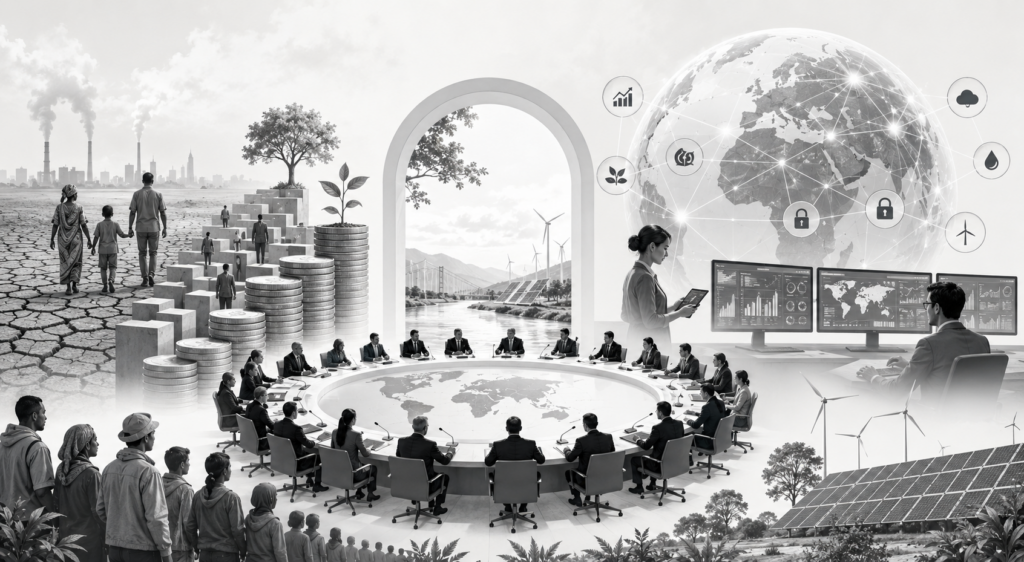
The question for COP31 is therefore not technical—”how do we fix the plumbing?”—but deeply political: are we building a global climate regime based on justice and shared humanity, or are we building a technological fortress that protects the interests of the few?
The answer will define not just COP31, but the entire climate regime for the next decade.