

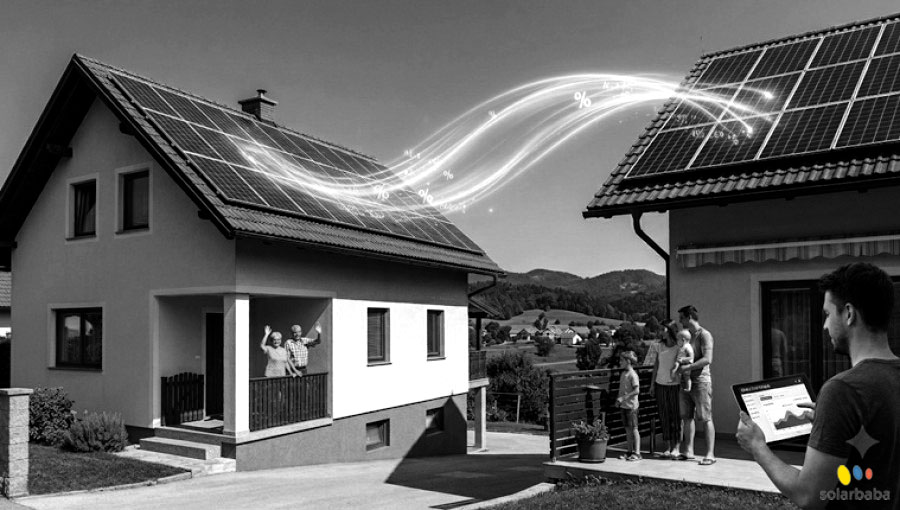
As of July 1, Slovenia has officially introduced a nationwide energy sharing system for households and businesses. Enabled through the transposition of European Union directives into national legislation, the new framework allows solar panel owners to transfer their surplus electricity in real time to any electricity meter across the country. Operating in 15-minute intervals, the system is designed to improve energy efficiency and optimize grid performance. To participate, users must have smart meters installed and maintain contracts with the same electricity supplier.
The new regulation marks a significant transformation in Slovenia’s energy market. Previously, energy sharing was limited to collective self-consumption models involving tenants within the same building or local energy communities. Under the new rules, individual solar panel owners are also eligible to participate. Surplus electricity that was previously either transferred to suppliers free of charge under the net metering system or sold at very low prices through net billing can now be sent directly to another consumer, making the prosumer model significantly more attractive.
The system operates under different rules depending on the selected self-consumption model. Consumers remaining under the net metering scheme can transfer their accumulated annual surplus to another electricity meter once per year. Those participating in the net billing model benefit from much greater flexibility, allowing real-time energy transfers. Energy communities also gain additional flexibility, as unused electricity can be automatically redirected to another member who is consuming power at that moment, reducing energy waste and improving overall system efficiency.
The technical infrastructure behind the energy sharing system relies on smart meters capable of recording electricity usage in 15-minute intervals. According to regulations established by the distribution system operator SODO, both the sender and the recipient must have contracts with the same electricity supplier for energy transfers to take place. Allocation percentages and sharing arrangements must be clearly defined within supplier agreements. Energy providers such as GEN-I are simplifying the process by offering digital platforms that enable dynamic energy sharing.
The regulation also introduces two different categories for grid usage fees. Local energy sharing within the same transformer area benefits from reduced grid charges because it places less strain on the electricity network. Nationwide energy sharing, however, is subject to standard grid usage tariffs. Electricity can be shared either as a voluntary contribution or traded commercially as an energy commodity. Households and businesses wishing to participate can register through the government’s official Moj Elektro portal to begin using the system.
Source: Solarbaba – In Turkish