


Reading policy, capital and market signals from Antalya
As COP31 approaches, much of the conversation is understandably focused on how to participate: which zone to enter, which events to attend, where to speak and how to secure visibility. Yet the more important questions may come before these logistical decisions. Why are we attending in the first place? What intelligence, relationships, investment signals or strategic clarity do we expect to gain? And what should be different in our decisions after we return?
COP31 will bring governments, international institutions, investors, companies, cities and technology providers together in Antalya from 9 to 20 November 2026. For investors, however, its value should not be measured by the number of panels attended, meetings held or contacts collected. COP31 is not an ordinary conference, nor is it a trade fair where companies simply present technologies, projects and sustainability credentials. It is a concentrated strategic intelligence environment where investors can observe how climate policy, regulation, capital allocation, industrial priorities and corporate transformation are beginning to converge. As the global climate agenda moves from ambition towards implementation, the central question for investors is no longer simply whether to attend COP31, or even how to participate.
It is how to read it.
From participation to intelligence
Climate investments are rarely shaped by technology or market demand alone.
They depend on a wider architecture involving regulation, infrastructure, financing conditions, institutional capacity, supply chains, public policy and commercial readiness.
At COP31, many of these elements become visible within the same ecosystem.
Governments communicate priorities. Development institutions signal where they may deploy capital or support risk reduction. Companies reveal where they are positioning their future businesses. Regulators discuss evolving frameworks. Project developers search for partners. Cities and public institutions present implementation needs.
The result is an environment in which investors can assess not only individual projects, but also the direction in which markets may be moving.
COP31 should therefore be approached through three interconnected lenses:
Policy intelligence: Which commitments may evolve into regulation, infrastructure programmes, incentives, procurement or market demand?
Capital intelligence: Where might public, concessional and development finance help mobilize private capital?
Competitive intelligence: Which companies, technologies and markets appear structurally capable of delivering what they promise?
The purpose is not to predict every policy outcome. It is to identify where policy, capital and execution capacity are beginning to align.
Look beyond climate ambition
Investors often compare countries through headline indicators such as emissions targets, renewable capacity, market size or announced investment needs.
These indicators matter, but they do not tell the full story.
The country with the most ambitious target is not necessarily the one with the most investable climate market. Ambition creates direction. Investment requires implementation.
A target becomes economically meaningful when it is supported by regulation, institutional ownership, infrastructure, financing mechanisms and a credible project pipeline.
Investors should therefore ask:
- Are climate objectives translated into sectoral programmes?
- Are regulatory frameworks clear enough to support long-term decisions?
- Is the required grid, transport, digital or industrial infrastructure available?
- Are permitting and implementation processes compatible with investment timelines?
- Do announced priorities translate into credible projects?
- Are financing and risk-sharing mechanisms available where commercial capital cannot act alone?
The more useful question is not:
Which country has announced the strongest ambition?
It is:
Which country can translate climate policy into investable and executable opportunities?
That is a more demanding benchmark, but also a more relevant one.
Follow the conversion from policy to demand
COP31 will generate a significant volume of political, institutional and corporate communication.
The investor’s task is to distinguish broad direction from signals that may create real market demand.
A commitment to electrification, for example, should not be read only through renewable energy targets. It may also imply investment needs in transmission, distribution, storage, charging infrastructure, industrial equipment, digital energy systems and flexible demand.
A focus on resilient cities may create opportunities in water, cooling, mobility, construction materials, distributed energy, climate data and disaster preparedness.
A stronger circularity agenda may affect recycling infrastructure, product design, traceability, industrial symbiosis and secondary raw-material markets.
The relevant question is therefore not which themes receive the most visibility at COP31.
It is:
Which priorities are most likely to become funded programmes, regulatory obligations and recurring commercial demand?
Understand how risk is being allocated
Climate markets are shaped not only by where capital is available, but also by how risk is distributed.
Many projects with strong climate relevance remain difficult to finance because of long payback periods, currency exposure, policy uncertainty, demand risk, technology risk or the absence of stable revenue models.
COP31 can help investors understand where governments and international financial institutions may be willing to intervene in this risk structure.
Which sectors are being prioritized by development banks?
Where could concessional finance lower the cost of capital?
Which risks may be addressed through guarantees, insurance or blended-finance mechanisms?
Which projects are approaching commercial viability, and which still depend on substantial public support?
The most valuable insight may not be where funding is promised, but why a particular financing structure is required.
A project that depends on public risk absorption can still represent a meaningful opportunity. But it is a different proposition from a business model capable of operating under standard commercial conditions.
Understanding this distinction is essential for assessing scalability and long-term value.
Read regulation as a market signal
Regulation is often treated as a compliance issue to be reviewed after an opportunity has already been identified.
Investors should reverse that sequence.
Carbon-pricing mechanisms, product requirements, climate disclosures, supply-chain due diligence, circularity rules and sustainable-finance frameworks can all influence future costs, demand and asset values.
Investors should therefore observe both regulatory convergence and divergence.
Which standards are becoming more widely adopted?
Which regional rules may become de facto market-access requirements?
Where could fragmented regulation increase cost and complexity?
Which markets are developing frameworks compatible with major trading partners?
Where does regulatory flexibility create opportunity, and where does it create uncertainty?
The European Union is particularly important in this respect. Its climate, trade and industrial policies increasingly connect carbon performance, product data, circularity, traceability and market access.
For investors assessing companies linked to European value chains, the strategic question is no longer only whether they comply with a particular rule.
It is:
Which assets and business models may become more valuable as European climate, industrial and trade policies converge—and which may become less competitive?
Test companies for delivery, not visibility
COPs provide a prominent stage for corporate announcements.
Companies present transition plans, new technologies, investment programmes and strategic partnerships. Visibility, however, should not be confused with investment readiness.
Investors should listen not only to what companies promise, but also to what they are structurally capable of delivering.
A practical assessment should consider six areas:
Policy relevance: Does the solution address a priority that regulators, public institutions or major customers are likely to support?
Regulatory readiness: Is the company preparing for emerging carbon, product, data, circularity and supply-chain requirements?
Commercial scalability: Can the technology or business model move beyond pilots and bespoke contracts?
Execution capability: Does the management team have the operational, technical and organizational capacity to deliver at scale?
Capital architecture: Is the funding requirement realistic, and is the allocation of equity, debt, public finance and strategic capital clear?
Evidence of impact: Can both financial performance and climate outcomes be measured through credible data?
This helps investors distinguish narrative maturity from business maturity.
It also shifts attention from the most ambitious story to the most executable proposition.
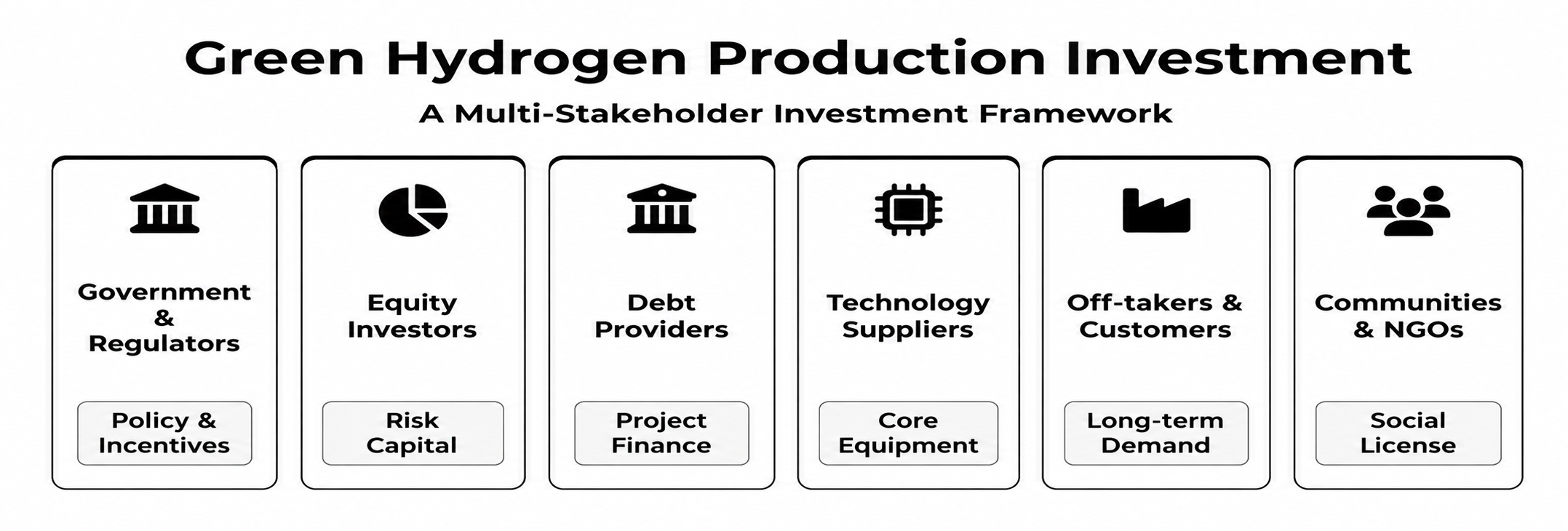
Look for the partnership architecture
Many climate investments cannot be delivered by a single actor.
A storage project may require coordination among regulators, grid operators, technology providers, project developers, lenders and customers.
Industrial decarbonization may depend on clean electricity, infrastructure access, equipment providers, public support and long-term demand.
Urban resilience may require municipalities, utilities, insurers, engineering companies and development institutions to work together.
For this reason, networking at COP31 should not be treated as a general relationship-building exercise.
The objective should be to identify the coalition required to make an opportunity executable.
Which institution controls the relevant policy instrument?
Which organization can support project preparation or risk mitigation?
Which company has local implementation capacity?
Which technology provider can meet the required standard?
Which customer can create a reliable demand signal?
Which capital providers are suited to different stages of the project?
The value lies not in collecting contacts, but in understanding how the necessary actors fit together.
The Türkiye lens: proximity, connectivity and implementation insight
Türkiye’s role as the host of COP31 gives the Antalya process a particular relevance for investors, companies and institutions connected to the region.
This relevance does not need to be framed simply as a question of investing in Türkiye.
A more useful perspective is to examine what COP31 in Türkiye can reveal about regional market dynamics, industrial connections, implementation needs and emerging partnerships.
Türkiye sits at the intersection of European, Mediterranean, Middle Eastern, Black Sea and Central Asian economic networks. It also has significant industrial, logistics, energy, construction and engineering capabilities.
This makes Antalya a useful place to observe several questions at once:
- How are European regulatory expectations influencing regional value chains?
- Which climate technologies and industrial solutions are becoming strategically relevant?
- Where are infrastructure, energy and resilience needs becoming more urgent?
- Which regional partnerships may be required to deliver large-scale projects?
- How can manufacturing, engineering and service capabilities support implementation across multiple markets?
- Which companies are positioning themselves not only for domestic activity, but also for regional deployment?
The Türkiye lens should therefore be understood as an opportunity to examine connectivity.
Connectivity between regulation and industry.
Between Europe and surrounding markets.
Between climate ambition and implementation capacity.
Between global technologies and regional deployment.
The key question is not only what may happen within Türkiye.
It is also:
What can be understood, connected, developed or scaled through the ecosystem gathered in Antalya?
This is where COP31’s location may create a distinctive advantage.
Türkiye can serve not only as the physical host of global climate discussions, but also as a setting in which investors can better understand how policy, industry, infrastructure and regional partnerships may interact.
What should an investor take back from Antalya?
A successful COP31 participation should produce more than a general impression of where the climate debate is heading.
An investor should leave Antalya with a more structured view of the market.
At minimum, this should include:
- a map of policy priorities likely to generate demand;
- a comparison of markets based on implementation readiness;
- an assessment of regulatory developments that may affect asset values;
- a shortlist of sectors and project pipelines requiring deeper analysis;
- a clearer understanding of where public or concessional finance may be necessary;
- a partnership map identifying the actors required for execution;
- a list of risks that may need to be repriced across the existing portfolio;
- and a set of hypotheses to test through subsequent commercial and financial due diligence.
Most importantly, the investor should return with a sharper investment thesis.
Not a collection of climate trends, but a view on where regulation, demand, infrastructure and financing are beginning to reinforce one another.
Not a list of ambitious markets, but an understanding of where implementation capacity exists.
Not a catalogue of technologies, but an assessment of which solutions can scale.
Not an accumulation of meetings, but a map of the partnerships required to move from opportunity to execution.
From attendance to strategic advantage
COP31 will inevitably generate announcements, declarations and high-level commitments.
Some will influence markets. Others may remain broad signals without immediate commercial consequences.
The investor’s task is to distinguish between them.
This requires preparation before Antalya, disciplined questioning during the conference and structured follow-up afterwards.
COP31 should not be approached as a place where a fully formed investment opportunity will simply appear.
Its value lies in providing access to the signals, actors and emerging alignments that allow investors to see opportunities earlier and assess them more intelligently.
The investors who gain the most from COP31 will not necessarily be those with the greatest visibility in Antalya.
They will be those who return with a sharper understanding of where policy, capital and execution are beginning to converge and what that convergence may mean for future markets.