

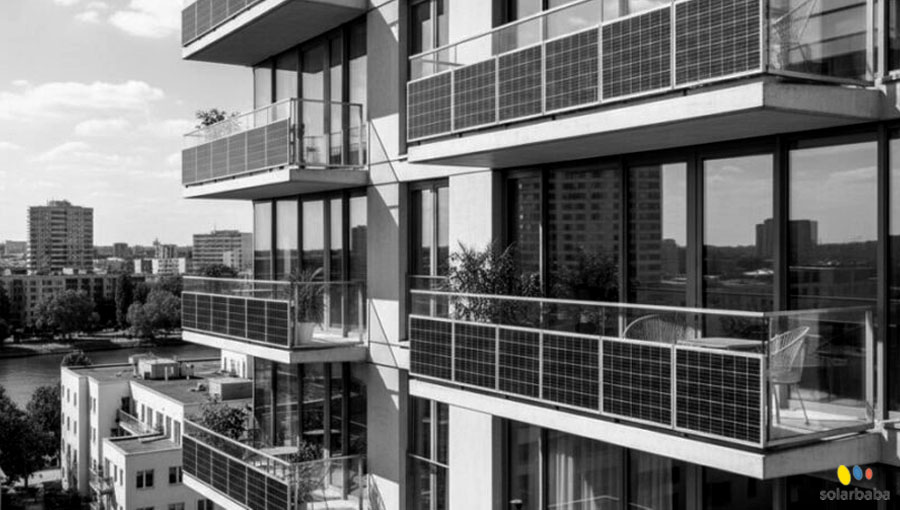
Germany’s individual energy transition has reached a historic milestone as solar power moves onto residential balconies. According to data from April 2026, the number of installed balcony solar systems across the country has surpassed 1.3 million, with officially registered capacity reaching 1.34 GW. When unregistered systems are included, the total installed capacity is estimated to have reached 2.5 GW. Supported by falling solar panel prices and simplified regulations, this rapid growth has increased the share of balcony systems within Germany’s overall solar capacity to 3.2%. The widespread adoption of the maximum permitted configuration 800-watt inverters paired with 2,000 watts of solar panel highlights both strong consumer interest and the dynamism of the market.
This remarkable transformation in the German energy sector represents more than a tenfold increase in just a few years. Annual new installation capacity, which stood at only 48 MW in 2022, approached 540 MW by the end of 2025. In the first quarter of 2026 alone, more than 64,000 new systems were installed, adding 87.6 MW of capacity. Data show that North Rhine-Westphalia, Bavaria, and Baden-Württemberg are leading the expansion. Balcony solar systems now account for 1.1% of Germany’s total photovoltaic capacity of 117 GW.
Technical trends indicate that consumers are increasingly opting for higher-performance systems. More than 90% of the installations completed during the first quarter of 2026 consisted of configurations with two or four solar panels. Four-panel systems are rapidly gaining market share, while 61% of users choose to utilize the legal maximum of 2,000 watts of panel capacity. On the inverter side, 800-watt output has become the new standard, while the market share of older 600-watt systems has fallen to around 6%. This trend demonstrates that individual consumers are seeking maximum efficiency and greater energy independence.
Beyond official statistics, the existence of unregistered systems suggests that the market may be significantly larger than reported. Research conducted by the Berlin University of Applied Sciences and Technology (HTW Berlin) indicates that many systems remain outside official records due to bureaucratic obstacles. Estimates suggest that nearly three million balcony solar systems could actually be connected to the grid across Germany, with real installed capacity exceeding 2.5 GW. Previous registration challenges have allowed the spread of these plug-and-play systems to advance much faster than official figures indicate.
From a social perspective, balcony solar systems enjoy a record approval rating of 82%. According to data from the Renewable Energy Agency, the visibility of these systems among neighbors has increased public trust and interest. As support for fossil fuels continues to decline in Germany, more citizens are embracing the opportunity to directly participate in their own energy production. Regionally, while city-states such as Berlin and Hamburg have high installation density per square meter, states with a larger number of detached houses, including Lower Saxony and Brandenburg, stand out in terms of per capita generation capacity.
Source: Solarbaba – In Turkish