

Every major technological transition in history has been preceded by a period when the tools existed but the institutional imagination to use them did not. We are living through exactly that period in climate action right now. Artificial intelligence is not a missing piece of the climate puzzle. It is the thing that changes what the puzzle looks like.
The Real Problem Was Never Data
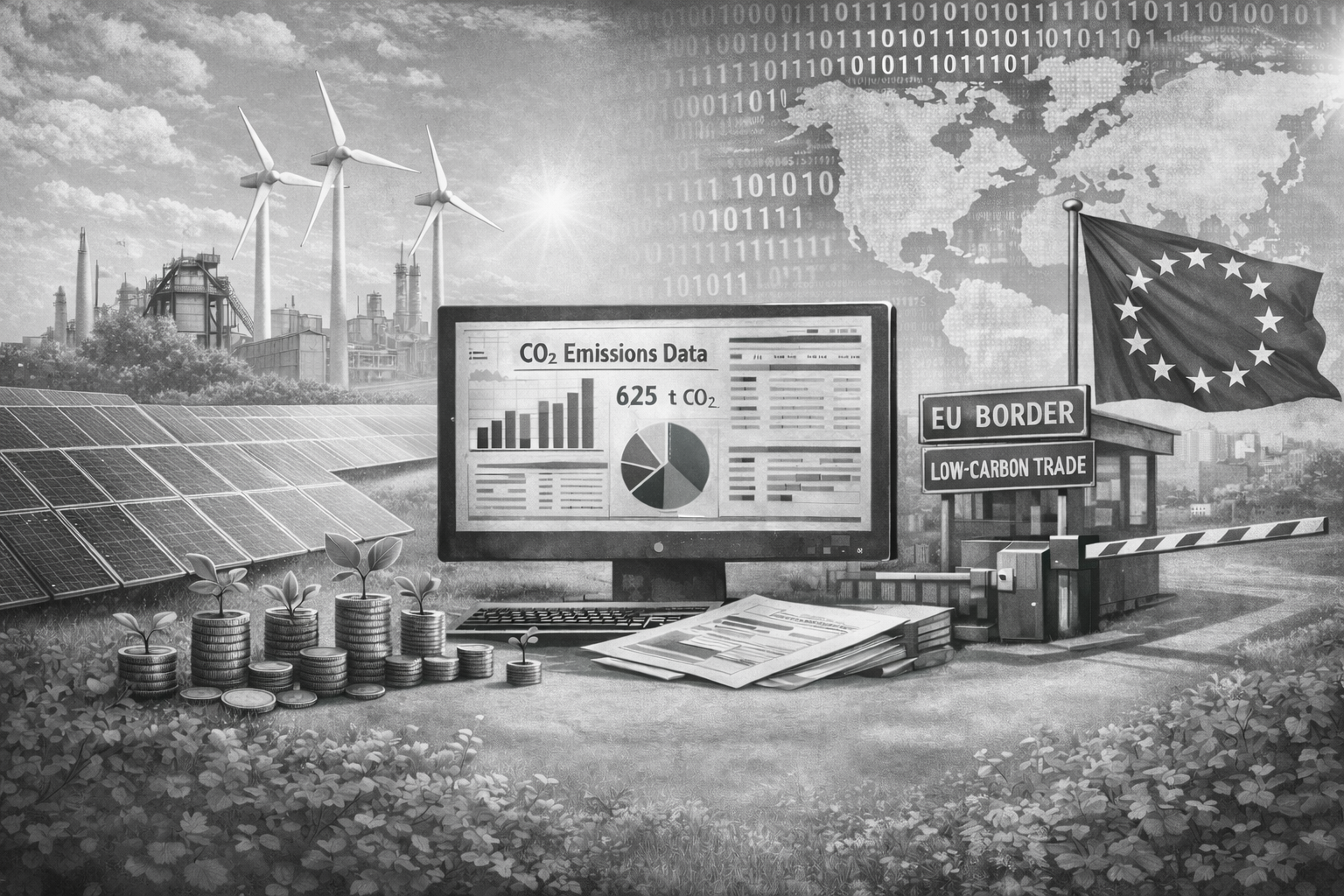
The dominant narrative in corporate sustainability has been, for most of the past decade, a data problem. Companies didn’t know their emissions. Supply chains were opaque. Energy consumption was tracked on spreadsheets, if at all. The first generation of climate tech — sensor networks, IoT monitoring, ERP integrations, carbon accounting platforms — was built to solve exactly that: to move emissions data from the analogue world into the digital one.
That work is not finished. But it is, for the first time, finishable. And as it reaches completion, a more fundamental problem comes into view. The bottleneck in climate action is not measurement. It is interpretation, decision-making, and institutional response, the ability to take what we now know and translate it, at speed, into action that is commercially viable, regulatorily compliant, and credible to the stakeholders who are watching.
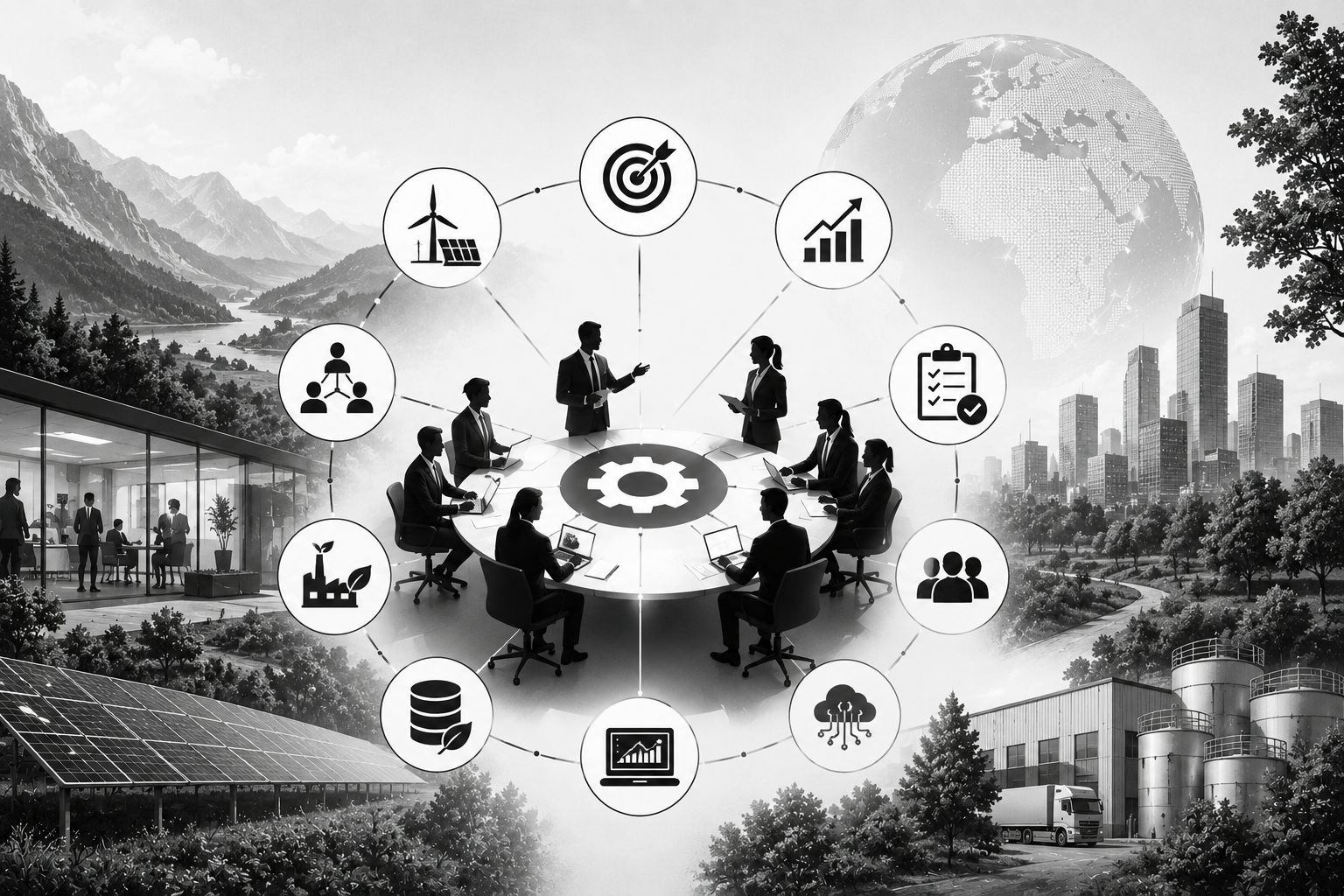
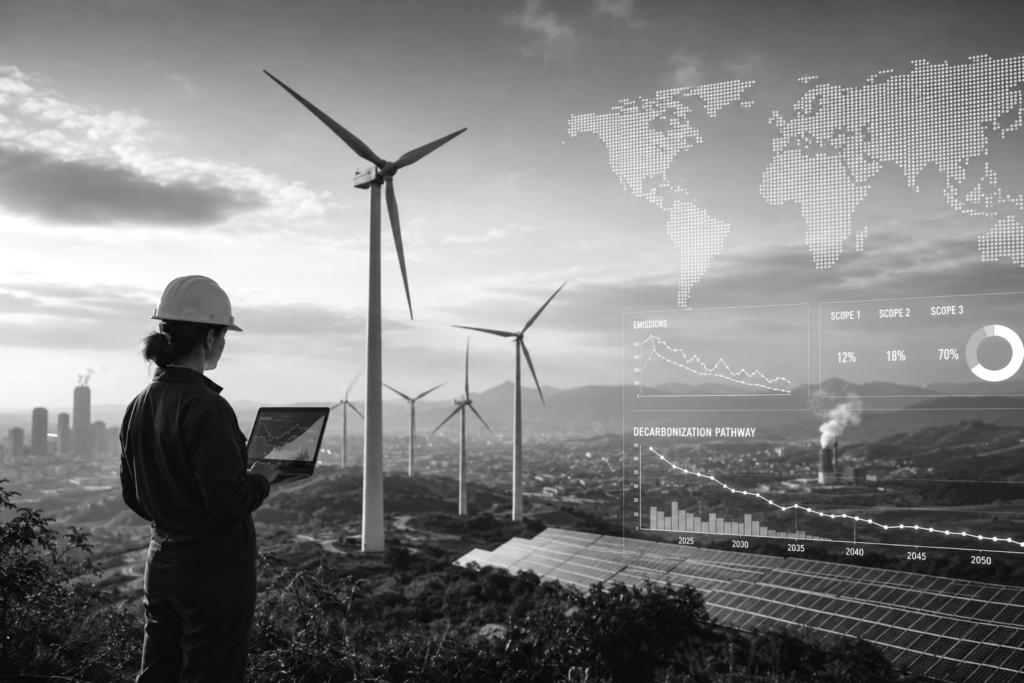
This is where artificial intelligence enters, not as a better sensor or a faster spreadsheet, but as a qualitatively different kind of capability. AI systems can hold the full complexity of a decarbonisation problem — Scope 1, 2, and 3 emissions simultaneously, across geographies, regulatory frameworks, and supplier tiers — and reason across it in ways that human analysts, working with traditional tools, simply cannot match at the speed that markets and regulators now demand.
From Compliance to Intelligence
The first wave of AI adoption in sustainability has been predictable: automating the manual, error-prone tasks that have made ESG reporting so costly and so inconsistently done. Natural language processing tools that read supplier questionnaires and extract material data. Machine learning models that flag anomalies in energy consumption and predict maintenance needs before they become emissions events. Large language models that draft GRI and CSRD disclosures from structured data inputs, cutting reporting cycles from months to weeks.
These are real and significant efficiency gains. But they are still, fundamentally, compliance tools — AI in service of doing what was already required, faster and cheaper. The more profound shift is only beginning to emerge: AI as a strategic intelligence layer that changes what organisations actually decide to do, not just how quickly they report on what they have already done.
Consider what this looks like in practice. A manufacturing company deploying an AI-native emissions management platform does not just get faster reporting. It gets a continuous simulation of its decarbonisation pathway under different energy price scenarios, regulatory tightening assumptions, and supplier transition timelines. It can model the NPV of capital investment in electrification versus carbon offsetting versus supply chain switching — in real time, as market conditions change. It can receive alerts not that it has exceeded a threshold, but that it is on a trajectory to miss a target three quarters from now, with enough lead time to intervene.
This is the difference between a rear-view mirror and a navigation system. The climate challenge has always needed the latter. AI, for the first time, makes it possible.
The Supply Chain Problem Finally Has a Match
If there is one domain where AI’s impact on climate action will be most consequential, it is Scope 3 emissions — the upstream and downstream footprint that, for most large companies, accounts for between 70 and 90 per cent of their total climate impact, and which has historically been the hardest to measure, verify, or act on.
The difficulty is structural. Scope 3 data lives in thousands of supplier relationships, logistics networks, and end-of-life processes — each with different reporting standards, different data quality, and different incentive structures. The traditional approach — annual supplier surveys, spend-based estimation, and periodic third-party audits — produces numbers that are, at best, directionally accurate and, at worst, meaningfully misleading.
AI changes the economics of Scope 3 transparency in two ways. First, it enables continuous, automated data collection and reconciliation across supplier networks at a scale no human team can replicate — cross-referencing procurement data, logistics records, and publicly available emissions factors to produce primary-data-quality estimates from secondary sources. Second, and more importantly, it enables the identification of high-leverage intervention points: the 5 per cent of suppliers that account for 40 per cent of Scope 3 emissions, the logistics routes where modal shift generates disproportionate carbon savings, the product categories where redesign creates compounding reductions across the value chain.
This transforms Scope 3 from a reporting headache into a strategic resource allocation problem — one that AI is well suited to solve.
Climate Finance Needs AI More Than Any Other Sector
The International Energy Agency estimates the annual clean energy investment gap at over $4 trillion per year through 2030. The barrier is not the absence of capital — institutional investors, sovereign wealth funds, and development finance institutions collectively hold far more than that. The barrier is the absence of bankable, investable pipelines: projects with credible financial models, verifiable impact metrics, and risk profiles that institutional capital can underwrite.
AI is beginning to dissolve that barrier in ways that are underappreciated outside the climate finance community. Satellite-based monitoring combined with machine learning can verify the additionality and permanence of nature-based carbon projects in near real time — reducing the verification costs that have historically made small-scale projects uneconomic and large-scale projects slow. Predictive models trained on grid data, weather patterns, and power purchase agreement structures can produce more accurate revenue forecasts for renewable energy projects, improving their credit ratings and reducing the cost of capital. AI-assisted due diligence can compress the assessment cycle for green infrastructure projects from months to weeks, unlocking pipelines that currently stall in the gap between developer ambition and investor readiness.
For emerging markets — including Türkiye and the GCC — these capabilities matter enormously. A significant portion of the global climate investment gap is concentrated in markets where data infrastructure is thin, regulatory frameworks are evolving, and the transaction costs of climate finance are highest. AI dramatically reduces these limitations — making markets investable that were previously too opaque or too costly to underwrite.
The Governance Question That AI Cannot Answer
It would be naive to end here without acknowledging what AI cannot do. It cannot set targets. It cannot build political will. It cannot resolve the distributional questions — who bears the cost of transition, who captures the benefits — that sit at the heart of every serious climate negotiation. And it cannot substitute for the institutional capacity, from well-staffed national MRV systems to capable corporate sustainability functions, that converts data and intelligence into credible action.
There is also a specific risk worth naming: AI systems trained on historical data embed historical assumptions. A model that predicts the decarbonisation pathway for a steel plant based on current technology costs and regulatory trajectories may systematically underestimate the pace of change — or overestimate the difficulty of transitions that turn out to be faster than expected. The climate crisis, almost by definition, is a domain where historical patterns are a poor guide to the future. Deploying AI in this space requires ongoing human judgment about when the model’s assumptions no longer hold.
None of this diminishes the fundamental case. It sharpens it. AI in climate action is most powerful when it augments human decision-making rather than replacing it — when it handles the complexity that humans cannot hold in their heads, freeing institutional attention for the judgment calls that only humans can make. That is not a modest ambition. It is, in practice, a transformational one.
What This Means for COP31 and Beyond
The COP31 Action Agenda is a document about implementation. Its priority areas are not calls for new commitments — the world has enough of those. They are calls for delivery: scaled financing mechanisms, robust national architectures, bankable pipelines, transparent industrial transformation. Every one of those demands is, at its core, an information and coordination problem. And information and coordination problems are exactly what AI is built to solve.
For Türkiye, preparing to host COP31 while simultaneously building its own climate tech ecosystem, the strategic implication is clear. The country that positions itself as the regional centre for AI-enabled climate intelligence — attracting the platforms, the talent, and the institutional frameworks that make AI-native sustainability management possible — will have a structural advantage in every dimension of the transition: investment attraction, regulatory credibility, export competitiveness, and diplomatic influence.
That positioning is available. The tools exist. The demand is building faster than most organisations realise. The question, as always, is whether the ambition to act precedes the moment when acting is no longer optional.