


Hard Question
Are transition taxonomies optimizing for compliance integrity instead of capital mobility?
The Core Friction
Taxonomies were designed to solve a real problem: credibility. Markets needed common definitions, comparable disclosures, and protection against greenwashing. In that sense, taxonomies have been useful. They have improved label discipline and forced financial actors to become more precise about what qualifies as sustainable.
But transition finance now faces a different problem. The issue is no longer only whether an activity can be classified. The issue is whether capital can move through the intermediate stages required for real-economy transition. This is where the taxonomy logic begins to strain.
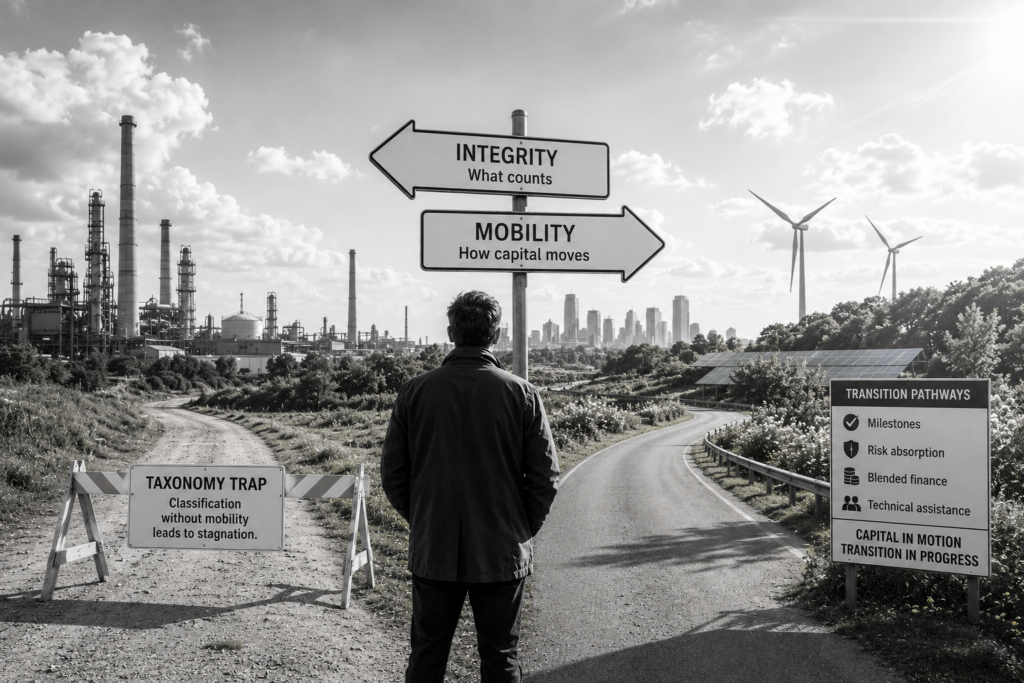
Classification integrity is improving. Capital mobility is not.
The Mechanics of Pathway Blindness
Many taxonomy frameworks suffer from what can be described as Pathway Blindness. They are effective at defining eligible activities and desirable end-states, but less effective at guiding the financing of transition trajectories. They often struggle with the “messy middle”—the sectors, assets, and business models that are not yet aligned, but are structurally necessary to decarbonize.
This creates three distortions:
- Capital concentrates where alignment is easiest: EU Taxonomy reporting is expanding, and average alignment is rising, but unevenly. Bloomberg data shows average Taxonomy alignment among EU-based reporting firms increased from 9.3% to 10.4% for revenue and from 13.0% to 13.8% for CapEx between FY2022 and FY2023; utilities show much higher CapEx alignment, above 60%, than many other sectors. This reinforces the core issue: taxonomy data is becoming more useful, but capital still flows more easily where alignment is already visible and verifiable.
- Transition-critical sectors remain structurally exposed: The IEA shows that energy-intensive industries remain difficult to electrify: electrification in steel, cement and primary chemicals is still well below 15% today, even though emerging electrification technologies could avoid 2.2 Gt CO₂ by 2050 in the NZE Scenario. These sectors require staged investment, technology substitution and operational retrofits; they cannot move from high-emission baselines to full alignment in one step.
- Labels begin to substitute for financing logic: A taxonomy can define “green steel,” but it does not explain how to finance the intermediate pathway. This problem is sharper in emerging markets: the World Bank finds that EMDEs excluding China account for around 25% of global GDP but receive only 14% of reported global climate finance flows, while nearly 60% of EMDE banks report climate finance at 5% or less of their lending portfolios. Classification alone does not resolve investability when the financial system lacks the structures to move capital through transition pathways.
Beyond Binary Finance
Real-economy transition is not binary. It does not move from brown to green through a single investment decision. It moves through declining emissions intensity, changing input structures, technology risk, and uneven sectoral readiness.
In these contexts, taxonomy alignment alone does not resolve investability. A project can be strategically important and still fail to meet classification thresholds. A company can be moving in the right direction and still remain excluded from green capital.
The Core Claim
We are not lacking classification systems. We are lacking financing architectures capable of navigating transition pathways.
Taxonomies optimize for what counts. Transition finance must also solve for how capital moves: which risks are absorbed, which milestones trigger financing, and how capital stacks evolve as assets move from high-emission baselines toward lower-carbon operating models.
Closing
The future of transition finance depends not only on defining what is green. It depends on financing what is becoming less brown. Until taxonomies evolve from static classification systems into pathway-oriented capital allocation tools, the sectors most critical to transition will remain caught between exclusion and underinvestment.Integrity matters. But integrity without mobility does not transform the real economy.