

ARTIFICIAL INTELLIGENCE IN THE ENERGY SECTOR IN THE CONTEXT OF THE GRAND NATIONAL ASSEMBLY OF TÜRKİYE (TBMM) AND THE PRESIDENCY DIGITAL TRANSFORMATION OFFICE ARTIFICIAL INTELLIGENCE WORKSHOP REPORT
I. The Structural Relationship Between Artificial Intelligence and the Energy Sector: A Two-Way Field of Transformation
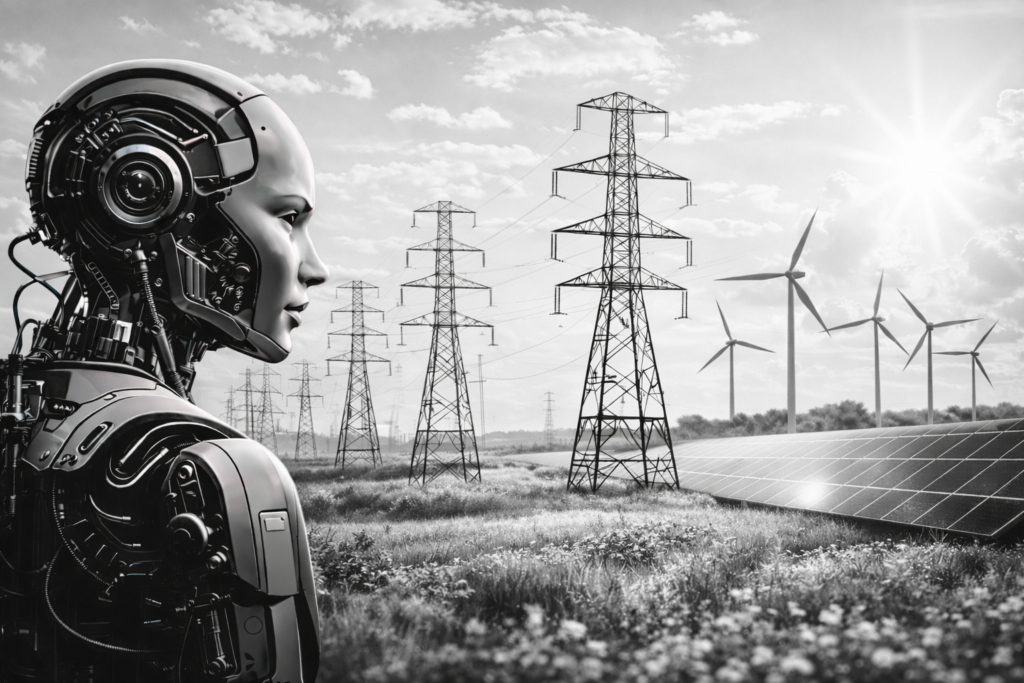
The report prepared within the scope of the Artificial Intelligence Workshop of the Grand National Assembly of Türkiye demonstrates that artificial intelligence technologies are no longer merely tools used in certain sectors, but have become factors transforming economic and infrastructural systems as a whole. Although the report does not contain a separate section specifically devoted to the energy sector, when the assessments scattered across different sections are considered together, it becomes clear that there is a two-way and structural interaction between artificial intelligence and the energy sector.
This relationship is shaped along two main axes. First, the high computing power and data-processing capacity required for AI systems to operate directly increase energy consumption, making the energy sector the “supporting infrastructure” of AI technologies. Second, AI technologies are being integrated into energy generation, distribution, and consumption processes, thereby transforming the operating logic of the sector itself. This dual structure makes the energy sector, in the age of artificial intelligence, both an infrastructure provider and a field of transformation.
Indeed, the fragmented yet complementary findings contained in the report indicate that the relationship between the energy sector and artificial intelligence should be addressed not merely as a matter of technical application, but as a transformation process with strategic, economic, and legal consequences.
II. New Areas of Debate from the Perspective of Energy Law
When all the findings above are evaluated together, it becomes evident that the effects of artificial intelligence technologies on the energy sector are not merely a technical transformation, but rather a multidimensional process of change requiring the reassessment of existing legal regulations.
In this context, issues such as the increasing dependence on energy infrastructure, the spread of data-based energy management systems, the development of smart grid applications, and the damages that may arise from AI systems bring new regulatory needs to the agenda in terms of energy law. In particular, the high-capacity energy supply required for AI systems to function causes energy infrastructure to become not merely a supporting element, but one of the main determinants of the digital economy. This makes it necessary to reconsider the current legal framework regarding energy supply security, capacity planning, and infrastructure investments in light of increasing demand and new consumption profiles.
On the other hand, the spread of data-based energy management systems and the development of smart grid applications are replacing central and hierarchical structures in the energy market with more distributed and algorithm-based decision-making mechanisms. This transformation brings issues such as data ownership, data security, the auditability of algorithmic decisions, and market transparency to the forefront in terms of energy law, and in particular makes it necessary to redefine the scope of regulatory authorities’ supervisory and auditing powers.
In addition, the nature and scope of the damages that may arise from the use of AI systems in the energy sector are pushing the limits of existing liability regimes. In particular, the lack of transparency in the decision-making processes of autonomous systems and their “black box” nature make it difficult to identify the source of damage, rendering classical approaches based on fault liability insufficient. In this framework, it is considered that alternative liability regimes such as strict liability, hazard liability, and product liability may find broader application in the energy sector.
Finally, the integration of AI technologies with the energy sector is no longer an issue that can be resolved solely through the interpretation of existing legislation; rather, it gives rise to a new and hybrid regulatory field at the intersection of energy law, environmental law, and information technology law. In this respect, it is considered necessary to move beyond the fragmented structure of the legislation and adopt a holistic and forward-looking regulatory approach that addresses sectoral needs and technological developments together.
II.1. The “Green AI” Approach
The TBMM Parliamentary Research Commission Report shows that the environmental impacts of artificial intelligence technologies on the energy sector are treated not merely as a technical issue, but also as an area requiring legal and regulatory intervention. At the same time, the report clearly states that the concept of “Green AI” should be adopted in response to the increasing energy and resource consumption of AI systems, and proposes various legal and administrative measures in this direction.
In this context, it is first stated that data centers and AI infrastructure investments requiring high energy and water consumption should be made subject to Environmental Impact Assessment (EIA) procedures. The report emphasizes that such facilities should be assessed not only in terms of their economic contribution, but also in terms of their impact on nature, and recommends that EIA procedures be implemented more strictly and comprehensively in this regard.
In addition, in order to make the environmental impacts of AI applications measurable and auditable, it is stated that declaration and reduction obligations should be introduced regarding energy consumption, greenhouse gas emissions, and carbon footprint. In particular, it is recommended that, throughout the life cycle of AI projects, the balance between “avoided carbon emissions” and “additional carbon burden” should be analyzed and that these analyses should be integrated into the regulatory framework.
Moreover, the report states that a “green compute” approach should be adopted and that legal arrangements should be developed to facilitate the establishment of data center infrastructures based on renewable energy sources. In particular, it is emphasized that circular economy models, such as using waste heat from data centers to heat cities, should be encouraged. Another important issue highlighted in the report is the risk that the high costs generated by AI infrastructures may ultimately be passed on to end users. As a matter of fact, it is specifically stated that regulatory mechanisms should be established to prevent infrastructure costs arising from data centers and energy-intensive AI projects from being directly reflected in consumers’ electricity bills under the name of a “service fee.”
II.2. Certification and Documentation Regime Within the Scope of “Green AI”: Standards, Measurement Criteria, and Compliance Mechanisms
The TBMM Parliamentary Research Commission Report emphasizes that the environmental impacts of AI systems should be monitored not only through regulatory obligations, but also through measurable, verifiable, and standardized certification mechanisms.
In this framework, first of all, the declaration of the energy consumption and emission effects of AI applications posing high environmental risks is determined as a basic certification criterion. This obligation is not merely a formal notification; it requires the presentation of measurable and comparable data on the system’s energy use, carbon emissions, and environmental impacts.
Another important criterion at the center of certification processes is the life-cycle assessment approach. Accordingly, the environmental impact of AI systems will be assessed not only through their instantaneous energy consumption, but also by considering the balance between the efficiency they provide and the energy they consume in order to operate, namely the “avoided CO2 / additional CO2” balance. This approach makes it possible to measure the net environmental contribution of the technology and adds analytical depth to certification processes.
At the same time, the report clearly states that, in order for such assessments to be carried out properly, national energy and carbon metrics must be standardized. In this regard, it is envisaged that common measurement criteria for assessing the environmental footprint of AI systems should be determined and that these criteria should be made mandatory in all certification processes.
The report also states that systems operating in line with sustainability goals should be certified within the framework of “clean production” and “resource efficiency” criteria. In this context, the certification of AI infrastructures that reduce energy consumption, lower emissions, and use resources efficiently is regarded both as an incentive tool and as a mechanism that directs market behavior.
II.3. Waste Heat Recovery in Data Centers and the Circular Energy Model: The Perspective of “Circular AI”
The TBMM Parliamentary Research Commission Report does not limit proposals aimed at reducing the environmental impacts of AI infrastructures merely to restricting energy consumption; it also comprehensively addresses circular-economy-based approaches that make it possible to reuse the energy generated. In this context, the recovery and reuse of waste heat released from data centers is considered a concrete application of the “Circular AI” (Circular/Green AI) concept.
Data centers generate significant amounts of heat during the operation of AI systems requiring high computing power, and in conventional systems this heat is mostly released into the environment as passive waste. However, the report emphasizes that this heat can be reused by integrating it into urban heating systems through appropriate technological infrastructure. In this context, it is stated that waste heat obtained from data centers can be transferred to centralized heating networks, referred to as “district heating,” and used to heat residential and commercial buildings.
When international examples of this approach are examined, it is seen that, particularly in Scandinavian countries, data centers are positioned not only as elements of digital infrastructure, but also as part of city-scale energy generation and distribution systems. In these countries, while cold climate conditions reduce the cooling costs of data centers, a dual efficiency is achieved by using the heat generated to warm cities.
The report considers this model to be applicable to Türkiye as well, and states that establishing data centers especially in regions with colder climatic conditions would both reduce cooling costs and facilitate the integration of waste heat into local heating systems. This approach requires data center investments to be planned not only from a technology and infrastructure perspective, but also in an integrated manner with regional energy policies.
In addition, it is clear that waste heat recovery has important consequences in terms of environmental impacts. The high energy consumption and cooling needs of data centers place serious pressure on carbon emissions and natural resource use, and this constitutes one of the main areas of debate regarding the sustainability of AI technologies. The reuse of waste heat, on the other hand, stands out as a mechanism that reduces the net energy footprint of these systems and has a positive effect on the carbon balance.
In this framework, it is considered that legal regulations concerning the planning and operation of data centers should not be limited only to energy consumption and emission limits, but should also be expanded to include obligations related to energy recovery and reuse. Such obligations will ensure that data centers operate in line with circular economy principles and will directly contribute to sustainable energy policies.
II.4. The Data Center Organized Industrial Zone (OIZ) Model: Spatial and Economic Organization of AI Infrastructure
One of the remarkable models proposed in the TBMM Parliamentary Research Commission Report to ensure the sustainable and scalable development of AI technologies is the establishment of organized industrial zones dedicated specifically to data centers. This model appears as an adaptation of the classical Organized Industrial Zone (OIZ) approach to systems requiring digital infrastructure and high computing power, offering a special planning approach intended to meet the intense energy and infrastructure needs of AI data centers.
The proposed structure is based on a “Data Center Organized Industrial Zone” model to be developed under private sector leadership but in coordination with public authorities. The most fundamental feature of these zones is that the high-capacity energy supply and fiber internet infrastructure required by AI infrastructures would already be installed in advance. In this way, it is intended that investors can begin their operations directly without facing the high costs and time burdens associated with infrastructure installation.
One of the main objectives of this model is to reduce investment costs and lower barriers to entry into the sector by taking into account the enormous energy consumption and technical infrastructure needs required by AI data centers. This approach is of a nature that can encourage the widespread adoption of AI projects requiring high computing power and is considered a strategic tool to enhance Türkiye’s competitiveness in this field.
However, the report emphasizes that the establishment of these zones should not be limited merely to the allocation of physical space; on the contrary, it should be addressed within the framework of a holistic planning approach. In this regard, it is stated that elements such as site selection, energy supply capacity, fiber infrastructure, cooling systems, and environmental impacts should be planned in an integrated manner through cooperation between the public and private sectors.
It is also recommended that data center OIZs be located in different regions and strategic points across Türkiye. When the legal dimension of this model is examined, it is seen that data center OIZs, unlike classical industrial zones, create a hybrid field of regulation at the intersection of energy law, telecommunications law, and environmental law. In this context, the legislation relating to the establishment and operation of such zones will need to be designed in a way that addresses not only industrial investments, but also issues such as data security, energy supply, environmental sustainability, and digital infrastructure management together.
II.5. Artificial Intelligence in Autonomous Energy Systems and the Legal Liability Regime: The “Chain of Liability” Approach
The TBMM Parliamentary Research Commission Report clearly states that the legal liabilities that may arise from the use of AI technologies in critical infrastructures, particularly in areas such as energy distribution and grid management, cannot be explained through the classical understanding of single-actor liability. In this regard, the report states that, taking into account the multi-layered and multi-actor structure of AI systems, a “chain of liability” approach should be adopted.
In this framework, first, the developers and software providers of AI systems are considered primarily responsible for errors arising from the design of the system, its algorithmic structure, and training data sets. In particular, situations such as the incorrect training of the model, biases in data sets, or the system producing unforeseen outputs directly bring the liability of these actors to the forefront.
Second, the liability of manufacturers and importers placing AI-supported energy systems on the market is evaluated within the framework of the Product Safety and Technical Regulations Law. In this context, it is stated that the manufacturer or provider may be held liable, in line with the principle of strict liability, for damages arising from the fact that the product placed on the market is not safe. This approach stands out as an important mechanism for protecting the injured party, especially in light of the complexity and unpredictability of AI systems.
Third, operators and users who actually operate the system, particularly actors such as energy distribution companies, are held liable in cases where instructions regarding the use of the system are not followed, maintenance and inspection obligations are neglected, or the system is configured incorrectly. In this respect, the improper operation of the AI system or the failure to ensure the necessary oversight may give rise to the legal liability of the operator.
The report also emphasizes that, due to the “black box” problem inherent in AI systems, it is often difficult to determine at which stage and as a result of which actor’s conduct the damage arose. In the face of this situation, it is stated that the classical fault-based liability approach may be insufficient and that, therefore, in some cases the application of a strict liability regime may be necessary.
CONCLUSION
Although the TBMM Artificial Intelligence Workshop Report contains a limited number of direct findings concerning the energy sector, it presents the scope and depth of the relationship between artificial intelligence and the energy sector from a holistic perspective. When the fragmented yet complementary evaluations in the report are considered together, it becomes clear that AI technologies have become a factor transforming the energy sector not only at the technical level, but also in its economic, environmental, and legal dimensions.
On the other hand, the energy consumption, environmental effects, and infrastructure costs generated by data centers and high-capacity AI systems make it necessary for regulatory authorities to establish a new balance. In this context, the EIA obligations, emission declarations, life-cycle analysis, and certification mechanisms developed within the framework of the “Green AI” approach stand out not only as tools for ensuring environmental sustainability, but also as fundamental instruments for restructuring energy policies.
In addition, the organized industrial zone model developed specifically for data center investments requires the integrated planning of energy infrastructure and digital infrastructure, thereby creating a new field of regulation at the intersection of energy law, environmental law, and information technology law. Likewise, circular economy practices such as the recovery of waste heat from data centers make it necessary to address energy policies not only from the axis of consumption and production, but also from the perspective of reuse and efficiency.
From the perspective of legal liability regimes, the multi-actor structure of AI-supported autonomous energy systems renders the classical fault-based liability approach insufficient. For this reason, mechanisms such as strict liability, product liability, and the redistribution of the burden of proof are expected to gain greater importance. In this framework, the developed “chain of liability” approach provides a structure that may enable legal risks to be managed in a more systematic and foreseeable manner for actors operating in the energy sector.