


The Evolving Meaning and Priorities of UNFCCC Conferences of the Parties (COPs)
The Conferences of the Parties (COPs) under the United Nations Framework Convention on Climate Change (UNFCCC) were initially conceived as diplomatic platforms primarily focused on negotiation and the formulation of commitments. Today, however, COPs have taken on a far more complex function. They are now assessed by the decisions adopted, and equally by how those decisions are reached, the degree of inclusiveness and trust embedded in the process, and the institutional and political legacy left behind by the host country once the summit concludes.
This evolution has fundamentally reshaped the role of COP presidencies. Host countries are not viewed as organizers, but as central actors in safeguarding the credibility, continuity, and legitimacy of global climate and sustainability governance.
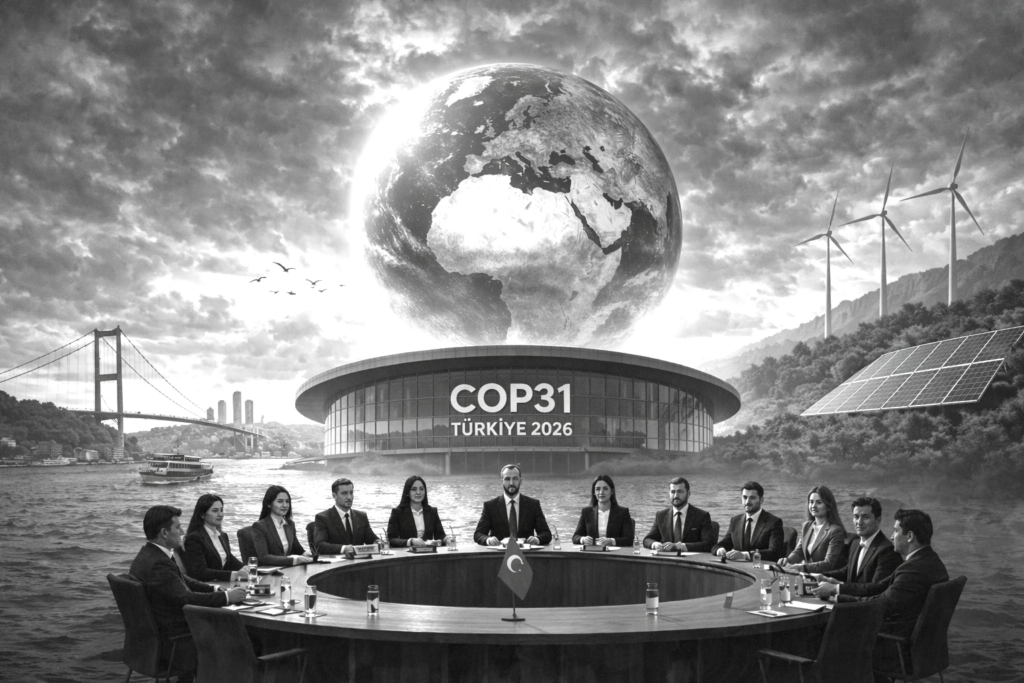
Within this context, COP31 represents for Türkiye a technical hosting responsibility, and a strategic opportunity for repositioning in climate diplomacy, industrial transformation, and regional leadership.
Three Distinct Measures of COP Success: Why There Is No Single Definition of “Success”
Labeling a COP as “successful” cannot be attributed to the assessment of a single actor. Rather, success is evaluated through three distinct and often tension-filled frameworks: public opinion and civil society, the UNFCCC institutional system, and the host country acting as COP presidency (in this case, involving both the host country and the country chairing the negotiations).
• Success from the Perspective of Public Opinion and Civil Society
For the public and international media, COP success is largely perception-driven. Clear messaging, symbolic decisions, and easily communicable outcomes are key. Issues such as fossil fuels, climate justice, finance, and the protection of vulnerable countries often dominate public expectations.
From this perspective, COPs that fail to produce strong headlines, do not cross symbolic thresholds, or raise concerns around civil society participation may quickly be labeled as “unsuccessful.” Perceptions of greenwashing, excessive sponsorship, or a narrowing of civic space are among the fastest drivers of public trust erosion.
• Success from the UNFCCC Perspective
For the UNFCCC Secretariat and Parties, success is defined in a far more systemic manner. The primary criteria include adherence to procedural rules, the preservation of trust among Parties, and safeguarding the integrity of the Paris Agreement framework.
From this standpoint, a “good COP” may generate limited public visibility, yet still be considered successful if it avoids negotiation deadlock, maintains the legitimacy of Party groupings, and protects institutional continuity. Consequently, the UNFCCC definition of success often diverges from public expectations.
• Success from the Host Country / Presidency Perspective
For the host country, COP success is measured through a combination of international reputation, domestic political balance, and the nature of the legacy left after the summit. From a presidency standpoint, it is essential that the COP aligns with long-term foreign policy and economic objectives, while effectively managing political and reputational risks. The inability to manage these three perspectives simultaneously has been a key reason why several past COPs have been widely perceived as unsuccessful.
COP28, COP29, and COP30: Diverging Models of Success
The most recent COPs clearly illustrate how these three evaluation frameworks can yield very different outcomes.
COP28 achieved high public visibility through strong political messaging, broad stakeholder participation, and the outcomes of the Global Stocktake. However, this elevated profile also raised expectations around implementation and accountability, leading to intensified post-COP criticism. From the UNFCCC perspective, COP28 nonetheless marked a critical milestone demonstrating institutional functionality.
COP29, by contrast, represented nearly the opposite model. The successful conclusion of technically complex yet essential negotiations particularly on climate finance and the new collective quantified goal was a significant achievement for the UNFCCC. Yet in the eyes of the public and civil society, COP29 received a low perception score due to concerns around inadequate finance, problematic political messaging, and justice-related critiques. This contrast clearly highlights the gap between a “quiet COP that satisfies the UNFCCC” and a COP perceived as unsuccessful by public audiences.
Expectations for COP30 center on elevating nature, land use, and multi-actor implementation agendas. While this approach offers opportunities, it also carries risks related to agenda over-expansion and potential misalignment between rhetoric and delivery.
Taken together, this landscape suggests that COP31’s success will depend on achieving a careful balance neither as (high-profile as COP28 nor as low-visibility as COP29) while simultaneously accommodating public feedback, UNFCCC procedural requirements, and the political and economic priorities of the host country across both public and private sectors.
COP31: Risks and Opportunities for Türkiye
Türkiye’s COP31 presidency carries particular sensitivity given current geopolitical and economic conditions. On one hand, Türkiye has adopted a Net Zero 2053 target and begun taking concrete steps in this direction. On the other, its industrial structure, export dependencies, and external pressures such as the EU Green Deal require a carefully managed transition.
The primary risk for Türkiye lies in COP31 remaining merely another event, or in the adoption of overly ambitious rhetoric that alienates domestic and international stakeholders. Similarly, perceptions of excluded civil society or opaque processes could undermine Türkiye’s international credibility.
Conversely, if designed thoughtfully, COP31 could position Türkiye as a pragmatic, implementation-oriented, and bridge-building actor in the climate space, strengthening trust within the UNFCCC system while delivering tangible value to the public.
Strategic Principles for a Successful COP31
For COP31 to be perceived as successful, three principles must be advanced simultaneously.
First is institutional discipline and process integrity. Transparent, inclusive, and procedurally sound negotiations are indispensable from the UNFCCC perspective. Given the decision architecture, the effective positioning of cooperation with Australia will be particularly critical. The presidency’s role should be to act as a balanced and credible arbiter among Parties.
Second is the creation of a clear and lasting legacy that is communicable to the public. At the conclusion of COP31, the question “What did Türkiye leave behind?” should have a concrete answer. This is more likely to be achieved through a post-COP mechanism or platform that continues to function beyond the summit, rather than through a single headline decision.
Third is a transition narrative aligned with national realities. A climate discourse that disregards industrial competitiveness is not sustainable in the Turkish context. COP31 should therefore offer a framework that prepares and supports industry for transformation, rather than framing climate action as punitive.
If Türkiye manages the process calmly, transparently, and in a balanced manner; establishes controlled yet genuine dialogue channels with civil society; and designs a functioning post-COP legacy in advance, it will move closer to the definition of a “successful COP” in the eyes of both the UNFCCC and public opinion.
Making COP31 Distinct
Ultimately, the success of COP31 will not be measured by how loudly Türkiye speaks, but by how much trust it builds, how durable an impact it leaves, and how much stability it contributes to global climate governance.
If Türkiye approaches COP31 not as a standalone event, but as a long-term starting point at the intersection of climate, economy, and innovation, it can deliver a presidency model referenced well beyond the summit itself—while redefining Türkiye’s international role in the climate arena and marking a genuine turning point.