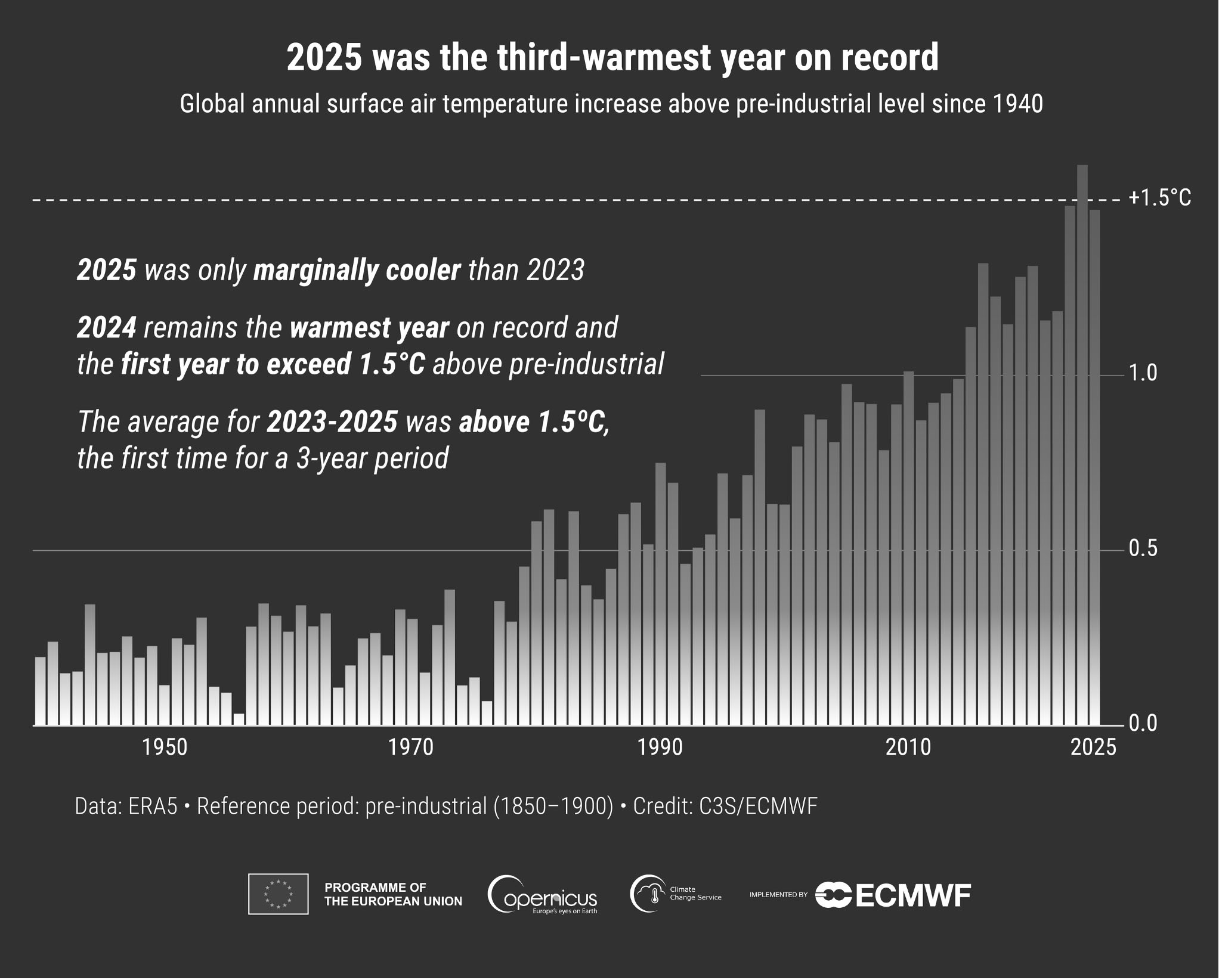
In a warming world, farming is no longer just about what the soil can grow. It is about what the climate will allow, what water will be available, and how quickly a farmer can adapt when weather stops behaving like history.
The clearest warning comes from drought. A UN-backed assessment of drought hotspots since 2023 describes impacts that are spreading “poverty, hunger, energy insecurity and ecosystem collapse” across multiple regions. In Southern Africa, roughly 68 million people needed food aid in August 2024. In Zimbabwe, the 2024 corn crop fell 70% year on year, maize prices doubled, and 9,000 cattle died from thirst and starvation.
That is climate change in its most immediate form: not a projection, but a supply shock that turns into food inflation.
Why sustainable farming is now a macroeconomic issue
The OECD and FAO expect global agricultural and fish production to increase by 14% over the next decade, mostly through productivity gains rather than land expansion. This is the optimistic part of the story: more output, fewer hectares.
But the same Outlook expects direct agricultural greenhouse-gas emissions to rise by 6% by 2034. Agriculture is both a climate victim and a climate driver, and that dual role is shaping the economics of food.
The risk is not only lower yields. It is volatility. OECD-FAO’s stochastic analysis flags that an “extreme event” that pushes prices outside expected ranges has a 40% probability of occurring at least once during the projection period, implying real fiscal exposure for governments through social assistance when food prices spike.
And hunger remains stubbornly high. SOFI 2025 estimates 673 million people experienced hunger in 2024 (8.2% of the global population), with a range of 638–720 million. The same report explicitly examines the causes and consequences of recent food price inflation.
In other words, sustainable farming is no longer a niche agenda. It is climate stabilization for household budgets.
The water constraint is tightening
Heat is the headline, but water is the binding constraint. A 2025 UN water report warning, summarized by UNESCO, notes that receding glaciers and dwindling snowfall in mountains will impact two-thirds of irrigated agriculture worldwide.
That matters because irrigation is not just a technical fix. It is the backbone of staple crop reliability in many regions. As snowpack becomes less predictable, the “calendar” of water shifts. Farmers may face water arriving too early, too late, or not at all.
The sustainable farming toolkit is increasingly digital
The most practical climate response in agriculture is not one silver bullet. It is a package: soil health, water efficiency, diversified cropping, lower emissions intensity, and better information. The OECD-FAO Outlook frames this as “emission reduction technologies (ERTs)” that reduce climate impact without compromising productivity, and it names the direction clearly: precision farming, improved nutrient and water management, and scalable practices such as crop rotations, intercropping, and compost-based nutrient management.
This is where green transition meets digital transformation.
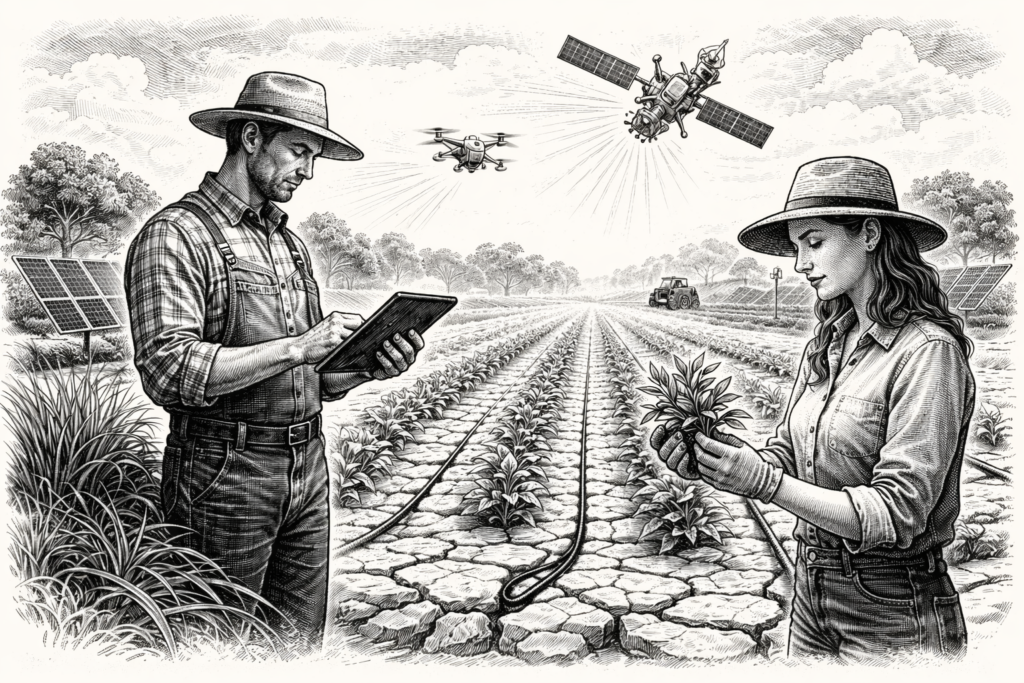
Precision agriculture (sensors, satellite imagery, GPS-guided machinery, decision-support software) helps farmers apply water and nutrients only where and when needed. In climate terms, that is not just efficiency—it is drought insurance.
Soil-first practices (rotations, intercropping, compost-based systems) strengthen water retention and resilience under heat stress. They also reduce reliance on expensive inputs that can become volatile during geopolitical shocks.
Livestock innovations (improved feed strategies and manure management) target methane and nitrous oxide while maintaining output—critical as demand for animal-source foods rises.
OECD-FAO’s scenario analysis suggests what is possible if these approaches scale: by 2034 undernourishment could be eliminated while direct agricultural emissions fall by 7% below current levels, but this depends on a 15% productivity improvement and broad adoption of available emission-reducing technologies.
Agri-tech needs systems, not apps
The technology exists. The constraint is adoption—especially for smallholders who face limited access to credit, infrastructure, training, and advisory services. The OECD-FAO Outlook notes that the pace and reach of implementation depend on infrastructure development and knowledge transfer.
This is why drought readiness is shifting from crisis response to proactive risk management. In 2025, WMO released a baseline review on drought impact monitoring, explicitly aiming to help countries move from reactive crisis management to proactive risk management supported by monitoring and early warning systems.
The agricultural “digital transformation” that matters most is therefore not only farm equipment. It is the public goods layer: climate services, forecasting, drought monitoring, and data infrastructure that makes private agri-tech useful at scale.
A concrete example of the shift
Digital agriculture is increasingly treated as a resilience strategy, not a modernization slogan. In 2025, FAO and EBRD launched a dedicated publication on Digital Technologies for Agriculture in Türkiye, describing how tools such as smart irrigation, precision farming and digital market platforms can improve productivity, sustainability and resilience, and noting the adoption gap for small farms.
That is a microcosm of the global reality: the opportunity is real, but the transition must be inclusive.
Climate change is turning farming into a volatility business. Drought is already compressing harvests and inflating prices. Hunger remains widespread, and food price inflation has become a central policy concern. Meanwhile, the water system that underwrites irrigation is becoming less predictable as glaciers retreat and snowpacks shrink.
Sustainable farming, especially when paired with agri-tech, is the most credible prevention strategy available now: it cuts emissions intensity, protects yields, reduces input waste, and helps farmers adapt to a climate that no longer respects averages.
The green transition in agriculture will not be won by rhetoric. It will be won by data, soil, water, and the speed at which resilience becomes normal practice, before the next drought writes the next price spike.