




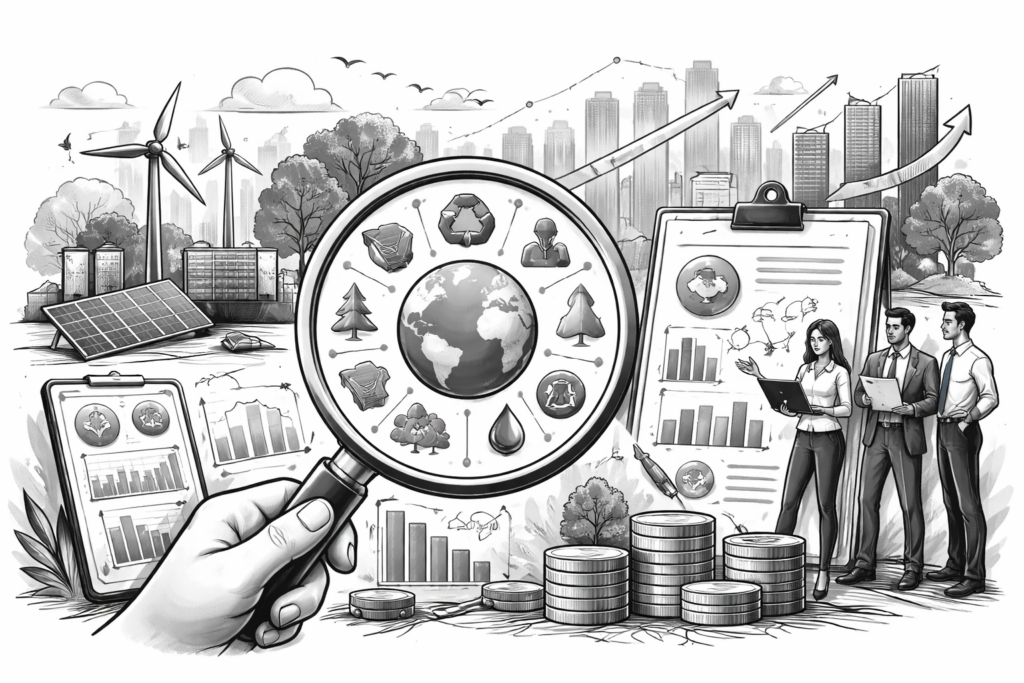
In the world of sustainability and climate finance one concept has quietly become central to how investors and companies think about environmental impact. The word is taxonomy. It sounds technical at first but it is fundamentally about making sense of what counts as truly sustainable in a way that can be measured and trusted.
In sustainability policy and finance a taxonomy refers to a common classification system that defines what activities can be considered environmentally sustainable. Without shared definitions it is easy for companies or funds to claim they are green or eco-friendly without meeting any clear standard. Taxonomy brings clarity and rigor to a landscape that is full of marketing terms with no universal meaning.
Why a Shared Classification Matters
Imagine a world where every investment manager could label their product as sustainable according to their own criteria. One fund might back renewable energy projects. Another might describe efficient cement production as sustainable. Without a consistent rulebook there is no reliable way to compare these claims or guide capital toward genuinely beneficial environmental outcomes.
Taxonomies solve this problem by providing objective criteria for classifying economic activities. In this way they help prevent misleading claims about environmental performance known as greenwashing. They also help investors and companies make more informed decisions about where capital should flow to support long-term climate and environmental goals.
The European Union Example
The European Union has developed the most influential sustainability taxonomy in the world as part of its sustainable finance strategy. Known simply as the EU Taxonomy for Sustainable Activities it is a regulatory framework that defines the conditions under which economic activities can be considered environmentally sustainable. The taxonomy supports the EU’s broader climate and environmental objectives including reducing greenhouse gas emissions and protecting natural resources.
An economic activity is considered environmentally sustainable under the EU Taxonomy if it meets criteria showing that it makes a substantial contribution to at least one of the six defined environmental objectives. These objectives include climate change mitigation, climate change adaptation, sustainable use and protection of water and marine resources, transition to a circular economy, pollution prevention and control, and protection and restoration of biodiversity and ecosystems. At the same time, the activity must do no significant harm to any of the other environmental objectives and meet minimum social safeguards to fully qualify as sustainable under the framework.
This approach means that not all investments that claim to be green qualify under the taxonomy. Only those that meet science-based criteria get counted as sustainable. This creates a clearer standard for companies and investors to report against and allows comparison across sectors and markets.
How Taxonomy Shapes Sustainable Finance
Taxonomies influence how sustainability is reported and evaluated. In the EU, companies and financial institutions have to disclose how much of their business activities align with the taxonomy criteria. This transparency provides investors with better information on the environmental sustainability of their portfolios. It also encourages companies to improve their environmental performance.
For investors the taxonomy provides a way to direct capital toward projects that support environmental goals while avoiding those that do not meet recognized standards. By identifying what activities truly contribute to sustainability objectives the taxonomy helps shift financial flows toward the energy transition and other climate priorities.
Taxonomies Beyond Europe
Taxonomies are not unique to the European Union. Policymakers and financial regulators in many countries are developing or adapting their own frameworks. International collaboration among governments and financial institutions aims to align these frameworks over time so that capital can move across borders with consistent sustainability definitions. This work includes efforts to support interoperability between national and regional taxonomies so that sustainable finance can operate on a global scale.
Why This Matters for Sustainability
Taxonomy in sustainability is not just a technical exercise. It is a tool that makes environmental claims transparent and comparable. In a world facing urgent climate and nature challenges clear definitions help investors, companies and regulators focus on activities that deliver measurable environmental benefits. Without such clarity the risk is that capital intended for sustainability will be diluted by vague claims and inconsistent standards.
By providing that clarity taxonomies help ensure that financial markets can genuinely support the transition to low-carbon and environmentally resilient economies.