




Cities like to think of transportation as neutral infrastructure. It is not.
Mobility determines who can get to work, to school, to a hospital, to a park. When movement is constrained, so is opportunity. The Toolkit for Gender Inclusive Mobility Planning recently published by Cities Forum makes a simple but disruptive point: most urban transport systems were historically designed around the needs of peak-hour male commuters. Everyone else has been expected to adapt.
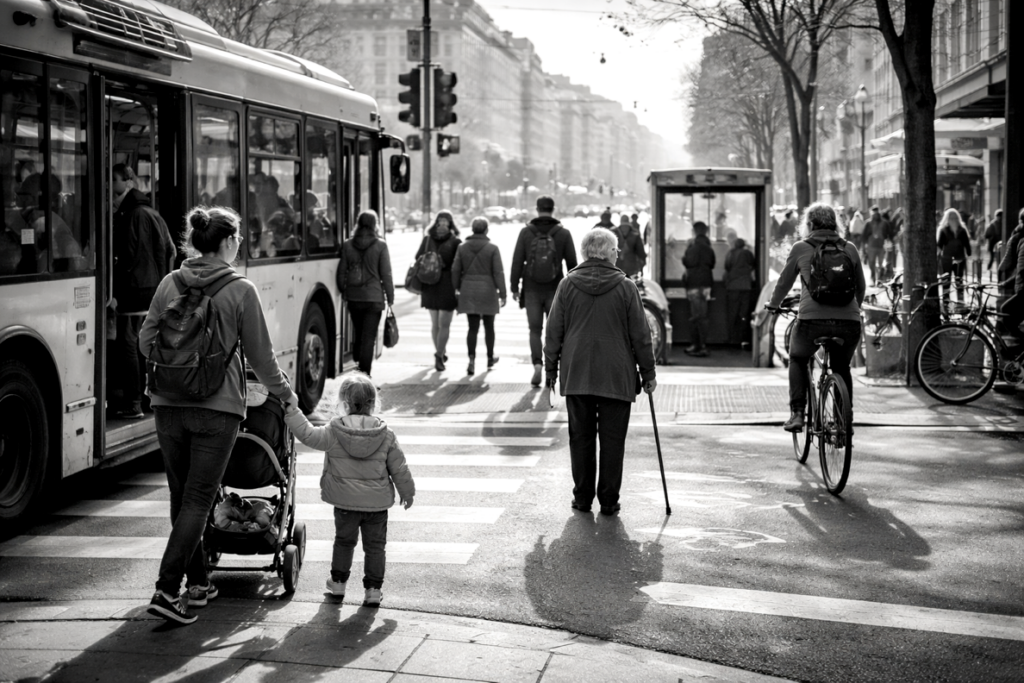
Women’s travel patterns rarely fit that model. Their trips are more likely to be multi-stop and care-related. They travel more often outside peak hours. They rely more heavily on walking and public transit. They are more likely to accompany children or elderly relatives. Yet planning assumptions still privilege long, linear commutes over short, chained, local trips.
Safety is the defining fault line. Poor lighting, unsafe transfer points and harassment on public transport restrict freedom of movement long before a timetable does. Accessibility is another barrier, not just for disabled users but for anyone navigating with strollers, groceries or caregiving responsibilities. Add time poverty shaped by unpaid care work, and unreliable systems become more than inconvenient. They become exclusionary.
The toolkit argues that when gender is not explicitly considered, benefits flow by default to those already best served. Equity does not happen accidentally. It must be designed.
Some cities are beginning to do exactly that.
In Vienna, a citywide survey in the late 1990s revealed gendered mobility differences and led to pedestrian-focused interventions such as wider crossings, better lighting and more seating. The changes were modest but transformative. They expanded who felt comfortable participating in public life.
In Umeå, Sweden, planners redesigned a pedestrian tunnel so that its full length was visible from the entrance and added a secondary exit. Public art and activity were introduced to increase foot traffic. The goal was simple: perceived safety improves when spaces are populated and visible.
In Los Angeles, officials discovered the problem was not just infrastructure but data. The city combined agency datasets with community-based research, training local residents to conduct surveys and interviews. Planning began to reflect lived experience rather than abstract averages.
Berlin’s protected bike lanes and traffic-calmed streets demonstrated another lesson. When public space is activated and visible, safety improves for everyone, particularly for those most vulnerable to harassment.
And in Leeds, open-source dashboards now track what makes parks feel safe or unsafe, from lighting to layout. The implication is clear: mobility systems can be monitored for equity just as they are monitored for efficiency.
The broader message moves past technical fixes to questions of equity and governance.
Mobility is not only about moving from point A to point B. It is about accessing life. When transit is unaffordable, unreliable or unsafe, social and economic gaps widen. When it is inclusive, cities become more productive and more just.
The future of transportation will not be judged solely by speed or congestion metrics.
It will be judged by who it enables to move freely, safely and with dignity.