

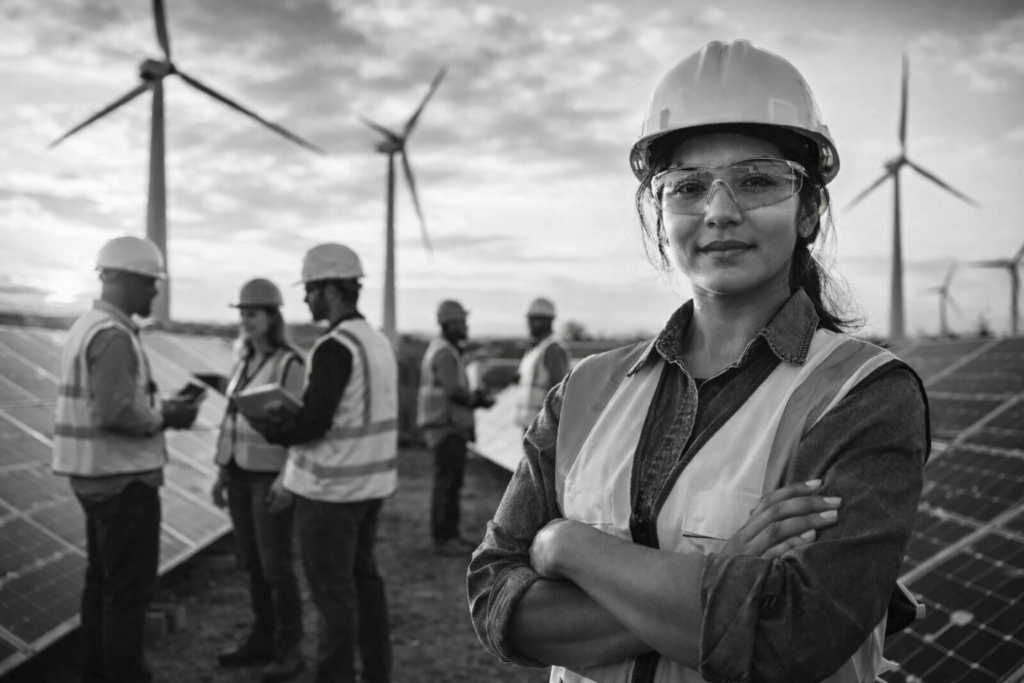
The global shift toward renewable energy is often framed as a technological and economic transformation. Yet, as the International Renewable Energy Agency (IRENA) makes clear in its 2025 Renewable Energy: A Gender Perspective report, it is equally a social one. The energy transition will not succeed at the scale or speed required if half of the global workforce remains structurally excluded.
According to IRENA, the renewable energy sector employed approximately 16.2 million people worldwide in 2023, a figure projected to rise to 30 million by 2030 and nearly 40 million by 2050 under a 1.5°C-aligned pathway. Despite this rapid growth, women currently hold only 32 percent of full-time jobs in the sector. While this is higher than in fossil fuel industries, it remains well below women’s overall participation in the global workforce.
The imbalance becomes more pronounced in core technical roles. When employment is narrowly defined to include manufacturing, installation, and operations, women’s participation falls to around 25 percent. Higher shares appear in services, research, and energy access-related activities, revealing that the gender gap is not about capability, but about where opportunities are structured and supported.
From experience working across energy, finance, and capacity-building initiatives, this distinction matters. Many women enter the energy transition through project development, advisory roles, or community-based initiatives, yet remain underrepresented where capital-intensive decisions, system design, and long-term asset ownership are concentrated. Without deliberate intervention, the transition risks reproducing the same hierarchies it claims to disrupt.
IRENA’s report also highlights the persistence of part-time and informal employment among women. Globally, 39 percent of part-time roles in the renewable sector are held by women. While flexibility can enable entry, it often comes at the cost of career progression, income stability, and leadership pathways. In practice, flexibility without structural support tends to reinforce traditional caregiving expectations rather than redistribute them.
The implications extend beyond the workforce. Nearly 670 million people still lack access to electricity, and 2.1 billion rely on polluting fuels for cooking. Women bear the heaviest burden of this energy poverty, both in health impacts and unpaid labour. At the same time, they are often central actors in deploying decentralized renewable solutions, managing energy use at household level, and sustaining community resilience.
These findings point to a clear conclusion: gender equity is not an ancillary issue in the energy transition, but a condition for its effectiveness. Unlocking the sector’s full potential requires moving beyond visibility toward structural change.
From a policy and implementation perspective, three priorities stand out. First, energy and climate strategies must integrate gender-responsive data and targets, not as standalone chapters, but across workforce planning, procurement, and financing frameworks. Second, capacity-building and skills programs need to focus on technical and leadership pathways, ensuring women can access not only jobs, but decision-making roles. Third, finance mechanisms, including green bonds and transition finance, should explicitly support inclusive project design, linking capital allocation to social as well as environmental outcomes.
As investment accelerates and energy systems transform, the question is no longer whether women should be included in the energy transition. It is whether the transition can deliver resilient, competitive, and just outcomes without fully integrating their expertise, labour, and leadership.