

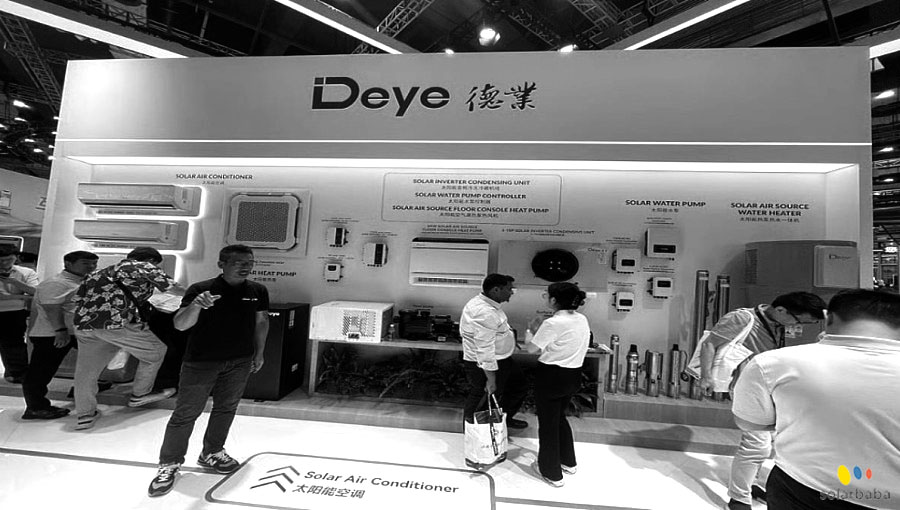
Deye showcased its next-generation solar-powered hybrid air conditioners at SNEC 2026, offering improved energy efficiency in both grid-connected and off-grid operating modes. Available in 1-ton, 1.5-ton, and 2-ton cooling capacities, the hybrid systems operate directly from solar panels during daylight hours and automatically switch to grid electricity at night or when solar generation is insufficient. This intelligent operation helps reduce electricity costs while lowering CO2 emissions. Users can also monitor the balance between solar and grid power in real time through a dedicated mobile application.
At SNEC 2026, Ningbo Deye Technology expanded its portfolio of solar-powered home appliances with its latest hybrid AC/DC air conditioning systems. During the day, the units run on direct current (DC) supplied by connected solar panels. When solar power becomes unavailable or insufficient, they seamlessly transition to alternating current (AC) from the electrical grid. This hybrid operating principle delivers significant energy savings compared to conventional air conditioners while minimizing environmental impact.
The company introduced three split-system models: DGA2-ACDCBLW-12K, DGA1-ACDCBLW-18K, and DGA1-ACDCBLW-24K. In off-grid mode, the units support solar capacities of 4 × 330 W, 6 × 330 W, and 8 × 330 W respectively. When connected to the grid, all models are compatible with standard 220 V single-phase power supplies, providing flexible installation options for residential users.
Optimized for both T1 and T3 tropical climate classifications, the air conditioners are available in 12,000 BTU (1 ton), 17,300 BTU (1.5 tons), and 22,000 BTU (2 tons) cooling capacities. In addition to cooling, the units feature a dry mode that removes excess indoor humidity to improve comfort. The systems are equipped with high-efficiency BLDC indoor and outdoor fan motors along with rotary inverter compressors to maximize performance and energy efficiency. Through Deye’s mobile app, users can monitor electricity consumption and track the proportion of energy supplied by solar power in real time.
Source: Solarbaba – In Turkish