




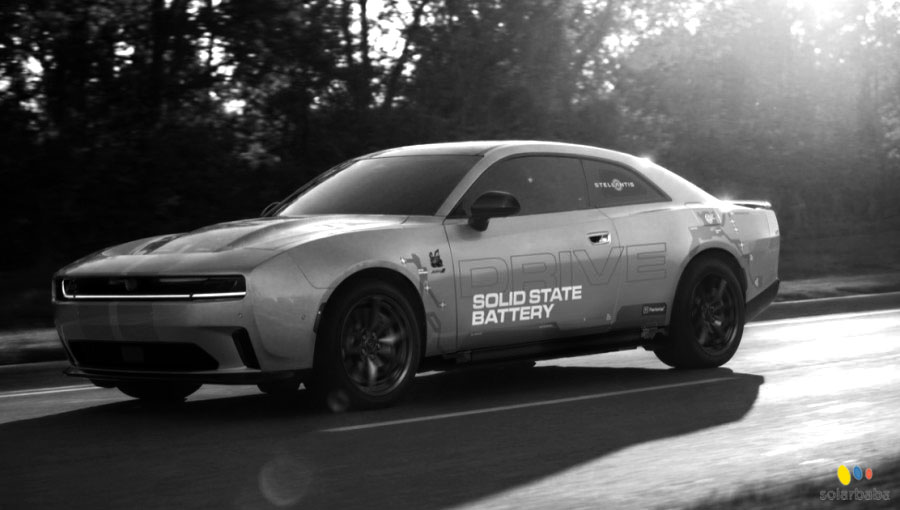
Road tests conducted in North America using a Dodge Charger have marked a major milestone in bringing solid-state battery technology from the laboratory to real-world driving conditions. The project, developed through a collaboration between Stellantis and battery technology company Factorial Energy, represents a significant step toward integrating next-generation battery cells into mass-production electric vehicles. Offering substantially higher energy density, faster charging capabilities, and improved performance across a wider temperature range than conventional lithium-ion batteries, solid-state technology is expected to transform the EV industry by improving efficiency while significantly reducing battery weight.
Engineers at Stellantis completely redesigned the battery pack architecture and vehicle control systems to integrate Factorial Energy’s FEST (Factorial Electrolyte System Technology) solid-state battery cells into an existing Dodge Charger platform. The project required extensive collaboration between the engineering teams of both companies. As the first solid-state battery integrated into a road-going vehicle in North America, the program represents a major achievement while following similar development efforts already underway in Europe by manufacturers such as BMW and Mercedes-Benz.
Instead of the liquid or gel electrolytes used in conventional lithium-ion batteries, Factorial’s technology utilizes a semi-solid electrolyte that combines liquid and solid components within a hybrid matrix. This design provides greater thermal stability, lower flammability, and optimized ion conductivity compared to traditional electrolyte systems. According to Factorial Energy, the semi-solid approach also offers lower manufacturing costs and easier scalability than fully solid-state electrolyte technologies.
One of the technology’s greatest advantages is its ability to nearly double energy density, dramatically reducing battery size and weight. For example, while a conventional battery pack may weigh approximately 624.5 kilograms, an equivalent solid-state battery capable of delivering similar performance could weigh as little as 256 kilograms. This substantial weight reduction improves overall vehicle efficiency, extends driving range, and enhances handling and driving dynamics.
Although mass production of solid-state batteries is still several years away, the technology is already beginning to reach commercial applications. Companies such as Verge Motorcycles have introduced motorcycles powered by proprietary solid-state battery systems, demonstrating the technology’s commercial viability. The partnership between Stellantis and Factorial Energy suggests that a similar transformation is approaching the automotive industry, with manufacturers racing to introduce the world’s first mass-produced electric vehicles powered by solid-state batteries.
Source: Solarbaba – In Turkish