


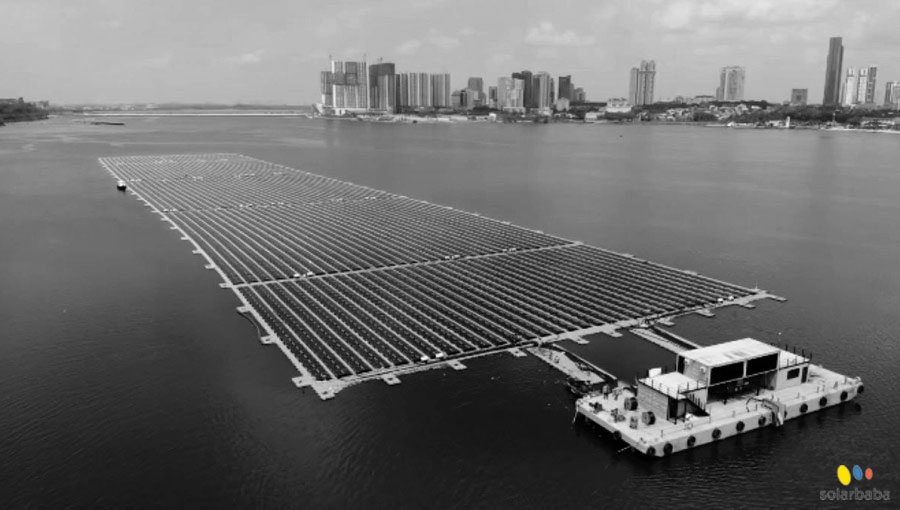
A team of Chinese and Swiss researchers has crossed a significant technological threshold by proving that solar panels can generate electricity at a depth of 10 meters underwater. Published in the journal Joule, the study marks a revolutionary development in solar energy technologies, which typically fail to operate at depths greater than two meters due to reduced light transmission. By optimizing lead halide solar cell technology for the underwater light spectrum, the experts aim to create a sustainable energy source for equipment used in areas such as offshore communication systems and aquaculture.
A team led by Wen-Hua Zhang from Yunnan University and Southwest United Graduate School noted that previous underwater solar energy studies had been limited to shallow waters, and to overcome this obstacle, they developed special modules capable of absorbing blue and orange light. In laboratory tests, solar cell samples kept in an oxygen-free environment for 300 days were observed to retain 96 percent of their initial efficiency. Furthermore, negligible degradation was recorded in 1.160 hours of simulated underwater exposure tests.
Seeking to prove the technology’s success in real-world conditions, researchers conducted field trials off the Weizhou Islands in the South China Sea. Solar panels mounted on underwater robots successfully generated electricity at a depth of 10 meters. These results, achieved with large-area modules, demonstrate that underwater photovoltaic systems could be a reliable energy solution for marine applications. The team plans to test this solar cell technology in deeper waters in the future and establish standard testing protocols for the industry.
Source: Solarbaba – In Turkish