Looking at the history of industry, we see that every major transformation actually began not with technology, but with data.
The agricultural revolution was made possible by measuring the land.
The industrial revolution grew by measuring production.
Digital transformation entered our lives with the measurement of processes and operations.
Today, we are in the midst of a new transformation:
The green transformation.
However, this time many businesses are facing an important reality. Sustainability is no longer just a matter for environmental departments. Nor is it just a matter of reporting. In fact, sustainability is fundamentally a data management problem.
Because;
You cannot manage what you cannot measure.
You cannot reduce what you cannot manage.
And you cannot verify what you cannot reduce.
That is precisely why sustainability regulations around the world are increasingly demanding more data.
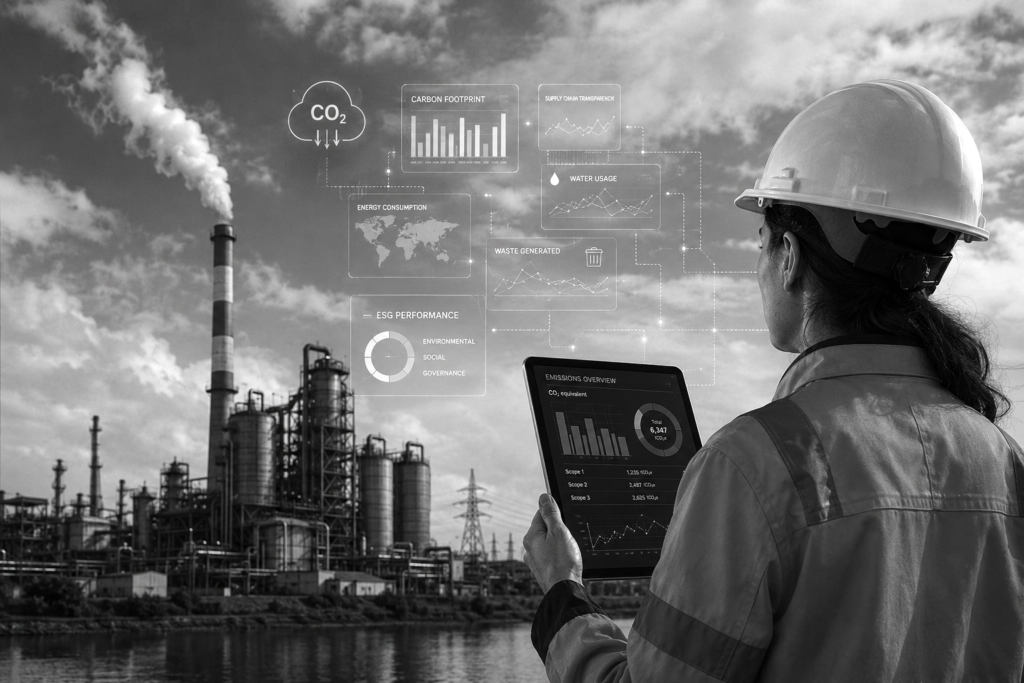
The European Union’s Border Carbon Adjustment Mechanism (CBAM) requires companies to disclose not only their carbon emissions, but also how these emissions are calculated.
Product carbon footprint studies are no longer just a result; they question the traceability of all data throughout the product’s lifecycle.
ESG reporting is becoming as auditable as financial reports.
Supply chains are being evaluated not only in terms of cost but also in terms of data quality.
In short, the world is entering a new era.
In this era, competitive advantage will not only be about producing at a lower cost.
Companies that can produce higher quality data will stand out.
The issue is even more critical for Türkiye.
Because many businesses have faced sustainability transformation before completing their digital transformation journey.
ERP systems have been implemented.
Accounting processes have been digitized.
Production systems have been modernized.
However, significant gaps still remain in the traceable transfer of field data to decision-making mechanisms.
Today, in many businesses, energy consumption data is kept in one system, production data in another, purchasing records in a different ERP, and logistics information in a completely separate structure.
Then, these data are attempted to be brought together in Excel files.
While this approach may produce reports in the short term, it is not sustainable in the long term.
Because future regulations will demand evidence, not reports.
They will want to see where an emission value comes from,
Which bill it is based on,
Which meter it was produced from,
Which supplier it comes from,
Which methodology was used to calculate it.
In fact, the essence of the green transformation lies here.
The problem is not carbon.
The problem is the quality of the data.
Therefore, it would be a big mistake to view sustainability technologies only as carbon calculation tools.
The real need is for infrastructures that can make sense of operational data, relate it, and transform it into corporate memory.
Just as ERP systems transform financial processes, next-generation sustainability platforms will make environmental data a part of corporate decision-making processes.
In the coming years, companies will not want to buy dozens of different sustainability software programs.
Instead of using separate systems for carbon,
water,
ESG,
CBAM,
and the supply chain; They will prefer integrated infrastructures that will manage all their data from a single center.
Because sustainability is actually a process, not a result.
And the raw material of this process is data.
Türkiye has a significant opportunity ahead.
Our industrial infrastructure is strong.
Our production culture is strong.
Our engineering capabilities are strong.
However, the competitive advantage of the new era will be determined not only by production capacity but also by data capacity.
Today we are talking about the age of artificial intelligence.
But the fuel of artificial intelligence is also data.
The fuel of sustainability is also data.
The industry of the future will not only be one that emits less carbon; it will be one that produces more accurate data.
Perhaps the most important question of the next decade will be:
Not “Do you know your carbon emissions?”
“Do you trust your data?”
Because the real heroes of the green transformation will not be carbon accounts, but the invisible data infrastructures that make those accounts possible.