

The conclusion of COP30 in Belém has been framed as a moment of collective mobilization, reinforcing ambitions that now speak in trillions rather than billions. With the adoption of the new global climate finance framework targeting USD 1.3 trillion annually for developing countries by 2035, political commitment has matured. Targets are clearer. Volumes are larger. Yet a fundamental friction persists: political scale does not equate to financial transmission.
While ambition has advanced in negotiation rooms, the mechanisms required to move capital into the real economy remain insufficiently standardised. In 2024, multilateral development banks committed USD 136.6 billion in climate finance globally, including USD 85.1 billion for low- and middle-income economies. These are large numbers. But large numbers alone do not create deployment architecture.
The critical question is not whether climate finance is “sufficient” in aggregate volume. It is this: if capital is increasingly committed at the global level, why does it still stall between commitment and sector-level deployment?
In financial terms, transmission is not a function of ambition. It is a function of architecture. Three mechanical requirements must be present:
- Predictable sector cashflows that translate transition pathways into foreseeable revenue streams.
- Standardized risk allocation frameworks that clarify who absorbs first-loss, currency, and policy exposure.
- Template-based capital structures that allow financing to move beyond bespoke negotiations toward repeatable blueprints.
Without these conditions, capital cannot flow at scale.
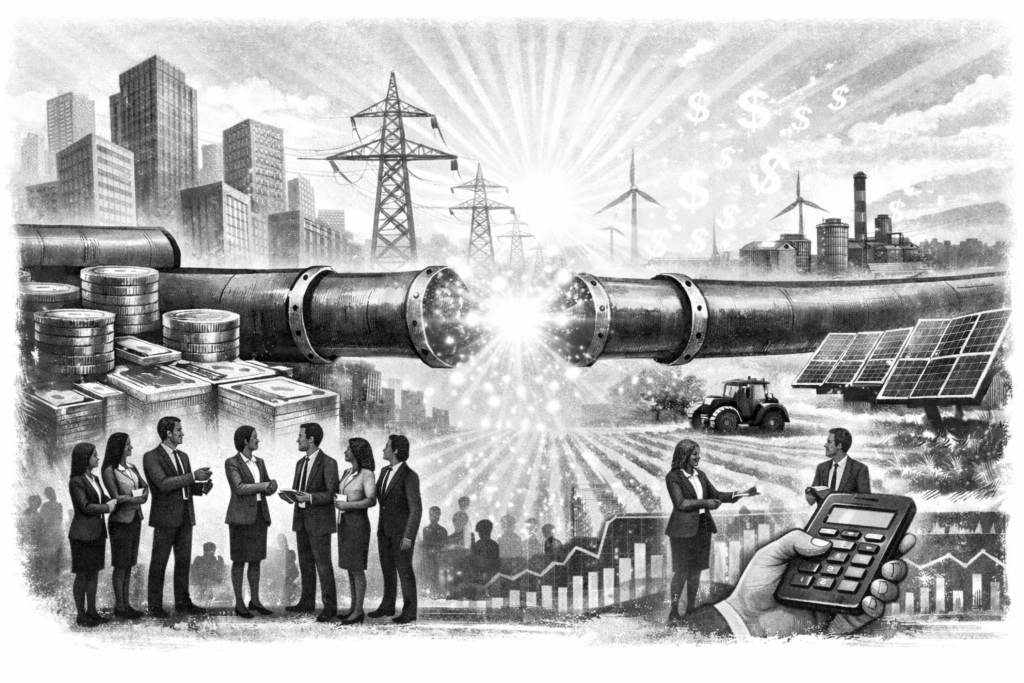
The current gap – what can be described as a Sectoral Transmission Failure – reflects the absence of a standardized interface between global capital commitments and the heterogeneous realities of industrial and agricultural transition. Sector pathways remain policy-sensitive, sovereign-risk exposed, and structurally uneven – conditions under which institutional capital hesitates.
This hesitation is visible in the cost of capital itself: in a sample of countries, the weighted cost of capital for utility-scale solar can reach 9–12% in emerging market and developing economies, compared with 5–6% in advanced economies. At the same time, the scale-up required in private finance remains far beyond current levels; the IHLEG estimates that private climate finance would need to increase 15–18 fold by 2030. OECD work on blended finance points to the same structural problem from another angle: capital mobilisation remains constrained by fragmentation, complexity, and the absence of standardized approaches that can be replicated at scale.
We are not confronting a shortage of capital. We are confronting a financial architecture that has not yet evolved to match political ambition. Closing this gap requires moving beyond aggregate commitments toward the design of sector-level transmission mechanisms. Structures capable of translating transition pathways into predictable cashflows, investable risk allocation, and repeatable capital stacks. Until that architecture is built, the trillions invoked in Belém risk remaining a political signal rather than a functioning deployment system.