


The global economy now consumes roughly 100 billion tonnes of resources each year, three quarters of them non-renewable. If trends continue, extraction could rise by 150% by 2060, intensifying climate risks, pollution and biodiversity loss.
The challenge is not simply environmental. It is structural.
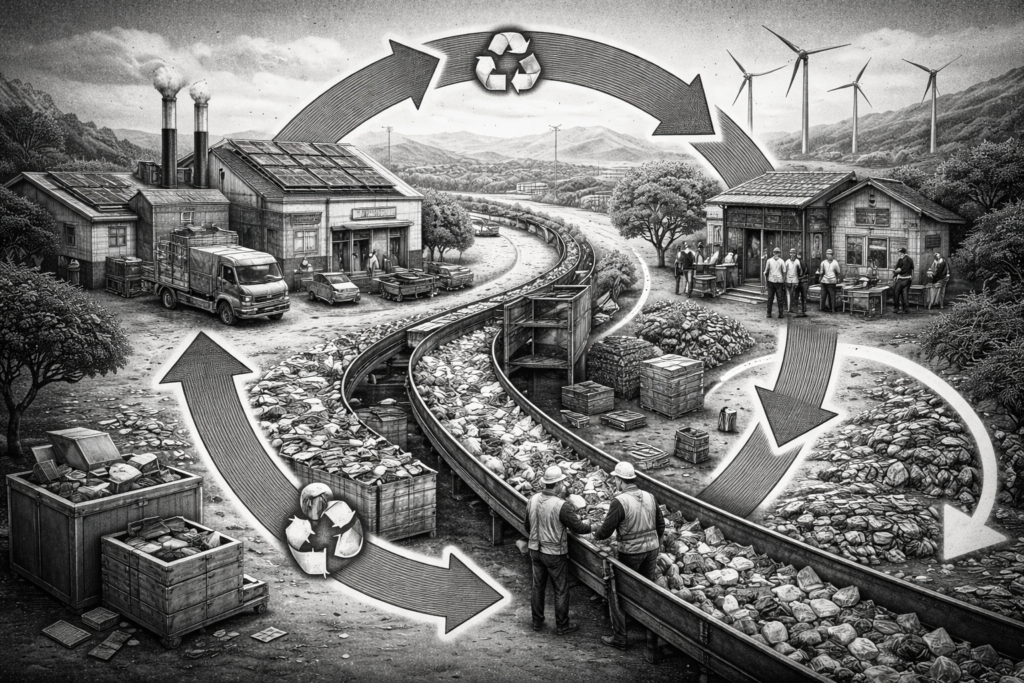
The Ellen MacArthur Foundation’s latest policy brief argues that governments must move beyond waste management and toward resource management — keeping products, parts and materials in use at their highest value for as long as possible. The report identifies three policy instruments as particularly transformative:
- Waste regulations and resource classifications
- Extended Producer Responsibility (EPR)
- Policies supporting secondary materials markets
Together, they create the legal clarity, financial incentives and market demand needed to shift from a linear “take–make–waste” model to circular value loops.
1. Waste Is a Legal Definition and a Policy Lever
Once a material is classified as waste, strict rules apply. That classification determines whether something can be reused, repaired, remanufactured, recycled or must be disposed of.
Poorly designed definitions can unintentionally discourage circular pathways. Clear and harmonised definitions, by contrast, reduce legal uncertainty, improve investor confidence and enable cross-border trade in secondary materials.
The European Union’s Waste Framework Directive establishes the basis for “end-of-waste” criteria, allowing materials like iron, steel, aluminium scrap, glass cullet and copper scrap to re-enter production streams. Ireland has operationalised this through national end-of-waste and by-product criteria, including for recycled aggregates and road planings.
The lesson: classification determines value.
2. Extended Producer Responsibility: Funding Circularity
EPR shifts responsibility for post-consumer waste management from governments to producers, requiring companies to finance collection, sorting and recirculation.
Well-designed EPR systems provide dedicated, ongoing and sufficient funding, improve transparency in material flows and align industry actors toward shared recovery targets.
Germany offers a mature example. Since launching packaging EPR in 1991, the system has evolved with strong enforcement and eco-modulated fees. By 2023, Germany achieved a 96% packaging recovery rate and a 69% recycling rate, surpassing the EU’s 65% target for 2025.
Brazil demonstrates a different dimension: inclusion. By integrating informal waste pickers into the formal system, Brazil has reached 97% recycling rates for cans and 67% for cardboard, despite limited separation-at-source coverage.
The message is EPR can mobilise finance. But design and enforcement determine impact.
3. Building Markets for Secondary Materials
Supply alone is insufficient. Secondary raw materials must compete with cheaper virgin resources.
Policies supporting secondary markets, through quality standards, pricing signals and cross-government coordination, can reduce price volatility, strengthen supply chains and stimulate domestic economic activity.
The Republic of Korea’s 2024 recycled plastics certification system illustrates this approach. The scheme sets minimum recycled content thresholds — 20% for electrical and electronic products, 10% for other consumer goods, containers and food-grade PET bottles — and could increase certified recycled plastic use from 2,600 to 7,000 tonnes per year, with potential to reach 80,000 tonnes, enough for three million refrigerators .
China’s remanufacturing strategy shows how national ambition can scale industry. The 2017 Smart Remanufacturing Action Plan set a goal of RMB 200 billion (USD 28 billion) for the sector by 2025, embedded within broader targets including RMB 5 trillion (USD 700 billion) for the resource recycling industry and raising resource productivity by 20% compared to 2020.
National targets create direction. Markets create scale.
A Policy Mix, Not a Single Tool
The report stresses that these instruments must operate within a broader ecosystem, aligning climate, fiscal, procurement, industrial and investment policies. Governments should embed circular economy impact assessments into budgets and establish formal coordination mechanisms across ministries.
Circularity is not only about materials. It is about coherence.
The Strategic Shift
The circular economy is often framed as an environmental strategy. This report reframes it as an economic resilience strategy.
Keeping materials in use reduces exposure to price volatility and supply chain shocks, supports domestic employment, strengthens industrial competitiveness and lowers environmental harm.
The choice is not between growth and sustainability. It is between value lost and value retained.