

Why Subsidy Reform Is Less About Prices Than About Time, Trust, and Adaptation
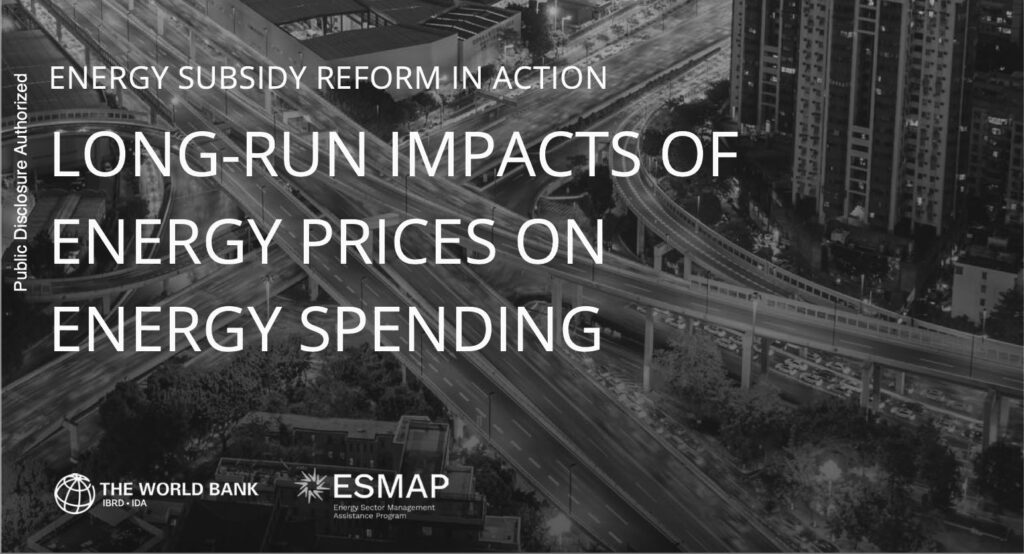
Energy subsidies are often defended as protection: a buffer against inflation, a safeguard for households, a political necessity. But new evidence from the World Bank’s Energy Sector Management Assistance Program (ESMAP) suggests that subsidized energy prices may also create something else: delay.
Delay in adaptation. Delay in investment. Delay in the structural shift toward efficiency.
The report’s core finding is simple but consequential. When energy prices rise, economies do adjust. But they do so slowly, and without policy support, that adjustment can take decades.
Price Shocks Hit Fast
In the short run, energy price increases pass through almost directly into higher energy spending.
ESMAP estimates that a 10 percent increase in energy prices leads to an approximately 8 percent increase in national energy cost shares within the same year. Consumers and firms feel the shock immediately.
Over time, however, the impact is partially absorbed. In the long run, a 10 percent price increase translates into only about a 4.8 percent increase in energy cost shares, reflecting adjustment through reduced energy intensity and behavioral change.
The gap between short-term pain and long-term adaptation is one of the report’s clearest policy signals.
Adaptation Takes Nearly Two Decades
Perhaps the most striking insight is the speed of adjustment.
The report finds that the median “half-life” of adjustment, meaning the time it takes for an economy to absorb half the impact of a permanent energy price increase, is about 18 years without policy support.
This is not a rapid market correction. It is a slow structural transition, shaped by the long turnover of energy-related capital stock and the inertia of energy-intensive systems.
Subsidies, in this framing, do not eliminate adjustment. They postpone it.
Subsidies Weaken Efficiency Incentives
The report also highlights that countries with low net energy consumption taxes, or high subsidies, are less likely to use energy efficiently.
Such countries show slower adjustment dynamics, with half-lives around 18 years, compared with quicker adjustment in higher-tax environments. Cheap energy reduces the urgency of efficiency improvements, locking economies into long-run vulnerability.
Efficiency Policies Change the Equation
The clearest conclusion of the report is that subsidy reform cannot succeed in isolation.
Using the World Bank’s RISE indicators, ESMAP finds that energy efficiency policies and regulations mitigate the impact of price increases on energy cost shares, across multiple sub-indicators.
In aggregate, the presence of strong efficiency policies reduces the price elasticity of energy cost shares by approximately 0.05, meaning price shocks translate into smaller spending burdens when efficiency institutions are in place.
Crucially, the report notes that high-level frameworks alone are not enough. The strongest impacts come from sector-specific incentives, mandates, and standards that directly influence household and firm decisions.
Reform Must Be Politically Managed
Because short-run impacts can be substantial, the report emphasizes that governments must design reforms as comprehensive packages.
Targeted compensation for vulnerable households is essential to political and social acceptability.
But mitigation alone is insufficient. Fiscal savings from subsidy reform are maximized when combined with energy efficiency measures and reinvested into productivity, welfare, and long-term development priorities.
The Fiscal Argument Is Stronger Than It Appears
Subsidy reform is often framed as fiscally risky. The report suggests the opposite.
With a long-run elasticity around 0.48, the fiscal savings from reducing subsidies are likely to exceed the cost of compensating consumers, because consumption declines as prices rise.
In this context, subsidy reform can generate net positive budget effects, provided compensation is targeted and time-bound.
The Larger Lesson
Energy subsidy reform is often presented as a pricing debate. This report reframes it as something deeper: a question of how quickly economies can evolve when energy prices begin to reflect real costs.
The evidence suggests that adaptation is possible, but slow. Efficiency policies accelerate it. And reform succeeds not when prices rise abruptly, but when governments manage the transition with credible institutions, targeted protection, and long-term investment.
Cheap energy may feel like stability. But in many cases, it is simply deferred adjustment.