




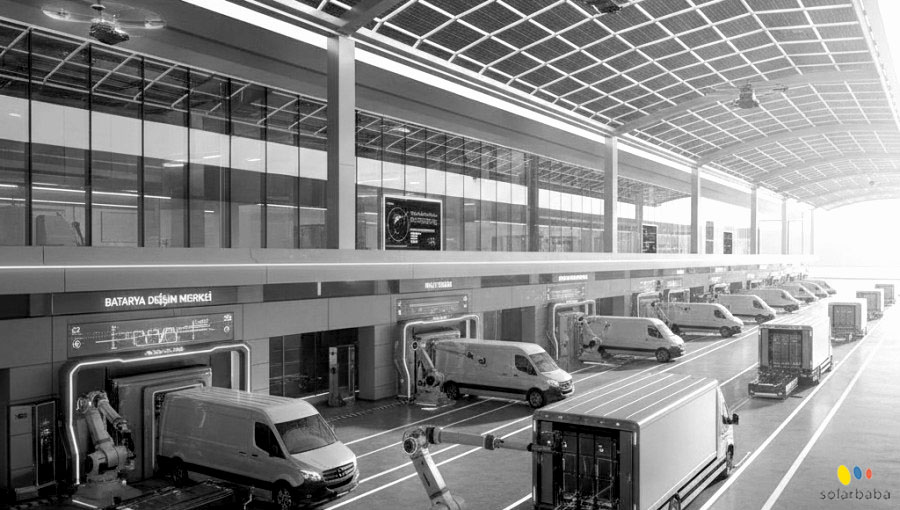
Battery manufacturer CATL has launched China’s first standardized battery swapping ecosystem for light commercial vehicles. Known as “Choco-Swap,” the system enables battery replacement in just 120 seconds, dramatically reducing downtime for logistics operations. Designed as a faster and more cost-effective alternative to conventional charging, the technology is already supported by dozens of battery swap stations across the Greater Bay Area. CATL plans to expand the network to 30 cities nationwide, creating a large-scale battery swapping infrastructure for both commercial and passenger electric vehicles.
Developed to improve the operational efficiency of logistics fleets, the battery swapping system significantly reduces vehicle downtime. Over an eight-year vehicle lifecycle, the technology is expected to save more than two hours compared to conventional refueling and charging processes while cutting energy costs by approximately 50% relative to fuel-powered light commercial vehicles. The modular swapping stations are compatible with vehicles featuring wheelbases ranging from 2.7 to 3.75 meters and support CATL’s standardized 25# and 35# battery packs, allowing multiple vehicle models to utilize the same infrastructure.
CATL currently operates 31 battery swapping stations across the Guangdong-Hong Kong-Macao Greater Bay Area and plans to expand that number to 140 by the end of the year. Working with its subsidiary Contemporary Amperex Energy Service Technology and logistics partner DST, the company aims to deploy 5,000 standardized electric light commercial vehicles in the region by 2026. The project is expected to serve as a blueprint for future urban logistics hubs across China.
Beyond light commercial vehicles, CATL is also accelerating the electrification of heavy-duty transportation. Following successful pilot programs, the company plans to establish 900 battery swapping stations for heavy-duty trucks by 2026 and has signed additional agreements to expand battery swapping networks for public transportation, including taxis. By eliminating lengthy charging times, CATL aims to maximize vehicle utilization rates and strengthen China’s rapidly growing electric mobility infrastructure.
Source: Solarbaba – In Turkish