Santa Marta did not deliver a treaty. It did something more immediate: it moved the fossil fuel phase-out debate from slogan to statecraft.
For three decades, climate diplomacy has largely treated fossil fuels as the thing just outside the frame. The negotiations counted emissions, priced carbon, encouraged renewables, tracked national pledges and debated finance. But the coal, oil and gas systems that created the crisis often remained politically abstract, described through their atmospheric consequences rather than their economic roots.
That changed, at least symbolically, in Santa Marta.
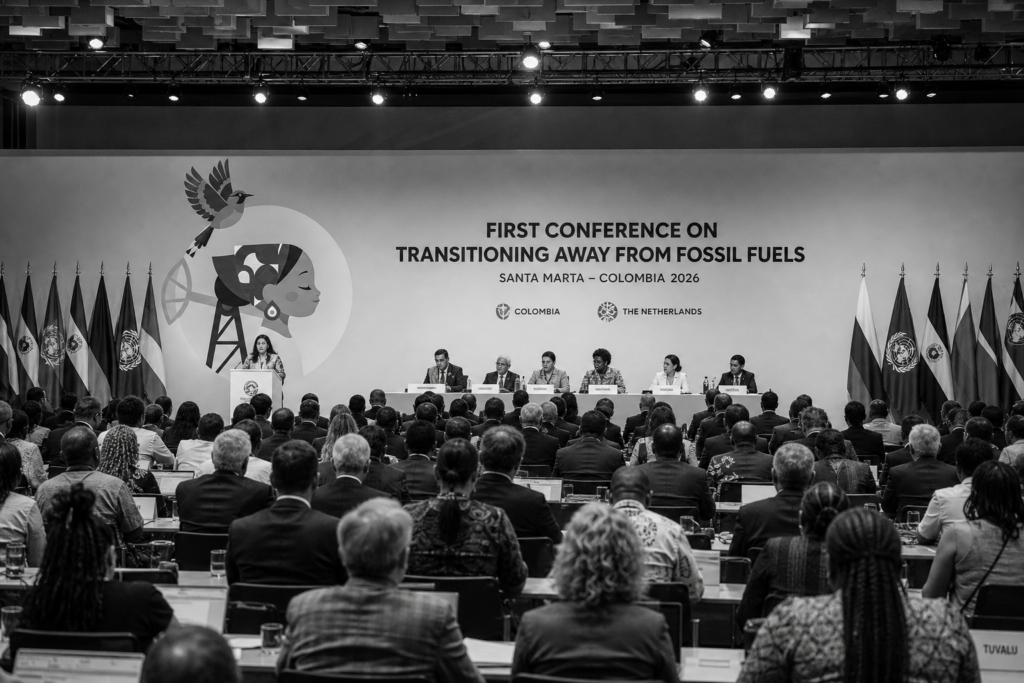
From 24 to 29 April 2026, Colombia and the Netherlands hosted the First Conference on Transitioning Away from Fossil Fuels in the Caribbean port city of Santa Marta. The meeting gathered 57 countries, alongside representatives from subnational governments, academia, social movements, NGOs, trade unions, parliamentarians, the private sector, multilateral development banks, Indigenous Peoples, people of African descent, peasants, children and youth, and women and diversity groups. Its stated aim was not to create new targets, but to ask how countries could begin implementing commitments already made under the Paris Agreement and at COP28.
That distinction matters. The world has already agreed, on paper, to transition away from fossil fuels. The harder question is whether governments are prepared to govern that transition.
Santa Marta was important not because it solved the fossil fuel problem. It did not. It produced no binding treaty, no universal deadline and no enforcement mechanism. Its importance lies elsewhere: it created a diplomatic space where countries willing to move faster than the slowest actors in the COP process could begin discussing fossil fuel decline as a practical agenda.
In climate diplomacy, that is not a small thing.
The road to Santa Marta began in Dubai
The conference’s origin lies in the wording of the COP28 Global Stocktake. In Dubai in 2023, governments agreed for the first time in a formal UN climate decision to call on Parties to transition away from fossil fuels in energy systems, in a just, orderly and equitable manner. The UNFCCC described the COP28 outcome as signalling the “beginning of the end” of the fossil fuel era.
But the Dubai text was a diplomatic breakthrough with a structural weakness. It named the direction of travel, but not the route.
There was no agreed roadmap. No production-side framework. No timetable for coal, oil or gas decline. No finance mechanism for fossil-fuel-dependent economies. No architecture for managing workers, regions or public revenues. No answer to the uncomfortable question of whether fossil fuel exporters could continue expanding production while claiming progress through domestic emissions targets.
By the time governments arrived at COP30 in Belém in 2025, this gap had become difficult to ignore. The Santa Marta process was explicitly born from the COP30 moment. Colombia’s environment ministry described the conference as an initiative that emerged at COP30 in Belém under the leadership of President Gustavo Petro and Acting Environment Minister Irene Vélez Torres, co-organized with the Netherlands to accelerate international climate action.
The immediate political bridge was the Belém Declaration on the Transition Away from Fossil Fuels, presented on 21 November 2025. The declaration stated that fossil fuels are the main driver of global warming, that projected emissions and subsidies are incompatible with the 1.5°C limit, and that accelerating the transition requires complementary action beyond the regular UNFCCC process.
On the same day, Colombia and the Netherlands announced that they would convene the first international conference in Santa Marta on 28 and 29 April 2026, with the broader process later structured across 24 to 29 April. The declared purpose was to deepen cooperation, build ambition and start constructing a global roadmap.
The sequence is therefore clear:
COP28 created the phrase. COP30 exposed the implementation gap. Santa Marta was built to fill it.
A coalition of the willing, outside the consensus trap
The conference was designed as a complementary process to the UNFCCC, not a replacement for it. That distinction matters.
The COP process is universal, formal and consensus-based. It gives every country a seat, but it also gives powerful blockers room to dilute or delay. A separate conference, by contrast, can gather countries that already accept the need to move faster and ask a different question: not whether the world should transition away from fossil fuels, but how.
Colombia’s diplomatic preparation reflected this logic. In January 2026, the Colombian government convened 40 ambassadors and representatives of its diplomatic missions to prepare for the conference, brief them on its objectives and strengthen relations with environment ministers from more than 60 countries that had expressed support for moving beyond fossil fuels.
By March, the scale of interest was already visible. Colombia reported that 2,608 organizations had expressed interest in participating, alongside invitations to 97 national governments and 30 subnational governments. Around 41 percent of registered participants came from Latin America and the Caribbean, while 33 percent represented multiregional or global organizations. The composition was also deliberately multisectoral: nearly half of registrations came from NGOs, with significant participation from Indigenous Peoples, Afro-descendant and peasant communities, social movements, academia, the private sector and trade unions.
This was not simply a ministerial meeting. It was built as a political laboratory.
What happened in Santa Marta
When the conference opened on 24 April 2026, Colombia and the Netherlands framed it as the world’s first conference of its kind. More than 50 countries from the Global North and Global South were convened, representing a diverse part of the fossil fuel supply chain. Colombia said the countries present together represented about one-fifth of global fossil fuel production and almost one-third of global consumption.
Acting Colombian Environment Minister Irene Vélez Torres said 56 countries had confirmed participation, with roughly one-third of country representatives from Europe, 20 percent from Latin America and the Caribbean, 16 percent from Africa, 12 percent from Asia and 15 percent from Oceania, including Pacific island states and Australia. She also noted the presence of UN agencies and the COP30 and COP31 presidencies.
The Netherlands framed the meeting in economic and geopolitical terms. Dutch climate leadership emphasized that the countries present represented more than 50 percent of global GDP, arguing that the group had the collective capacity to turn the COP28 phrase into concrete action at a time of volatile fossil fuel markets.
The agenda was organized around three pillars:
First, reducing economic dependence on fossil fuels.
This meant fiscal revenues, debt constraints, public finance, subsidies, industrial policy, regional diversification and labour transition.
Second, transforming supply and demand.
This included electrification, efficiency, renewable energy, grid modernization, energy access, phase-down of fossil fuel extraction, fossil fuel incentives and the risk of new lock-ins.
Third, advancing international cooperation and climate diplomacy.
This meant roadmaps, finance, trade, technology transfer, institutional coordination and the relationship between this new process and the UNFCCC.
The conference unfolded in stages. From 24 to 27 April, participants consolidated proposals built through prior written submissions and global virtual dialogues. These inputs were then brought to the high-level segment on 28 and 29 April, with ministers and international leaders.
That process matters because Santa Marta was not improvised. It was preceded by diplomatic mobilization, public registration, written inputs, virtual dialogues and stakeholder engagement. The event itself was the visible part of a longer effort to turn the fossil fuel phase-out debate into a working agenda.
The science panel: a bridge between ambition and implementation
One of the most concrete announcements came early in the conference: the creation of the Science Panel for the Global Energy Transition, known as SPGET.
Colombia described it as the first scientific panel of its kind in the world dedicated to advising countries on concrete action to move beyond fossil fuels. It was announced with scientists including Johan Rockström, director of the Potsdam Institute for Climate Impact Research; Carlos Nobre, the Brazilian Amazon scientist; and Gilberto M. Jannuzzi of the University of Campinas.
The panel’s purpose is to organize evidence across climate, economics and technology, and provide guidance for cities, regions, countries and coalitions over the next five years. Vélez Torres described it as filling a historical gap: a dedicated body to help governments overcome fossil fuel dependence in the energy matrix. Rockström framed the panel as a bridge between countries that want to move faster and those that still hesitate.
This is politically important. The fossil fuel transition is often treated as if the science has spoken and only politics remains. But the implementation questions are themselves evidence-heavy. How fast can demand decline? What happens to revenues? How should closure be sequenced? Which investments create lock-in? How should transition risks be reflected in public finance, credit ratings and infrastructure planning?
Santa Marta’s science panel is therefore not an academic add-on. It is an attempt to turn climate science into transition design.
What the conference produced
The official co-host takeaways identified five key outcomes.
First, the process will continue. A second conference will be held in 2027, co-hosted by Tuvalu and Ireland, with the main conference in Tuvalu and a pre-conference meeting in Ireland.
Second, a coordination group will be created to avoid duplication and maintain continuity. It will include countries leading relevant alliances and initiatives, as well as the co-hosts of the first and second conferences: Colombia, the Netherlands, Tuvalu and Ireland. It will also connect with the COP30 Activation Group on transitioning away from fossil fuels in a just, orderly and equitable manner.
Third, the process will be linked back to the UNFCCC. The co-hosts said they would hand the conference report to the COP30 Presidency to inform its roadmap, share it before the Bonn intersessionals in June, present it at London Climate Action Week and deliver it to the UN Secretary-General during New York Climate Week. They also committed to working with incoming COP presidencies and channeling contributions toward the second Global Stocktake.
Fourth, three workstreams will be established:
Roadmaps, supported through connections with the Science Panel and the NDC Partnership, to help countries develop roadmaps aligned with their NDCs.
Macroeconomic dependencies and financial architecture, including debt constraints, finance, investment flows, subsidies and incentives.
Producer-consumer alignment, supported by the OECD, to map cooperation between fossil fuel producers and consumers, decarbonize trade balances and move toward fossil-fuel-free trade systems.
Fifth, the Science Panel will anchor future work, helping countries design roadmaps aligned with a 1.5°C trajectory and dismantle legal, financial and political barriers to the energy transition.
These are not treaty outcomes. But they are institutional outcomes. They create continuity, division of labour, scientific backing and links to the formal climate process.
Why the agenda is so difficult
The easy climate story says the world must stop burning fossil fuels. The harder story asks what happens to countries, regions and workers whose economies have been built around them.
Santa Marta’s co-hosts were explicit: transitioning away from fossil fuels is more than replacing one energy source with another. It requires broad economic transformation, debt management, expanded energy access and diversified, resilient economies. It must be planned with workers and communities, be rights-based and deliver benefits for marginalized groups.
The official takeaways also recognized that countries experience fossil fuel dependence differently. For some, it means extraction-related public revenues. For others, vulnerability to price shocks, import dependence or financing pressures. Both producing and importing governments can face revenue dependency.
This is the heart of the matter. A fossil fuel transition is not only a technical substitution. It is a fiscal and political settlement.
That is why the discussions included debt-for-climate swaps, sovereign funds, fossil rent taxation, windfall profits, green budgeting, concessional finance, MDB coordination, credit rating methodologies, country platforms and direct access to finance for territorial actors and Indigenous Peoples.
A serious transition away from fossil fuels cannot be managed only by environment ministries. It requires finance ministries, energy regulators, trade negotiators, labour institutions, development banks, planning agencies and local governments. It requires a view of fossil fuels not only as a source of emissions, but also as a source of public revenue, geopolitical leverage and economic risk.
The subsidy contradiction
One of the sharpest contradictions discussed around Santa Marta is the continued scale of public support for fossil fuels.
The co-host takeaways were blunt: fossil fuel subsidies and misaligned financial incentives continue to keep fossil fuels artificially competitive, delay clean alternatives and create distributional tensions. Countries differ in the social and political function of subsidies, fiscal space and access to clean alternatives, which affects the timing of reform.
Participants identified subsidy transparency and reform as an important first step. The Coalition on Phasing Out Fossil Fuel Incentives Including Subsidies, known as COFFIS, was presented as ready to support countries in identifying fossil fuel subsidies and making them transparent, including explicit and implicit subsidies, fiscal costs, distributional impacts and wider effects.
This is crucial. Governments cannot credibly promise a fossil fuel transition while preserving fiscal systems that make fossil fuels cheaper, more profitable or less risky than clean alternatives.
But subsidy reform is politically dangerous. It affects household energy prices, industrial costs, inflation, elections and social stability. That is why Santa Marta’s emphasis on targeted transfers for vulnerable groups and policy packages that link fiscal savings to investment in clean alternatives matters.
A roadmap that ignores subsidies is not a roadmap. It is a press release.
The supply side is finally on the table
The Paris Agreement mainly governs emissions through national pledges. It does not directly regulate fossil fuel extraction, licensing, expansion or closure.
Santa Marta put that missing supply-side question at the center.
Participants discussed not only whether extraction must decline, but how to organize decline in a managed, fair and politically viable way. The official takeaways mentioned clear policy signals, long-term planning, strategies for state-owned enterprises, closure plans, fossil-fuel-free zones where relevant, halting new licenses, stranded asset management, fair distribution of closure costs and even auctioning the closure of fossil fuel production plants over time.
This is the politically uncomfortable part of the transition.
Demand reduction alone may not be enough if new production continues to be licensed and financed. But production decline cannot be managed by moral pressure alone. It requires alternatives for workers, regions, public budgets and energy systems. It also requires international cooperation, because countries acting alone may fear losing competitiveness, revenue or energy security.
Santa Marta did not resolve this dilemma. But it named it.
The Indigenous warning
Santa Marta also showed that the fossil fuel transition cannot be reduced to a simple fossil-versus-renewable story.
The co-host takeaways repeatedly refer to the need to prevent new forms of extractive dependence and to ensure that human rights, labour rights, Indigenous Peoples, people of African descent, women, youth, children, informal workers and rural communities are included in transition planning.
This is central. A transition that replaces oil wells with poorly governed lithium, copper, nickel or rare earth extraction will reproduce many of the injustices that helped discredit the fossil fuel economy in the first place.
Santa Marta’s message was: the clean energy transition must not only be fast, but also fair, rights-based and respectful of communities.
That distinction will matter increasingly as demand grows for minerals, grids, transmission lines, storage systems and industrial decarbonization infrastructure. The fossil fuel exit cannot become an alibi for a new extractive disorder.
Who is leading?
The countries most active in the Santa Marta process are not necessarily the largest emitters or producers. That is one of the defining features of this diplomacy.
The core conveners were Colombia and the Netherlands. Colombia’s role is especially notable because it is a fossil-fuel-producing Global South country, not simply a wealthy clean-energy advocate. The Netherlands brought European diplomatic weight and helped frame the process around implementation.
The next phase will be shaped by Tuvalu and Ireland, the co-hosts of the 2027 follow-up conference. Tuvalu brings the voice of climate vulnerability. Ireland adds a European partner with diplomatic reach.
Other active countries and coalitions include small island states, members of the Beyond Oil and Gas Alliance, Powering Past Coal Alliance countries, and countries associated with the Belém Declaration and Fossil Fuel Treaty Initiative.
The absence, or limited leadership, of major fossil fuel powers remains the central weakness. The process can move because it is not universal. It cannot decide for the world because it is not universal.
But that does not make it irrelevant. Climate norms often emerge first from smaller coalitions, then travel into larger forums when politics change.
Where does Türkiye stand?
Türkiye appears on the official participant list for the Santa Marta conference. That means it was in the room.
But based on the official conference materials reviewed, Türkiye does not appear to be among the countries most visibly leading the process through the Belém Declaration or fossil fuel treaty advocacy. Participation is not the same as leadership. It does not indicate that Türkiye has endorsed a national fossil fuel phase-out roadmap or joined a formal treaty track.
Still, Türkiye’s presence matters.
Türkiye is not a major oil and gas exporter in the way Gulf producers or Russia are. Its fossil fuel exposure is different. It is tied to energy imports, coal-fired power, gas infrastructure, industrial competitiveness, electricity demand, grid flexibility, current account pressures and energy security.
That gives Türkiye a particular stake in the Santa Marta agenda.
For Türkiye, the transition away from fossil fuels is not mainly about replacing lost hydrocarbon export revenue. It is about reducing import dependence, scaling renewables, managing coal regions, modernizing grids, protecting industry from carbon-related trade measures, mobilizing climate finance and ensuring that decarbonization strengthens rather than weakens economic resilience.
This is where the Santa Marta process could become relevant for COP31 Türkiye.
If Türkiye is to host COP31, or even shape its agenda, the question will not simply be how to repeat the COP28 language. It will be how to translate that language into credible national, regional and sectoral pathways. A Turkish contribution could focus on the middle ground between fossil fuel exporters and climate-vulnerable states: the large emerging economy seeking energy security, industrial competitiveness and decarbonization at once.
That is a politically useful space. It is also a demanding one.
The COP31 opportunity
Santa Marta matters for COP31 because it points to a future climate agenda that is more concrete and more uncomfortable.
The next generation of climate diplomacy will not be judged only by targets. It will be judged by transition management.
Can countries map fossil fuel decline honestly?
Can they align NDCs with energy investment plans?
Can they reform subsidies without creating social backlash?
Can they finance alternatives before shutting down old systems?
Can they protect workers and regions?
Can they reduce fossil fuel imports while keeping energy affordable?
Can they build clean industries without violating Indigenous rights or deepening mineral dependency?
These are not rhetorical questions. They are the agenda.
For COP31 Türkiye, Santa Marta offers three lessons.
First, fossil fuel transition must be framed as an economic transformation agenda, not only a climate mitigation agenda. This is especially relevant for Türkiye, where energy security, industrial policy and trade competitiveness are central.
Second, countries need roadmaps that connect energy, finance, trade, labour and regional development. A roadmap limited to power-sector targets will not be enough.
Third, the just transition conversation must become more specific. It must move from general statements about fairness to concrete policies for coal regions, industrial clusters, workers, consumers and vulnerable communities.
Santa Marta did not create a universal consensus. But it showed that a smaller group of countries is ready to move the conversation from diplomatic language to policy architecture.
The bottom line
The world has already agreed, on paper, to transition away from fossil fuels. The harder question is whether governments are prepared to govern that transition.
Santa Marta was the first serious attempt to gather countries around that question outside the constraints of COP consensus. It did not end the fossil fuel era. It did not produce a treaty. It did not force major producers to change course.
But it changed the room.
It made fossil fuel decline a subject of roadmaps, finance, trade, science and governance. It connected the COP28 breakthrough to the unresolved implementation gap after COP30. It gave climate-vulnerable countries, progressive governments, scientists, Indigenous leaders and civil society a platform to push beyond the lowest-common-denominator politics of consensus.
If COP31 Türkiye is to be more than another stop in the climate calendar, it will need to engage the question Santa Marta placed on the table: not whether the world must transition away from fossil fuels, but how countries can do it without losing development, stability or justice along the way.
That is the next climate test.