
Africa’s next food and jobs story may come less from its farms than from its waters.
A World Economic Forum white paper published in January 2026, titled Investing in Blue Foods: Innovation and Partnerships for Impact, makes a compelling case for blue foods — fish, shellfish, seaweed and other aquatic foods — as one of Africa’s most promising pathways to address three pressing challenges at once: protein insecurity, youth unemployment and climate stress. Its headline estimate is ambitious: if Africa doubled blue food production to roughly 26 million tonnes a year, it could narrow the continent’s protein gap by about a quarter, add an estimated $17 billion to GDP and create roughly 3.3 million additional jobs. But the fine print matters. These are scenario estimates, not certainties, and they rely on assumptions about output, GDP and employment multipliers laid out in the report’s appendix.
The central argument, however, is hard to dismiss. Africa’s average daily protein supply stands at about 65 grams per person, compared with a global average of 91 grams. Blue foods already account for about 18 percent of the continent’s animal protein intake, and in some countries they are far more important than that. Doubling output from today’s base of about 13.1 million tonnes to 26.2 million tonnes, the report says, would add around 3.3 million tonnes of protein supply. In a continent where food demand is rising faster than many supply systems can adjust, that is not a niche intervention. It is a structural one.
Recent external data strengthen the case. The FAO’s latest (2024) fisheries assessment shows that Africa was responsible for 10.6 million tonnes of captured aquatic animals in 2022 and nearly 30 percent of global inland fisheries production. Yet it also warns that Africa may be the only region where per capita aquatic animal consumption declines by 2032 because production growth is not expected to keep pace with population growth. To maintain today’s per capita consumption by 2050, African supply would need to rise by 74 percent; to reach the current global average, it would need to rise by 285 percent. That makes the WEF report’s argument less a grand vision than a response to a looming arithmetic problem.
Still, the optimistic case should not be mistaken for an easy one. The WEF report is strongest where it catalogues bottlenecks. Feed accounts for 70 to 80 percent of aquaculture costs in Africa, above global norms. Roughly one-third of Africa’s blue food output is lost before it reaches consumers. Disease remains a major drag, with ISKNV outbreaks on Lake Volta associated with farm mortality rates of 60 to 90 percent. And illegal, unreported and unregulated fishing continues to erode both sustainability and export credibility.
This is where the broader literature becomes especially useful. A 2024 World Economic Forum paper on aquatic food loss and waste found that about 23.8 million tonnes of aquatic foods were lost or wasted globally in 2021, equal to 14.8 percent of production. That finding reinforces one of the most important insights in the Africa report: the opportunity is not only to produce more, but to lose less. Indeed, the report estimates that if Africa merely improved toward global averages on key loss drivers such as inputs, spoilage, disease and traceability, it could raise annual blue food supply by about 5 million tonnes, or roughly 40 percent above current output.
That may be the most compelling part of the story. It suggests Africa does not need a technological miracle. It needs competent systems: feed, cold storage, transport, hatcheries, diagnostics, traceability and finance.
And finance is increasingly central to the global blue food conversation. A 2025 World Bank and WWF-backed assessment argued that aquaculture could generate 13 million to 22 million new jobs globally by 2050 under a higher-investment scenario, with a total investment opportunity of around $1.5 trillion. The same assessment notes that aquaculture already accounts for nearly 60 percent of global seafood production. That does not validate every WEF projection, but it does underscore the scale of investor interest now forming around aquatic food systems.
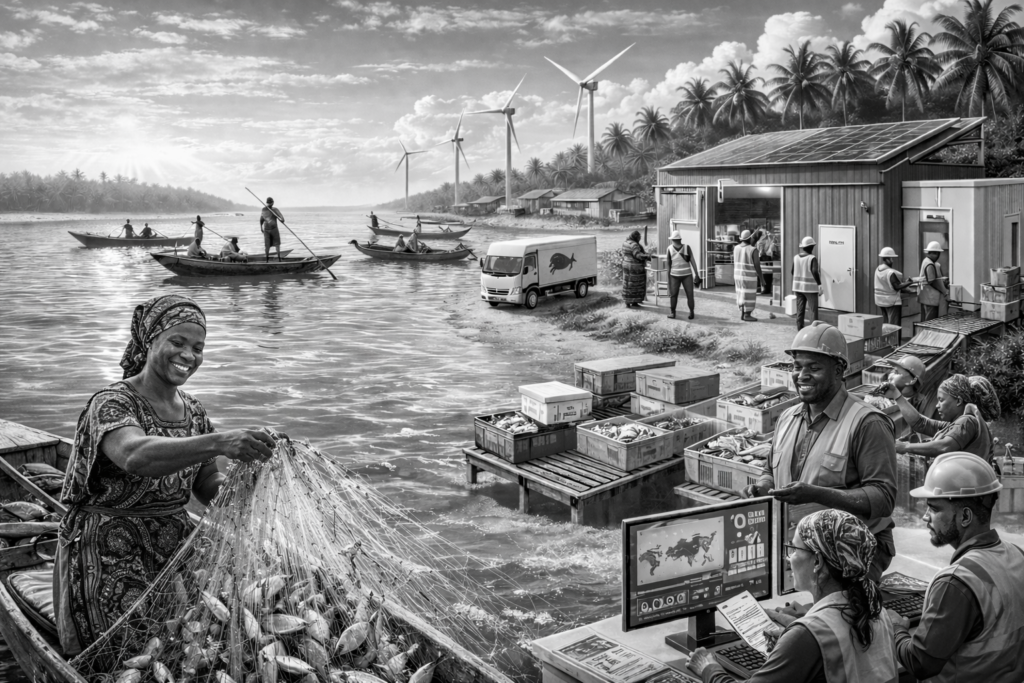
The WEF report is also right to insist that innovation alone will not carry the sector. Its examples are practical rather than speculative: insect-based feed in Ghana, AI-supported fish monitoring in South Africa, solar-powered drying in Uganda, digital traceability, smarter grading and circular waste systems that turn fish byproducts into feed, fertilizer or other inputs. The lesson is not that Africa lacks ideas. It is that many of the needed solutions already exist, but remain fragmented, underfinanced or insufficiently embedded in policy.
That fragmentation is visible in country experience. Morocco, for example, has paired sector targets with public finance and pipeline development, aiming to lift aquaculture production dramatically while crowding in private investment, even though actual output still remains far below its long-term ambitions. The gap between target and execution is a reminder that blue food strategies rise or fall on implementation capacity, not just rhetoric.
There is another reason to resist easy triumphalism. Blue foods are often presented as a climate-friendly alternative to more land-intensive proteins, and there is evidence to support that general direction. But scaling badly can damage precisely the systems the sector depends on. The WEF report warns about overfishing, poorly managed aquaculture, biodiversity loss and social displacement. Africa holds about 20 percent of the world’s mangroves, and those ecosystems are not empty frontiers for expansion. They are living infrastructure. Rapid commercialization without safeguards could deepen inequality for small-scale fishers, women processors and coastal communities while also degrading wetlands, fisheries and consumer trust.
What matters is not simply whether Africa invests in blue foods, but whether it can do so in a way that builds a productive economy without reproducing extractive models.
The most persuasive reading of the report is not as a celebration of fish, but as an argument for system design. Blue foods work when they are linked to food policy, rural infrastructure, climate adaptation, public health, logistics and blended finance. They work when governments treat fisheries and aquaculture as economic sectors, not subsistence leftovers. They work when private capital is matched by cold chains, extension services, seed systems and rules that small producers can actually navigate. And they work when growth is disciplined by ecological limits instead of pretending those limits do not exist.
Africa’s waters will not solve the continent’s food future on their own. But the latest evidence suggests they may be one of the most underused pieces of it. The opportunity is real. So is the risk of getting it wrong.