

When COP29 closed in Baku on 24 November 2024, a deal had been struck. The New Collective Quantified Goal (NCQG) set a floor of $300 billion per year by 2035 from developed countries, within a broader ambition of $1.3 trillion annually. But India called the outcome “extremely disappointing.” Nigeria called it an insult. Small island states said they were “literally sinking.“
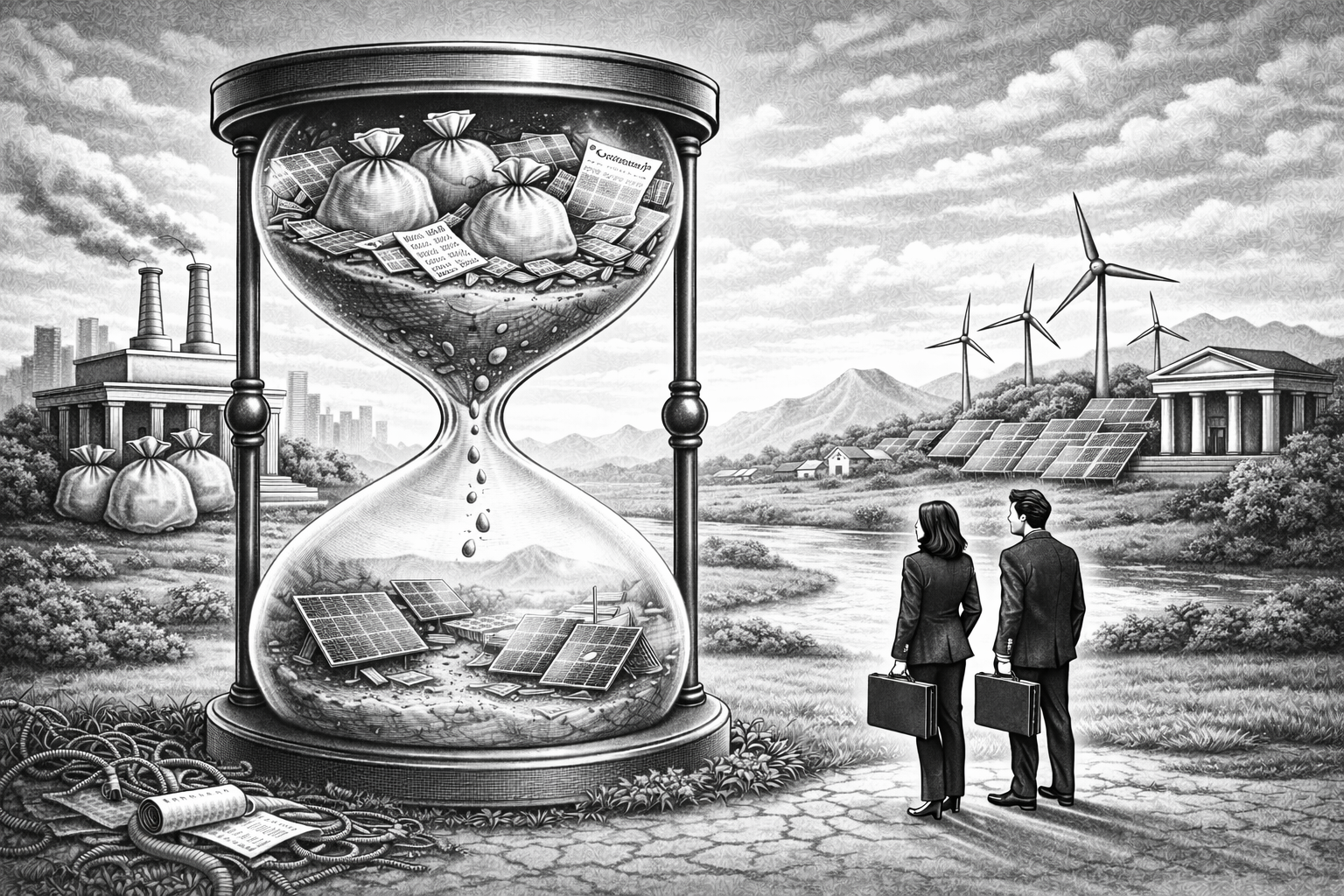
This is the central paradox of green finance in 2025: the numbers have never been bigger, and yet the capital still does not reach the places that need it most — not in sufficient volume, not at acceptable cost, and not in a form that can actually be deployed. To understand why, you have to stop reading climate finance as a technical story. It is, above all, a geopolitical one.
Progress, or Arithmetic?
The original $100 billion annual goal was agreed in Copenhagen in 2009, meant to be met by 2020. Developed countries crossed that threshold in 2022 — two years late. The NCQG was meant to be transformational. Most expert assessments suggest it falls short.
Table 1: The Climate Finance Gap — Key Numbers (2024–2025)
| Benchmark | Annual Figure |
| NCQG floor (developed countries, by 2035) | $300 billion |
| NCQG broader ambition (all actors, by 2035) | $1.3 trillion |
| UNCTAD estimated need from 2025 | ~$900 billion |
| Developing country need, ex. China (IHLEG, by 2030) | $1.3 trillion international / $2.7 trillion total |
| Actual adaptation investment in EMDEs (2023) | $46 billion |
| Global climate finance reached (2023) | $1.9 trillion |
Sources: WRI, UNCTAD, IHLEG, CPI Global Landscape of Climate Finance 2025
Global climate finance crossed $1.9 trillion in 2023 — yet the overwhelming share flows to advanced economies and China. In almost 60% of banks in Emerging Market and Developing Economies (EMDEs), lending for climate-related investment accounts for less than 5% of their portfolios. This is not a failure of ambition. It is a failure of architecture.
Why Capital Avoids the South
Climate finance does not flow on the basis of need. It flows on the basis of risk-adjusted return, institutional capacity, and political legibility — all of which systematically disadvantage the countries most exposed to climate change. The result is a compounding injustice: countries that contributed least to historical emissions face the highest climate risks and pay the heaviest cost-of-capital premium for green investment.
Table 2: Structural Barriers to Climate Finance in EMDEs
| Barrier | Effect |
| Sovereign risk premium | Higher borrowing costs; private capital demands elevated returns |
| Currency risk | Investors demand FX hedging or hard-currency instruments, raising cost |
| Institutional capacity gaps | Absence of bankable projects, MRV systems, ESG disclosure frameworks |
| Conditionalities on MDB/IMF lending | Political friction reduces uptake and delays disbursement |
| Perceived vs. actual risk | Historical default data overweighted; available returns often exceed adjusted risk |
Three Fault Lines in Baku
The NCQG negotiation was not a technical dispute. It was a negotiation over power, liability, and the future shape of the international financial system. Three fault lines ran through it — and will run through every COP until resolved.
The contributor base. Developed countries pushed to formally include China and Gulf states. The G77 rejected this as diluting historical responsibility. The final text allows voluntary South-South contributions, but does not mandate them.
Private vs. public finance. Counting mobilised private investment toward the $300 billion goal allows developed nations to claim credit for flows they did not direct or guarantee. Developing countries called this an accountability shell game. The tension is unresolved.
The Trump factor. Counting all MDB climate finance — not just the share attributable to developed country contributions — was a “Trump-proofing” mechanism. Whether it preserves the goal’s integrity depends on whether MDBs deliver on their $120 billion commitment to low- and middle-income countries by 2030.
Table 3: COP Climate Finance Milestones — Copenhagen to Antalya
| COP | Year | Key Decision | Gap / Outcome |
| COP15 Copenhagen | 2009 | $100bn/year by 2020 goal | Met two years late, in 2022 |
| COP26 Glasgow | 2021 | Acknowledged $100bn shortfall | Partial delivery confirmed |
| COP27 Sharm el-Sheikh | 2022 | Loss and Damage Fund established | Underfunded; slow operationalisation |
| COP28 Dubai | 2023 | Fossil fuel transition pledge | No binding mechanism |
| COP29 Baku | 2024 | NCQG: $300bn floor / $1.3tn ambition | India, Nigeria, Pacific: insufficient |
| COP30 Belém | 2025 | Baku-to-Belém Roadmap | NDC ambition and NCQG delivery under scrutiny |
| COP31 Antalya | 2026 | First NCQG progress milestone | Türkiye between developed and developing |
The Middle-Income Trap
Türkiye occupies an instructive position. It is an OECD member and G20 economy with a 2053 net zero target — and the COP31 host. Yet structurally, it faces the same barriers as most middle-income countries: too wealthy for the most concessional instruments; not wealthy enough to attract unsubsidised private capital at scale; and still building the institutional capacity to absorb large MDB programmes.
The same applies to Brazil, South Africa, Indonesia, Egypt, Vietnam and Colombia. These countries collectively represent a disproportionate share of global emissions trajectories. If they cannot access affordable green capital, the 1.5°C pathway becomes arithmetically impossible.
For Türkiye specifically, CBAM — the EU’s Carbon Border Adjustment Mechanism — is already a present-tense financial reality, not a future risk. Steel, cement, aluminium, fertiliser exports to the EU will carry a carbon price. The question is not whether Türkiye needs credible carbon pricing. It is whether it is built on Türkiye’s terms or under external pressure.
What COP31 Should Deliver
Three structural gaps need solutions by Antalya — not further process commitments.
A quality standard for climate finance. Not all $300 billion is equal. Loans at market rates are not equivalent to grants for adaptation in small island states. A taxonomy of finance quality — by instrument, purpose, and recipient — is essential for accountability.
A technology-enabled delivery infrastructure. The biggest barrier to disbursing climate finance in EMDEs is not political will. It is the absence of bankable projects, credible MRV systems, and institutional capacity. Digital public infrastructure — emissions tracking, ESG disclosure standards, project preparation facilities — is a prerequisite, not an afterthought.
An honest reckoning with contributors. The current NCQG relies on a shrinking set of willing developed-country contributors and hopes private finance fills the gap. It will not. A credible path to $1.3 trillion requires new contributors, new instruments, and new accountability mechanisms.
Capital Will Follow Credibility
The deepest lesson from thirty years of COP negotiations: capital does not move because of commitments. It moves because of conditions — regulatory, institutional, and informational conditions that make green investment legible, predictable, and profitable.
Germany attracted private capital through feed-in tariffs and regulatory certainty. Chile attracted it through transparent clean energy auctions. Morocco’s Noor solar complex attracted it through credible state-backed financing and MDB co-investment. Climate credibility is not just a reputational asset. It is a balance sheet factor. For Türkiye, COP31 is not merely a diplomatic event. It is a signal to capital markets about the seriousness of the host country’s own transition.