

Europe’s clean energy transition has entered a new phase, and it is increasingly powered not just by solar panels and wind turbines, but by batteries.
According to SolarPower Europe’s EU Battery Storage Market Review 2025, published in January 2026, the European Union installed 27.1 GWh of new battery storage capacity in 2025, marking its 12th consecutive record-breaking year. Growth accelerated sharply, rising 45% year-on-year, a return to faster expansion after the slowdown observed in 2024.
But the more significant story is structural.
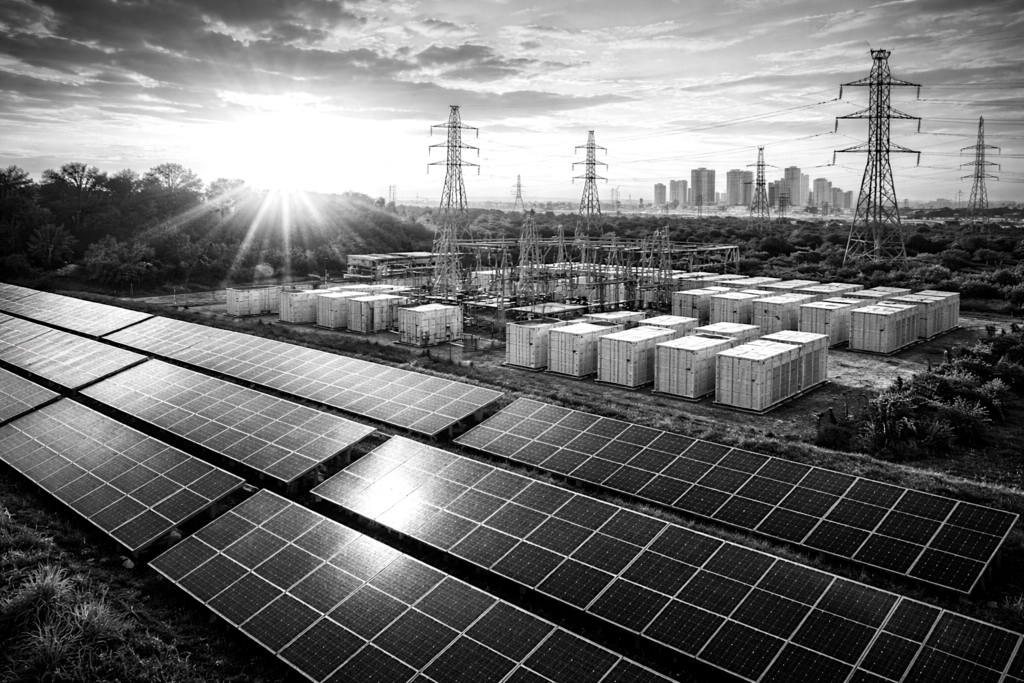
For the first time, utility-scale batteries delivered the majority of new installations, accounting for 55% of added capacity. Europe’s battery market, long dominated by residential systems, is now being reshaped by grid-scale assets designed to stabilize power systems, absorb excess renewables, and prevent curtailment.
The shift comes at a critical moment. Europe’s solar boom is showing signs of strain. Annual solar installations fell slightly in 2025, the first decline in a decade, driven largely by a collapse in rooftop demand.
At the same time, grid stress is rising.
Negative electricity prices hit an all-time high in 2025, occurring 3.4% of the year, equivalent to roughly 310 hours of below-zero power prices. In major solar markets like Spain, Germany and the Netherlands, negative-price hours exceeded 540 hours, more than 22 days.
This is the new paradox of abundance: renewable power is growing so quickly that the system cannot always absorb it.
Spain offers the clearest warning. After a major blackout on April 28, 2025, the grid operator relied increasingly on gas-fired plants for stabilisation services. Curtailment of renewables nearly doubled to more than 5 TWh in 2025, while fossil-based balancing operations climbed sharply.
Battery storage is increasingly seen as the fastest remedy.
The EU’s cumulative battery fleet reached 77.3 GWh by end-2025, a tenfold increase since 2021. But SolarPower Europe warns that this is still far from sufficient. To meet 2030 system needs, Europe must scale toward 750 GWh within five years, requiring another tenfold expansion.
The market remains concentrated. Germany led with 6.6 GWh installed in 2025, followed by Italy, while Bulgaria surged into third place with 2.5 GWh, driven by EU-funded support schemes.
Behind the deployment boom lies an industrial question. Europe hosts 252 GWh of battery cell manufacturing capacity, but around 92% is still geared toward electric vehicles, not stationary storage. Supply chains remain fragile, with heavy dependence on imported raw materials and processing dominated by China.
The report’s message is: batteries are no longer a niche technology and they are becoming core infrastructure.
Without rapid investment in storage, flexibility markets, permitting reform and grid modernisation, Europe risks building renewable generation faster than it can use it.
The next chapter of the energy transition will not be decided only by how much clean power Europe produces. It will be decided by how well it can store it.