
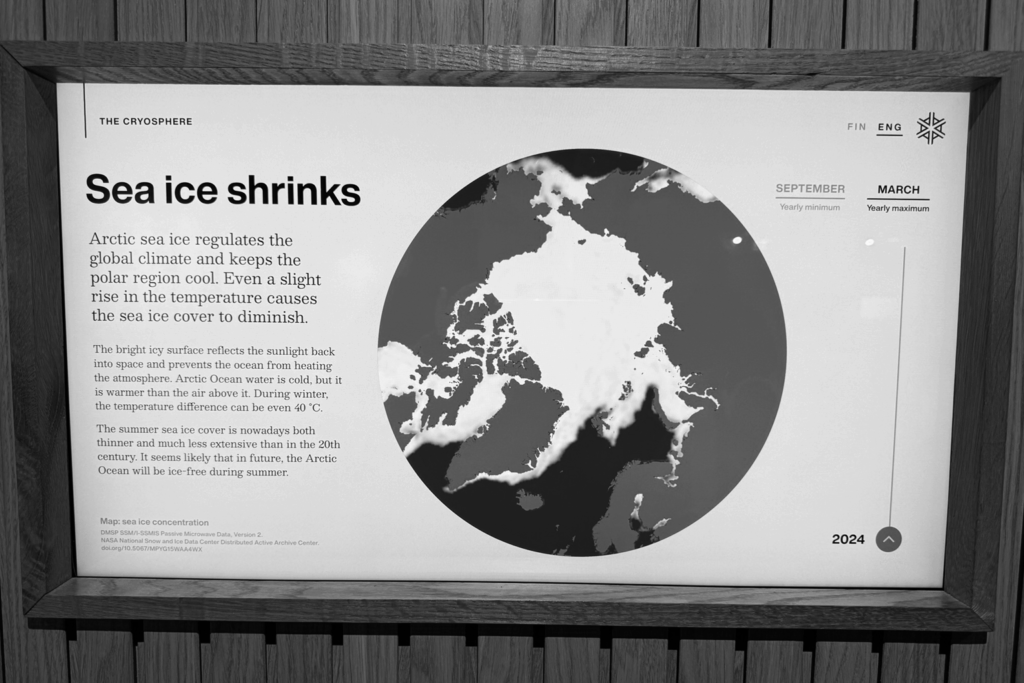
I’m in Rovaniemi (Finland), and visiting Arktikum makes the Arctic feel less like a distant concept and more like a place under visible pressure. One of the museum’s exhibits is titled simply: “Sea ice shrinks”. It sounds almost minimal, but it captures a planetary-scale shift. Sea ice is not just frozen water sitting at the top of the world. It plays a central role in regulating climate by reflecting sunlight back into space. When it disappears, the ocean absorbs more heat, and warming accelerates.
The recent numbers underline how fast this change is unfolding. According to the National Snow and Ice Data Center (NSIDC), the Arctic likely reached its 2024 annual minimum sea ice extent on September 11, dropping to 4.28 million square kilometers. That was the seventh-lowest minimum in the nearly 46-year satellite record. NOAA’s Climate.gov also highlights the same minimum, placing it among the lowest extents observed since satellite monitoring began in 1978.
NASA’s analysis of the 2024 melt season describes the Arctic minimum as near-historic low, reinforcing that this is part of a long-term trend rather than a one-off anomaly. And the direction of travel remains clear: while sea ice naturally grows in winter and shrinks in summer, the baseline is shifting downward as the Arctic warms.
That warming is itself uneven and dramatic. NOAA’s Arctic Report Card 2024 notes that the Arctic continues to warm faster than the global average and stresses that the pace and complexity of Arctic change demand adaptation as well as major reductions in fossil fuel pollution. The report’s surface air temperature section also cites research indicating the Arctic is warming about three times faster than the global mean since 1980, after accounting for natural variability.
Inside Arktikum, the science becomes a story of feedback loops. Less ice means darker ocean. Darker ocean means more absorbed heat. More heat makes it harder for ice to recover. It is a self-reinforcing cycle that turns loss into momentum. What felt like a regional change becomes global in consequence, influencing weather patterns, ecosystems, and long-term climate stability.
What stays with me most from Arktikum is how the museum narrows the distance between data and reality. It does not present melting ice as a faraway tragedy. It presents it as an unfolding condition of the planet. Standing there in Rovaniemi, the Arctic stops being “somewhere else.” It becomes a warning system, one that is flashing in plain sight.