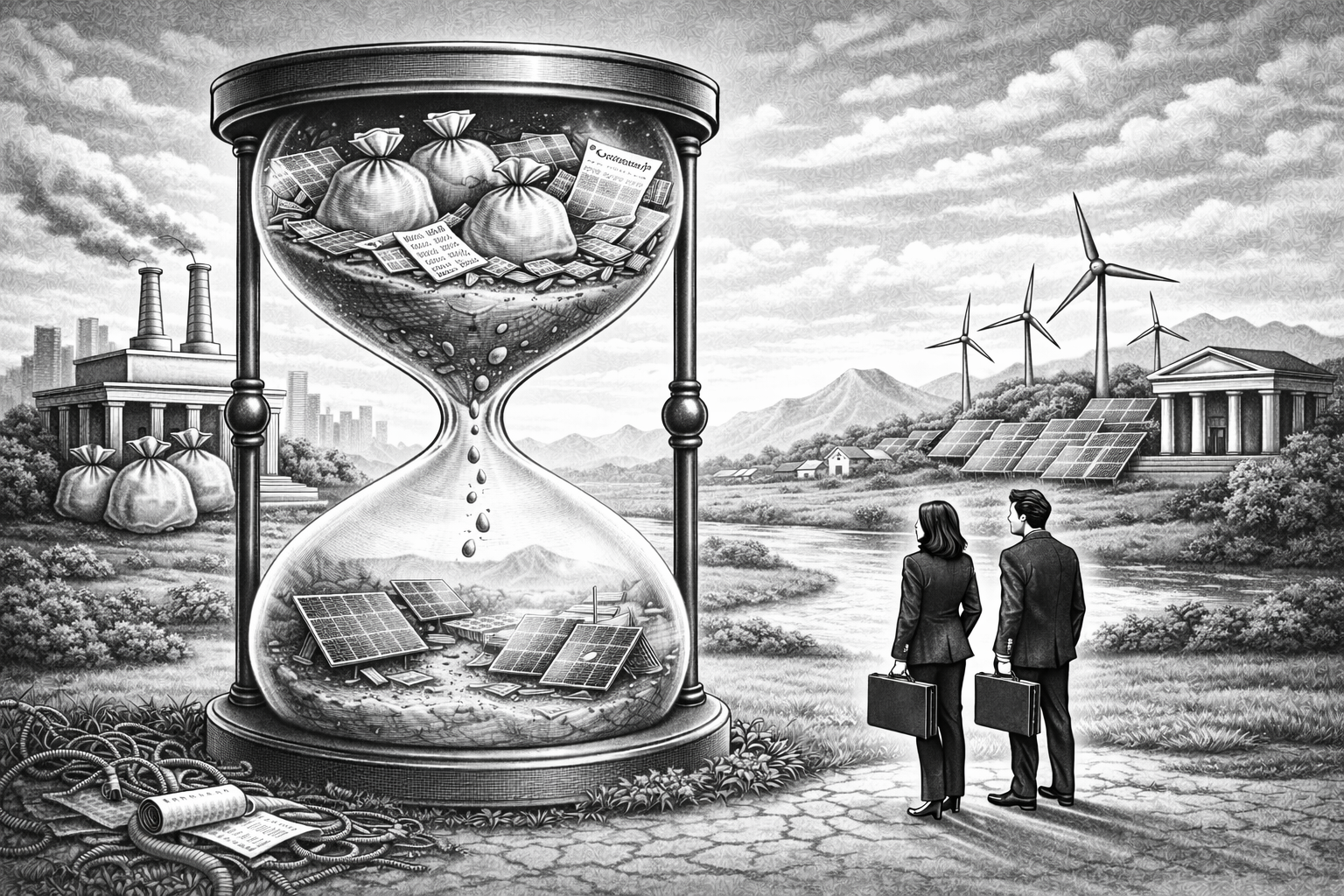



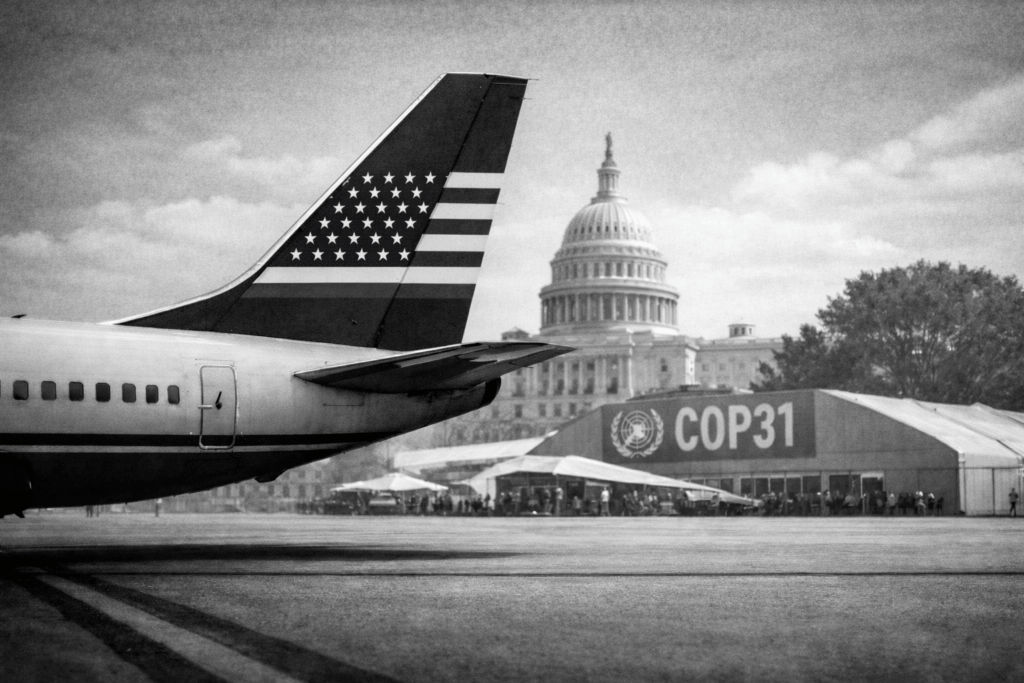
In early days of January 2026, U.S. President Donald Trump signed a proclamation directing the United States to withdraw from dozens of international bodies, specifically 35 non–United Nations (UN) groups and 31 UN entities, arguing they “operate contrary to U.S. national interests.”
This piece looks at what that move could mean for COP31 (the 31st UN Climate Change Conference of the Parties), as a practical read of incentives, coalition dynamics, finance, and negotiating bandwidth.
The keystone is the United Nations Framework Convention on Climate Change (UNFCCC) exit.
Among the withdrawals, the most consequential is the decision to leave the United Nations Framework Convention on Climate Change (UNFCCC), the foundational 1992 climate treaty that underpins the annual COP process and enabled later instruments such as the Paris Agreement.
The UNFCCC has 198 Parties today, and — according to Reuters — this move would make the U.S. the first country to exit the Convention.
It also goes further than the already-announced U.S. withdrawal (for a second time) from the Paris Agreement, reported as part of the administration’s January 2025 posture shift.
The White House framed the withdrawals as a funding-and-effectiveness reset, not a narrow climate decision.
The White House materials and the published withdrawal list span climate, energy, science, culture, and social policy — well beyond “climate-only” institutions.
The administration’s messaging is also explicitly fiscal: it argues these withdrawals end U.S. taxpayer funding and involvement in entities it describes as prioritizing “globalist agendas” over U.S. priorities or delivering results “inefficiently.”
That breadth matters, because it shapes how other capitals interpret intent: a system-level repositioning, rather than a dispute with one treaty
The move raises immediate operational and legal uncertainty, exactly the kind that ripples into COP planning.
Reuters reports that some legal experts argue a unilateral exit from a Senate-ratified treaty may require congressional involvement, making the withdrawal potentially contestable or delayed in practice.
At the UN level, the uncertainty isn’t only legal; it’s budgetary and procedural. The Associated Press reports UN officials pointing to ongoing assessed-contribution obligations even as the U.S. signals withdrawal from multiple UN-linked bodies.
For COP dynamics, ambiguity is its own problem: negotiators plan around credible commitments, and legal “gray zones” degrade trust and slow coordination.

Before we go “full hardcore,” it’s worth asking—can this trigger a domino effect?
A fair question is whether the U.S. step-back could become a catalyst for other exits, or even institutional reshaping — similar to what we have seen in parts of sustainable finance.
Recent examples (different sector, similar coalition logic):
- The Net-Zero Banking Alliance (NZBA) ended operations after major departures, illustrating how fast “voluntary architecture” can unravel once a critical mass leaves.
- The Net-Zero Insurance Alliance (NZIA) was discontinued in April 2024.
- The Net Zero Asset Managers initiative (NZAM) suspended activities after BlackRock exited in January 2025.
However, we should not forget that UNFCCC is not a voluntary club, it is a treaty system with near-universal membership. So a straight “NZBA-style collapse” is unlikely. But a domino dynamic can still show up as: reduced political will, weaker finance signals, slower ambition cycles, and more “wait-and-see” behavior among governments already reluctant to lead.
Withdrawing from non-UN bodies can be read as strategic economic positioning, not necessarily an attack on specific countries.
When a country exits non-UN, purpose-driven coalitions alongside UN entities, observers often interpret it less as a targeted geopolitical strike and more as a bid to reposition domestically — especially around energy, industry, and trade.
Industry professionals note the withdrawals are tied to an agenda emphasizing oil, gas, and mining development.
From a climate-policy standpoint, that can create an external perception that the U.S. is optimizing for short-term economic leverage (and negotiating optionality) rather than collective problem-solving.
The breadth of withdrawals can reinforce a “U.S. isolation” narrative-human, environmental, scientific.
Because the list spans environment, health, arts, and rights-related institutions, critics argue it signals climate disengagement together with a broader retreat from shared institutions. It can be described as exits that include the Intergovernmental Panel on Climate Change (IPCC), the core scientific assessment process feeding the “common evidence base” for COP negotiations.
Even if many countries continue regardless, this kind of exit can be interpreted as: “We are stepping away from the shared language and the shared table.”
Simon Stiell’s message is that this is economically self-harming—and he ties it directly to household impacts.
Simon Stiell, Executive Secretary of the UNFCCC, argues the withdrawal undermines U.S. prosperity and resilience. His statement says the step back from cooperation “can only harm the US economy,” and he links the impacts to affordability, disasters, and energy-market volatility. Whether one agrees or not, the framing is important for COP31: it places the debate squarely in jobs, cost of living, and competitiveness.

COP31 could spend meaningful time on “How do we proceed without the U.S.?” diplomacy and damage control.
In that format, any major shock to the multilateral climate system risks consuming negotiating bandwidth — informal bilateral meetings, reassurance efforts, and procedural recalibration — before substantive agenda items even get oxygen.
Negotiations may get harder even without copycat exits because “radical reluctance” spreads faster than formal withdrawal.
Even if no one else withdraws, a U.S. exit can still stiffen resistance among states that already avoid ambitious commitments. Topics like transition finance, fossil fuel phase-out language, deforestation, biodiversity alignment, and community rights are hard in the best of years; when a major power signals disengagement, the baseline for consensus can drop further.
A leadership vacuum is real and China’s role becomes the obvious question.
At COP30 (Belém, Brazil) it is reported that China found a bigger role as the U.S. sidelined itself at the summit.
California Governor Gavin Newsom, criticizing the withdrawals, argued the U.S. is creating a leadership vacuum “that China is already exploiting.”
China is simultaneously the world’s largest emitter and a major clean-energy manufacturing and deployment powerhouse so COP31 may see intensified debate over whether China will fill the diplomacy gap, and on what terms.
Finance is the pressure point and the Green Climate Fund (GCF) scenario tree is already forming.
The U.S. has pulled out of the Green Climate Fund (GCF), widely viewed as the largest multilateral climate fund.
Three plausible pathways (with COP31 implications):
- Others overcompensate and increase contributions to close the gap (possible, but politically hard in an era of competitiveness anxiety).
- Others hold steady,maintaining current commitments and keeping the GCF functional, but stretched.
- Others retrench, using the U.S. exit as cover to slow climate finance and soften domestic obligations, arguably the highest-risk trajectory for COP outcomes.
The European Union (EU) has already shown how competitiveness pressures can weaken sustainability architecture: the EU agreed to scale back parts of major corporate sustainability rules (including CSRD — Corporate Sustainability Reporting Directive and CSDDD — Corporate Sustainability Due Diligence Directive) amid business and government pressure.
That doesn’t prove a straight line from U.S. choices to EU choices but it illustrates how quickly “economic protection mode” can reshape climate policy commitments.
There is also a contrarian possibility – others could use the moment to tighten climate guardrails against U.S. backsliding.
A full U.S. retreat can motivate other blocs to harden climate-related trade and competitiveness tools (carbon border measures, standards, procurement rules), accelerate clean-tech industrial policy, and increase scrutiny of corporate claims and ratings — creating external pressure that partially offsets U.S. federal rollback.
Of course it is not likely but COP31 could become a venue where “coalitions of the willing” become more assertive precisely because the U.S. is absent.
Finally, the uncomfortable “chicken-and-egg” question – leader-driven anomaly or broader societal shift?
Trump’s second term came via a democratic process, and his positions on multilateral climate cooperation were not hidden. That raises a difficult question for other countries: are we seeing one leader’s policy choices, or a deeper societal and political trend that could appear elsewhere?How other advanced economies respond, whether by doubling down on cooperation or retreating into competitiveness-first postures, will be the real test, and COP31 will be one of the first global stages where that answer becomes visible.